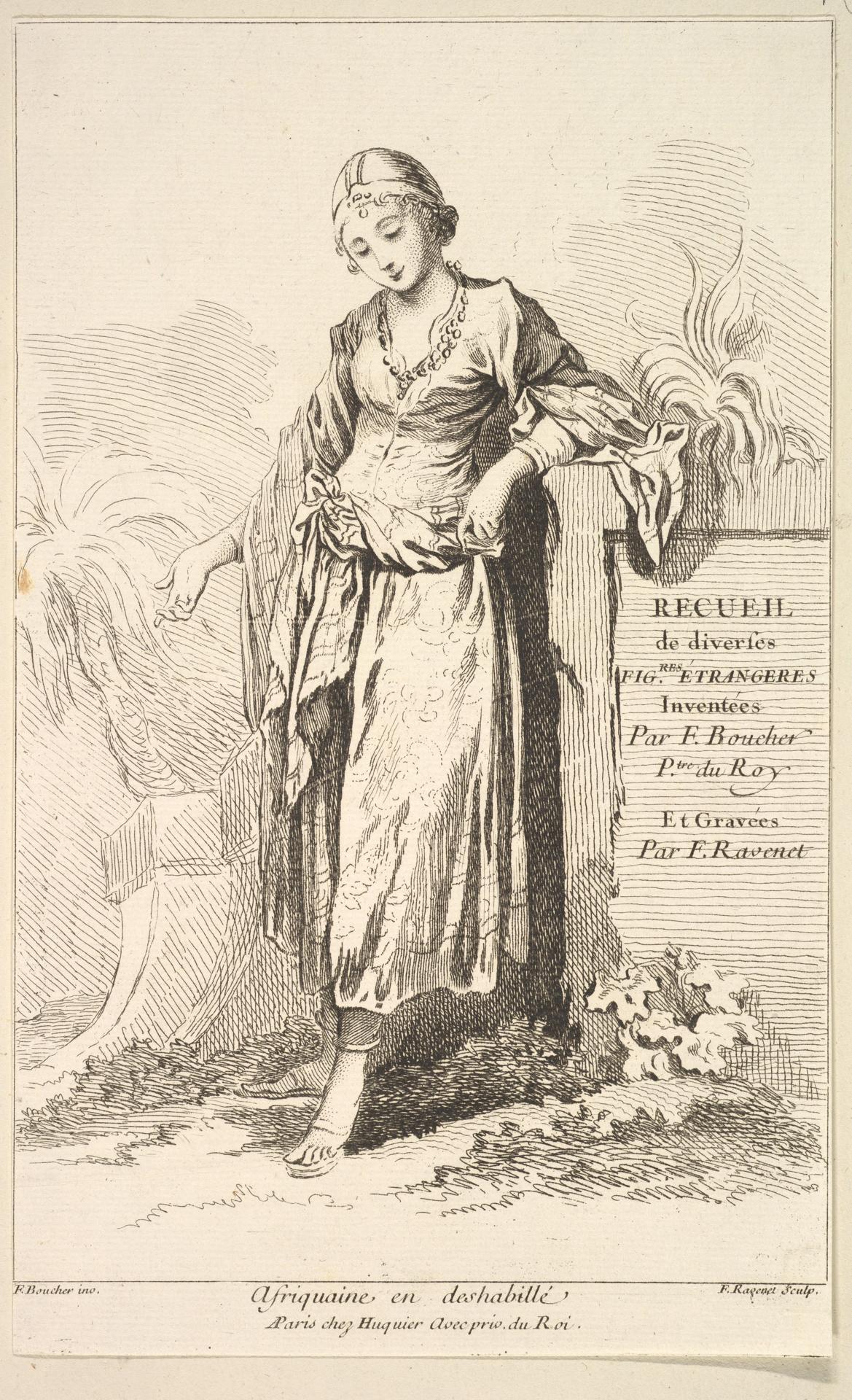
Afriquaine en deshabillé, plate 1 from "Recueil de diverses fig.res étrangeres Inventées par F. Boucher P.tre du Roy et Gravées par F. Ravenet"
Original title: Afriquaine en deshabillé, plate 1 from "Recueil de diverses fig.res étrangeres Inventées par F. Boucher P.tre du Roy et Gravées par F. Ravenet" (Collection of Various Foreign Figures, Devised by F. Boucher, Painter of the King and Engraved [etched] by F. Ravenet)
kurzbeschreibung
A half-nude woman in African dress stands at the center of this etching, designed by François Boucher and executed in etching and engraving by Simon Francis Ravenet the Elder in the 18th century. The sheet belongs to a series of varied foreign figures.
Description
Positioned on a pedestal and surrounded by plants, the woman wears a long, flower-decorated gown with a sash around her waist. Her hair is tied in a knot, and she wears jewelry at her neck and arms. The layout feels symmetrical, with the figure at the center. Because this is an etching, the coloring remains monochrome; light and shadow arise from lines and hatching, as is typical of detailed 18th-century French printmaking.
Context
François Boucher, the king's first painter, invented the model for this series, which Simon Francis Ravenet the Elder, active in Paris, engraved in copper. Collections of exotic figures were highly popular in 18th-century France and testified to an interest in foreign motifs. Boucher often designed decorative scenes that circulated as prints and reached a wide audience.
Impact
The symmetrical arrangement and clean linework give the sheet a calm balance. The half-nude pose and exotic clothing evoke a mixture of grace and strangeness that stirs the viewer's curiosity. Since the etching is executed only in black and white, contours and details stand out clearly, making the figure appear almost sculptural.
Technique
Etching and engraving come together here, allowing fine lines and precise shading. The monochrome results from the printing process, in which depth is created by varying stroke thickness and density. At 26.5 x 16.2 cm, the sheet is hand-sized and likely intended for private viewing.
AI-generated description text
Source: Metropolitan Museum of Art · Public Domain (CC0 1.0)