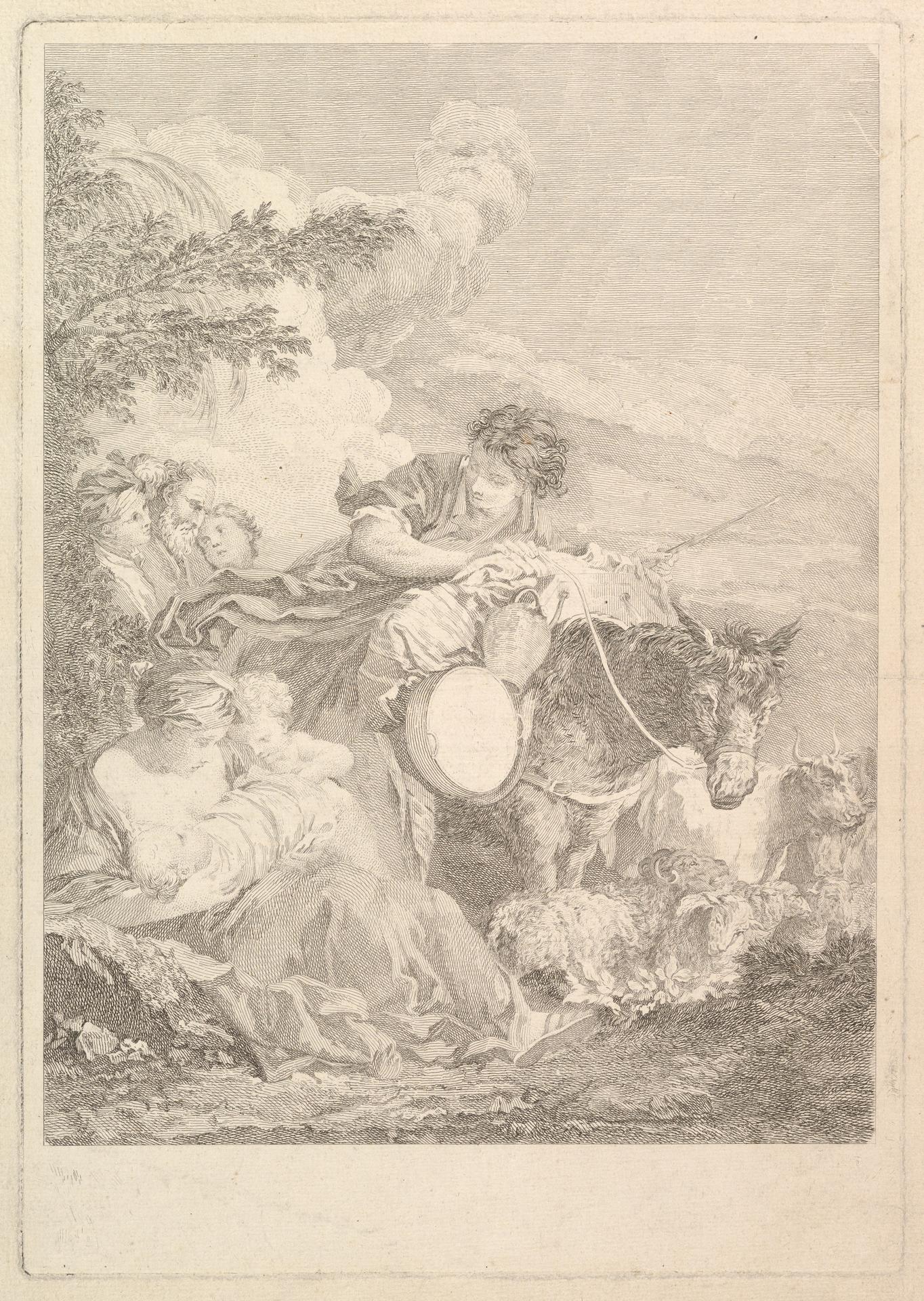
Départ de Jacob (The Departure of Jacob)
Original title: Départ de Jacob (The Departure of Jacob)
kurzbeschreibung
Elisabeth Cousinet Lempereur's 18th-century etching "Jacob's Departure" brings to life the biblical farewell of Jacob from his brothers. Jacob sits on a mount, equipped with a sack and staff, while two brothers hold him back and a third offers him a basket. The monochrome print in shades of grey measures 38.4 × 27 cm in the plate.
Description
Jacob has taken his place on a mount, furnished with a sack and a staff; two brothers grasp his arms, and a third presents him with a basket. This creates a movement from left to right. Clouds and a bearded head at the upper edge suggest divine presence. On the ground, sheep and a donkey enliven the rural setting. Fine lines and hatching shape the figures and bring out contours and textures with clarity.
Context
The French engraver Elisabeth Cousinet Lempereur was known in the 18th century chiefly for reproductive prints. The model was a biblical story from the Book of Moses, a subject often treated in Baroque and Rococo art. Women artists rarely worked publicly at the time, but a few gained recognition in printmaking. The large format suggests a representative function, perhaps as part of a biblical picture series.
Impact
A quiet yet narratively dense impression arises from the etching's fine lines and the animated arrangement of the figures. The grey tonality draws the eye to gestures and interaction without the distraction of colour. The divine figure in the background lends the scene a solemn, almost devotional mood.
Technique
This print is an etching: the drawing was incised into a copper plate, which was then etched with acid. The visible fine lines and hatching are typical of this process and allow precise rendering of textures and shading. It was printed on paper measuring 50 × 34.1 cm; the plate mark is 38.4 × 27 cm.
AI-generated description text
Source: Metropolitan Museum of Art · Public Domain (CC0 1.0)