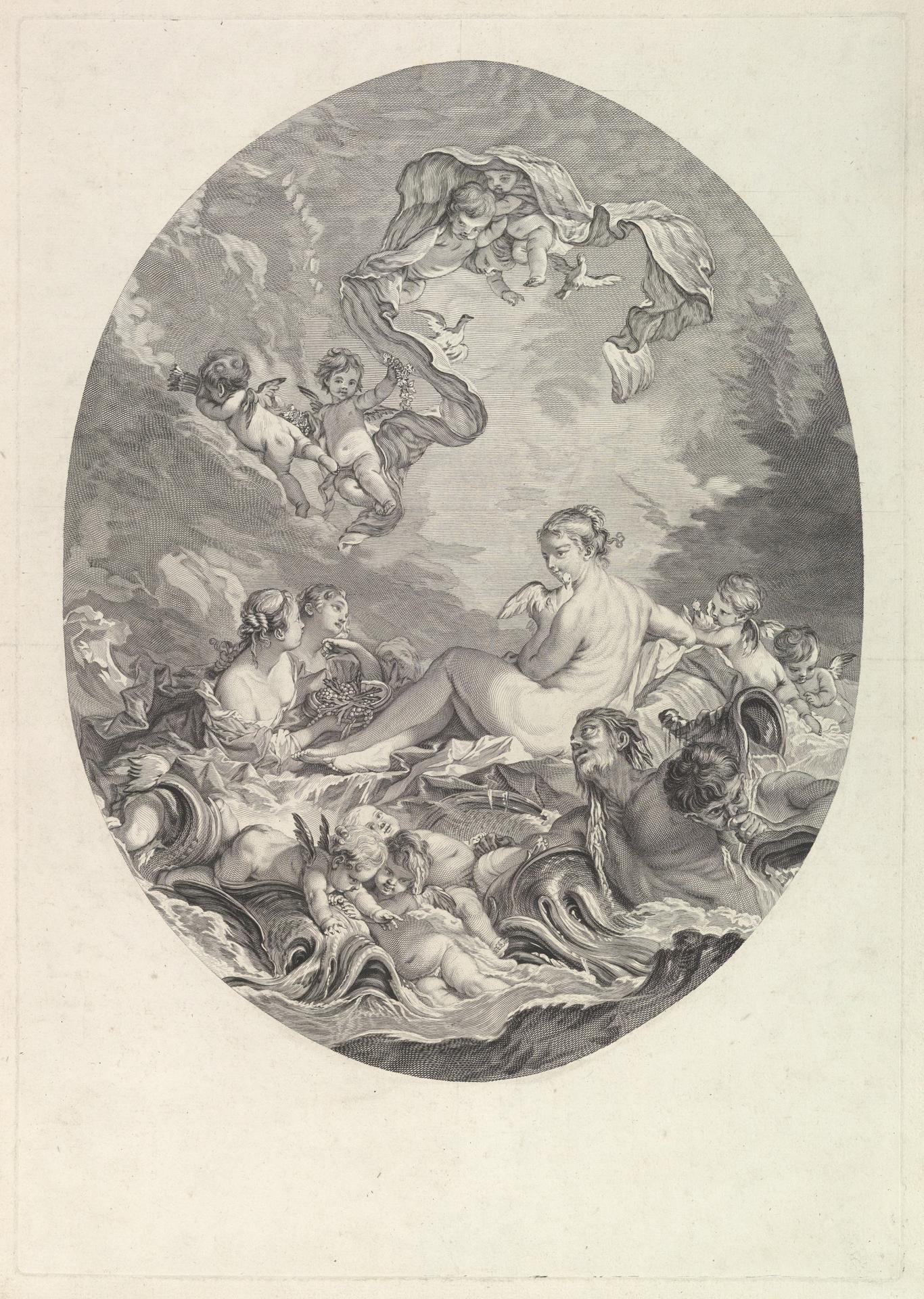
The Birth and Triumph of Venus
Original title: Naissance et Triomphe de Venus (The Birth and Triumph of Venus)
kurzbeschreibung
Jean Daullé produced this sheet, Geburt und Triumph der Venus, in the 18th century. Within an oval arrangement it presents both the birth of Venus and her triumph. Etching and engraving are used together, and the subject comes from the realm of mythology.
Description
In the oval arrangement, several angels sweep through the sky at the top in lively motion, scattering veils and other accessories into the air. Below, Venus sits naked on a rock; her arms have wings, and her gaze is directed downward. Beside her, other angel figures have settled and interact with one another. The lower section shows waves and sea creatures in agitated movement, while an angel sits on a rock and looks out at the waves. The rendering remains monochrome in shades of gray, with strong shadows and contrasts such as result from the printing process.
Context
Jean Daullé was an 18th-century French engraver who made a name for himself primarily with reproductive prints. The work presumably goes back to a painting or drawing by another artist, which was common practice for printmaking of that era. The winged Venus is unusual and is likely due to a specific iconographic source. Etching and engraving were widespread means in the 18th century of bringing paintings closer to a larger public.
Impact
The contrast between the animated angel figures and the calm seated posture of Venus lends the pictorial structure an inner tension. The monochrome gray tonality and the differentiated shadows create an elegant, graphic quality characteristic of 18th-century printmaking.
Technique
Etching and engraving are combined here, with etching contributing soft lines and engraving providing precise details. The sheet measures 54 x 39 cm, the plate 49.6 x 34.8 cm. The monochrome effect arises from printing in black ink on paper; various gray tones are achieved through different hatching densities.
AI-generated description text
Source: Metropolitan Museum of Art · Public Domain (CC0 1.0)