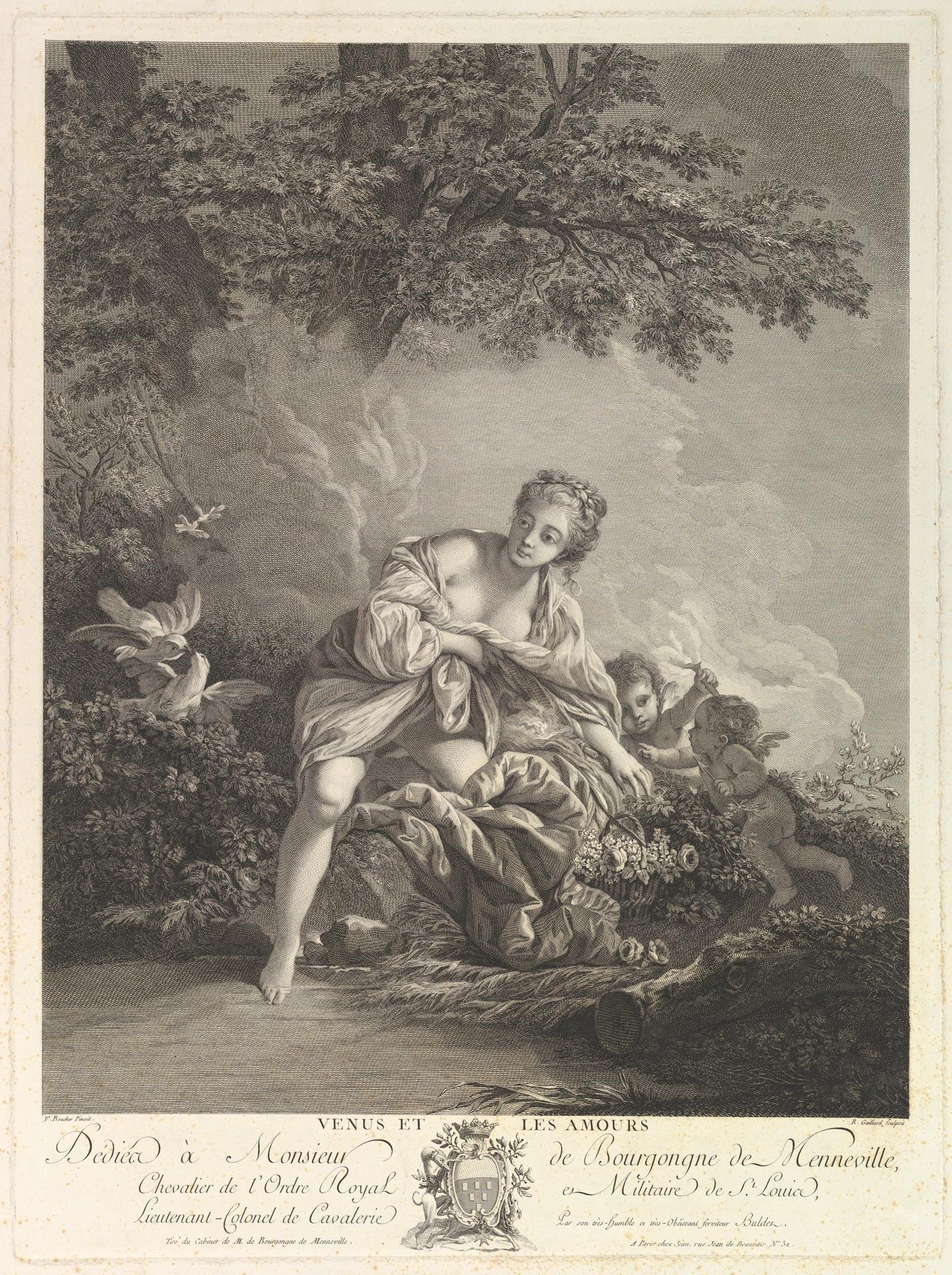
Venus et les Amours (Venus and the Loves)
Original title: Venus et les Amours (Venus and the Loves)
kurzbeschreibung
René Gaillard, an eighteenth-century French engraver, made Venus and the Cupids, an etching and engraving that places the goddess Venus in an idyllic landscape, flanked by two winged amoretti.
Description
Venus sits on a rock at the center of the image, barefoot and wrapped in a long, light gown. Her relaxed gaze falls on two small amoretti who have taken their places beside her and are offering her something. Trees and clouds behind them create a peaceful atmosphere. The layout is symmetrical: Venus in the middle, the amoretti on either side. The linework is sharp and richly detailed, and the palette is monochrome.
Context
René Gaillard was an eighteenth-century French engraver known above all for his reproductions after paintings. The work carries a dedication to Monsieur de Bourgogne de Menneville, which points to an aristocratic patron or sponsor. Mythological subjects of this kind were popular in the Rococo and the late eighteenth century because they addressed ideals of beauty and love. The pairing of Venus with amoretti is a classic motif from ancient mythology that art has often taken up.
Impact
With Venus placed at the center and the amoretti arranged symmetrically, the print radiates a calm and harmonious effect. The delicate linework and the detailed rendering of the landscape produce an atmosphere that is elegant and natural at once. The viewer is drawn into an idealized world of myth, which convinces through its clear graphic execution.
Technique
Executed in etching and engraving, the work allows for precise and fine linework. The plate measures 19 7/8 by 14 7/8 inches and is printed on a sheet of 21 15/16 by 15 3/4 inches. Combining the two techniques permits both soft and sharp contrasts, which contributes to the detail fidelity of the depiction.
AI-generated description text
Source: Metropolitan Museum of Art · Public Domain (CC0 1.0)