Pastorale
Original title: Pastorale
kurzbeschreibung
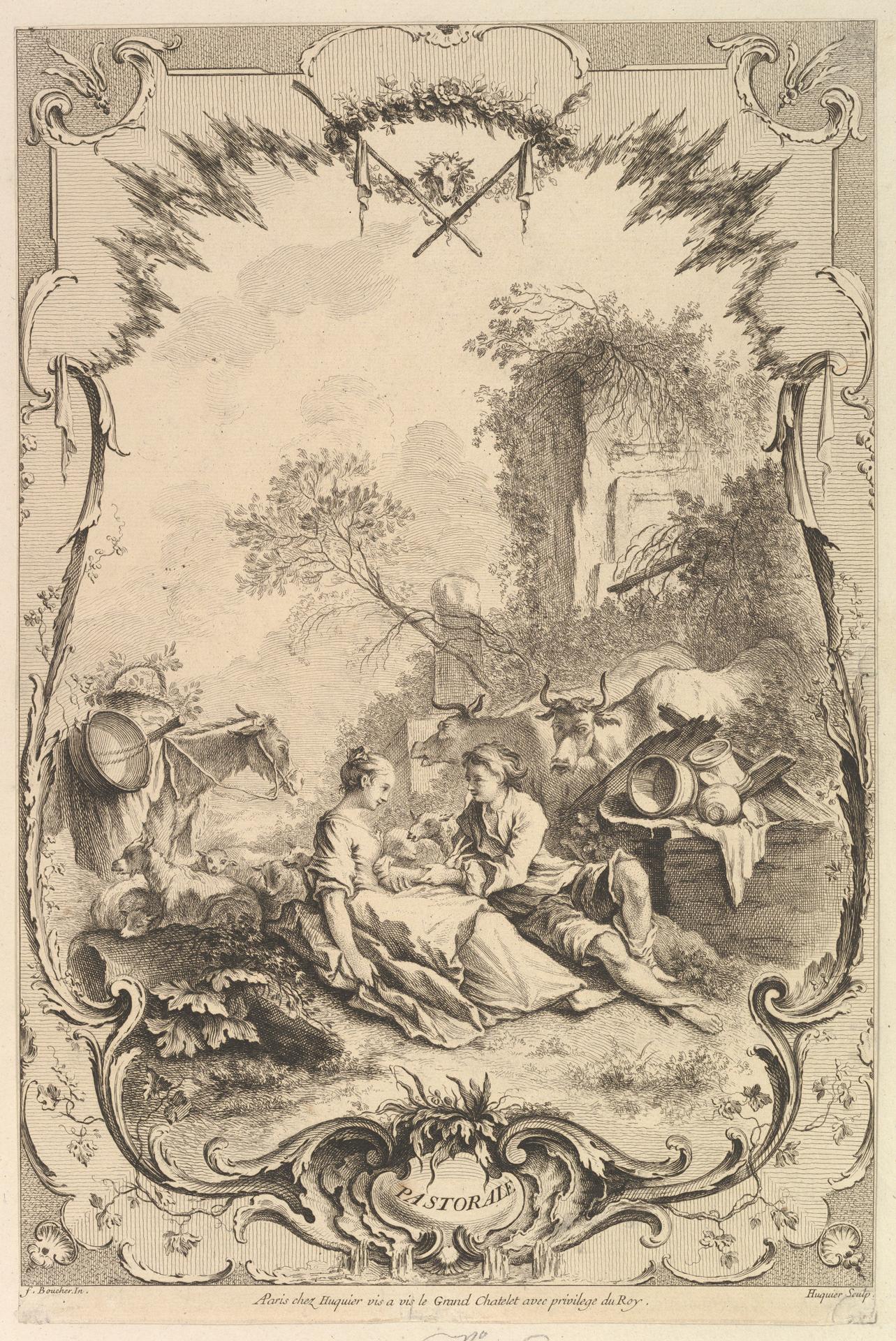
Gabriel Huquier, an 18th-century French engraver and art dealer, produced Pastorale as a combined etching and engraving. The print presents a rural idyll with two figures and animals, enclosed by an elaborate ornamental frame. It belongs to the Rococo tradition of ornamental and pastoral printmaking.
Description
A woman seated on the ground cradles a sheep in her arms, while a man beside her has taken his place and looks toward her. Around the pair are scattered cows, more sheep, farming tools, and barrels. A lush frame of floral and vine ornaments, with a crest-like symbol at the top, surrounds the scene. At the bottom center appears the title “PASTORALE.” Rendered in black and white, the print uses fine lines and stippling to create effects of light and shadow.
Context
Huquier worked in 18th-century France as a draftsman, engraver, and art dealer, gaining renown chiefly for ornamental engravings and reproductions after artists such as François Boucher. Pastoral motifs were highly popular in the Rococo period, when courtly society cherished an idealized vision of country life. Huquier’s works often served as models for decorative objects and interior furnishings. Whether the print was issued as a single sheet or as part of a series is not recorded; the exact commission remains undocumented.
Impact
The precise linework and symmetrical framing give the sheet a calm, decorative presence. Rural life appears harmonious and idealized, without dramatic tension. The ornamental border draws attention to the scene and underscores the print’s character as crafted ornament.
Technique
Etching and engraving are combined here, yielding precise lines and delicate shading. Parallel hatching and stippling model the tonal values and light in the landscape. The print was taken on paper, which was then trimmed to a format of 40.5 × 16.8 cm.
AI-generated description text
Source: Metropolitan Museum of Art · Public Domain (CC0 1.0)