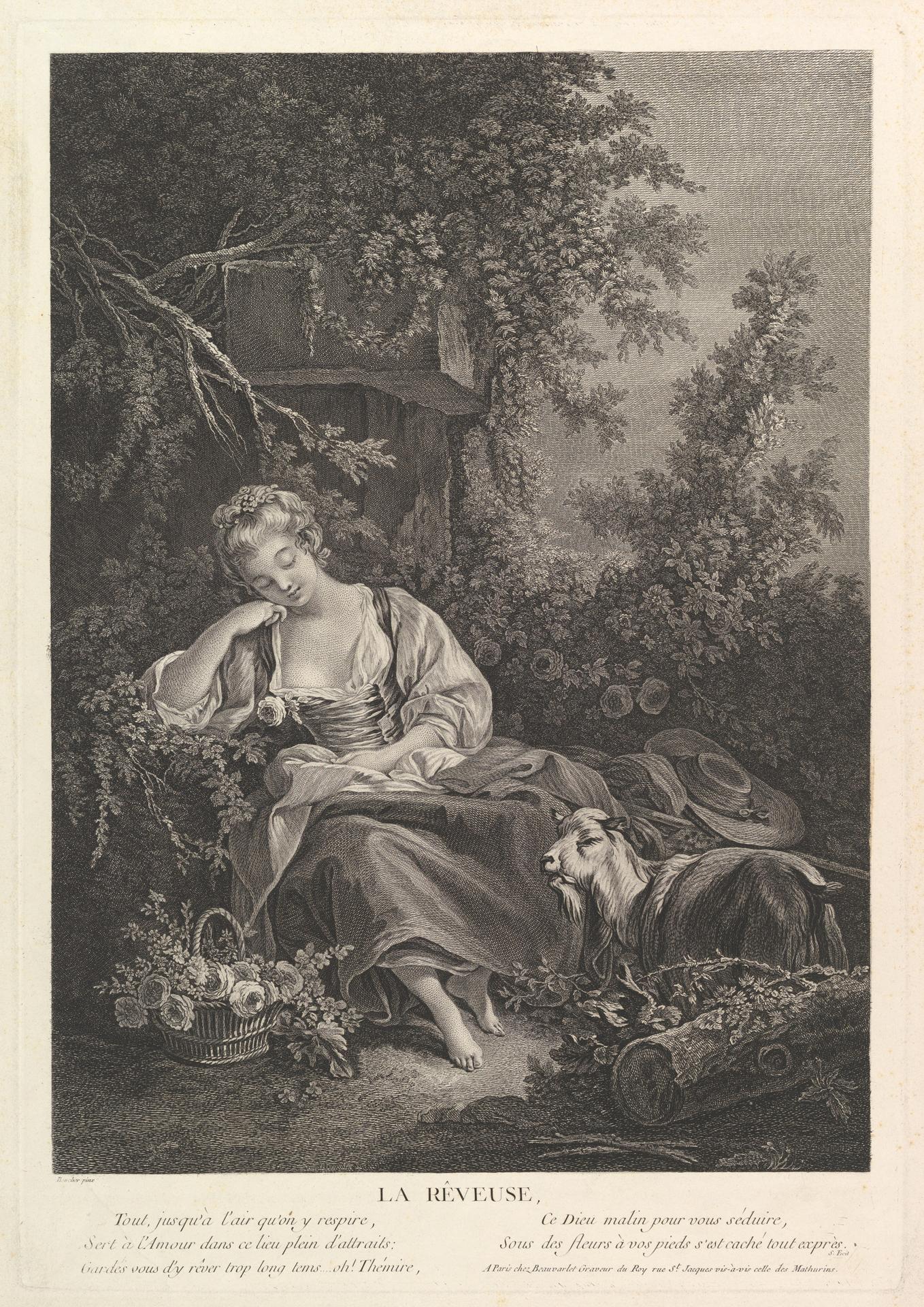
La Rêvuse (The Dream)
Original title: La Rêvuse (The Dream)
kurzbeschreibung
Jacques Firmin Beauvarlet produced this copperplate engraving with etching, La Rêvuse (The Dream), in the 18th century. A woman has settled comfortably into an idyllic landscape, her arms folded behind her head, while a sheep slumbers at her side.
Description
Seated at the heart of a natural setting, the woman wears a long, pale gown. Her arms folded behind her head give her pose a thoughtful cast. To her right a small white sheep lies sleeping peacefully. A basket of flowers stands in the foreground, and further back appears a pavilion with an open door, surrounded by plants. The arrangement feels symmetrical, the light is subdued, and the palette stays largely within greys.
Context
Beauvarlet, an 18th-century French engraver, was known chiefly for his reproductive prints. Printmaking flourished in France during this period and reached a wide audience. This sheet probably derives from a painting by another artist, in keeping with the reproductive practice of the day. An idyllic motif of a dreaming woman in nature suited the era's taste for sentimental and pastoral scenes.
Impact
A quiet, dreamy mood emanates from the print, reinforced by its symmetrical layout. The meditative atmosphere invites the viewer into the scene. Delicate lines and subdued lighting lend the work an elegant, almost poetic air.
Technique
Etching combined with engraving allows fine lines and precise detail. Light and shadow can be rendered with nuance, which supports the calm mood of the sheet. Typical of printmaking is the use of grey tones, which emphasises the drawing's linear quality.
AI-generated description text
Source: Metropolitan Museum of Art · Public Domain (CC0 1.0)