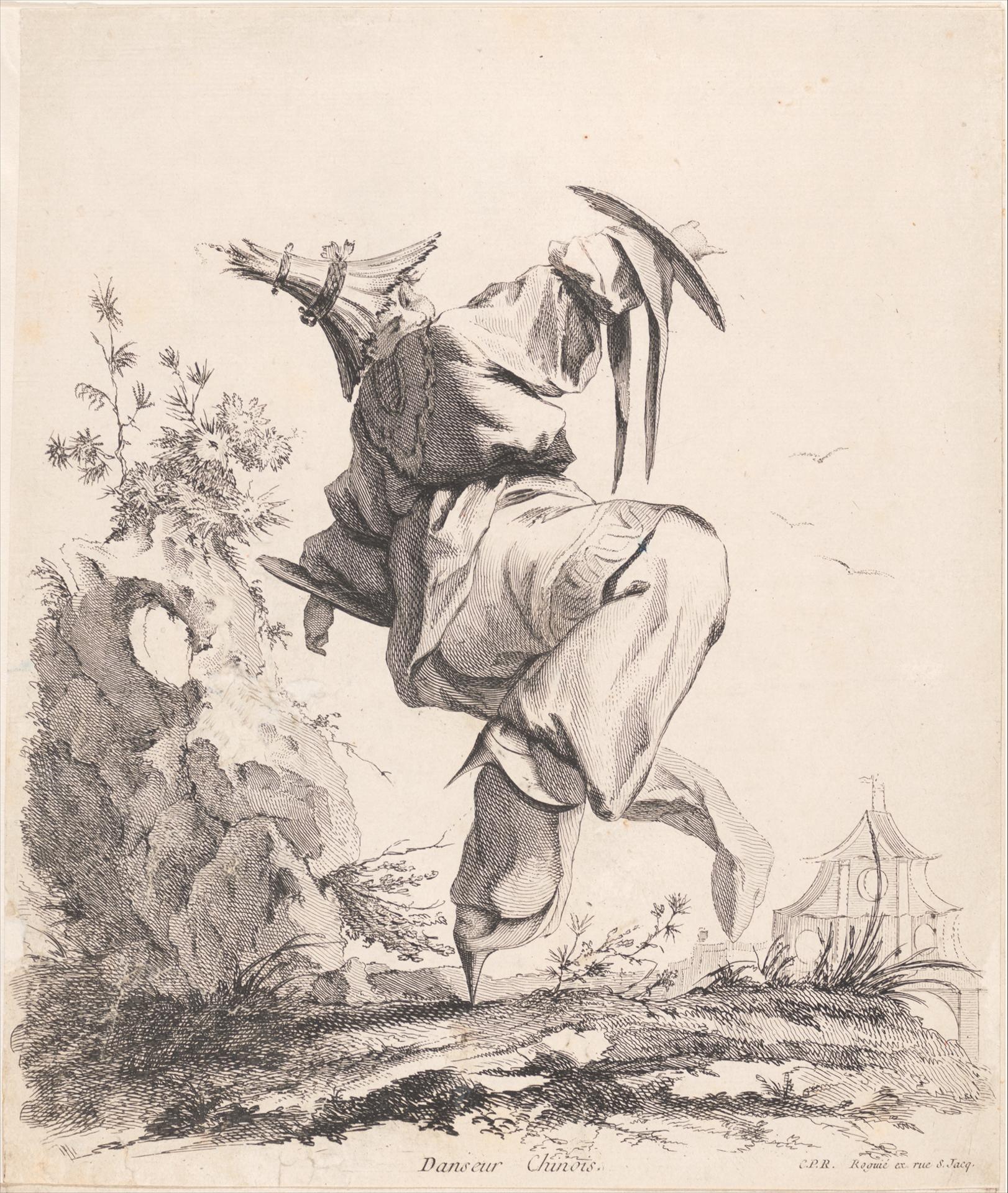
Chinese Dancer, from Livre de Chinois (Book of Chinoiserie)
Original title: Chinese Dancer, from Livre de Chinois (Book of Chinoiserie)
kurzbeschreibung
François Boucher's Chinesische Tänzerin, made between 1720 and 1770, fuses etching and engraving into an image of a dancing woman in Chinese dress. It belongs to the Livre de Chinois series, where exotic motifs meet the French art of the eighteenth century.
Description
The figure's dancing swing catches the eye at once: arms raised, the right hand holding a fan. Folds in sleeves and skirt suggest how the fabric moves in the wind. Behind her a landscape rises, with a rock, shrubs, birds, and a pavilion whose roofs curve upward at the ends. Precise lines and graded shading reveal the hand of etching and engraving.
Context
The Livre de Chinois appeared at a time when chinoiserie was widely admired in French art and culture. It joined a larger body of prints that presented exotic scenes to a European audience. Boucher, one of the leading Rococo artists, offered here an example of the idealized, fanciful view of the Far East that managed without any actual travel accounts.
Impact
Lightness and elegance, hallmarks of the Rococo, set the tone. Movement and exotic setting combine into something graceful, almost theatrical, carrying the viewer into a distant, imagined world.
Technique
Etching and engraving work together, visible in the precise lines and the graded shading. The method allowed both the details of the clothing and the landscape behind to be reproduced with great accuracy.
AI-generated description text
Source: Metropolitan Museum of Art · Public Domain (CC0 1.0)