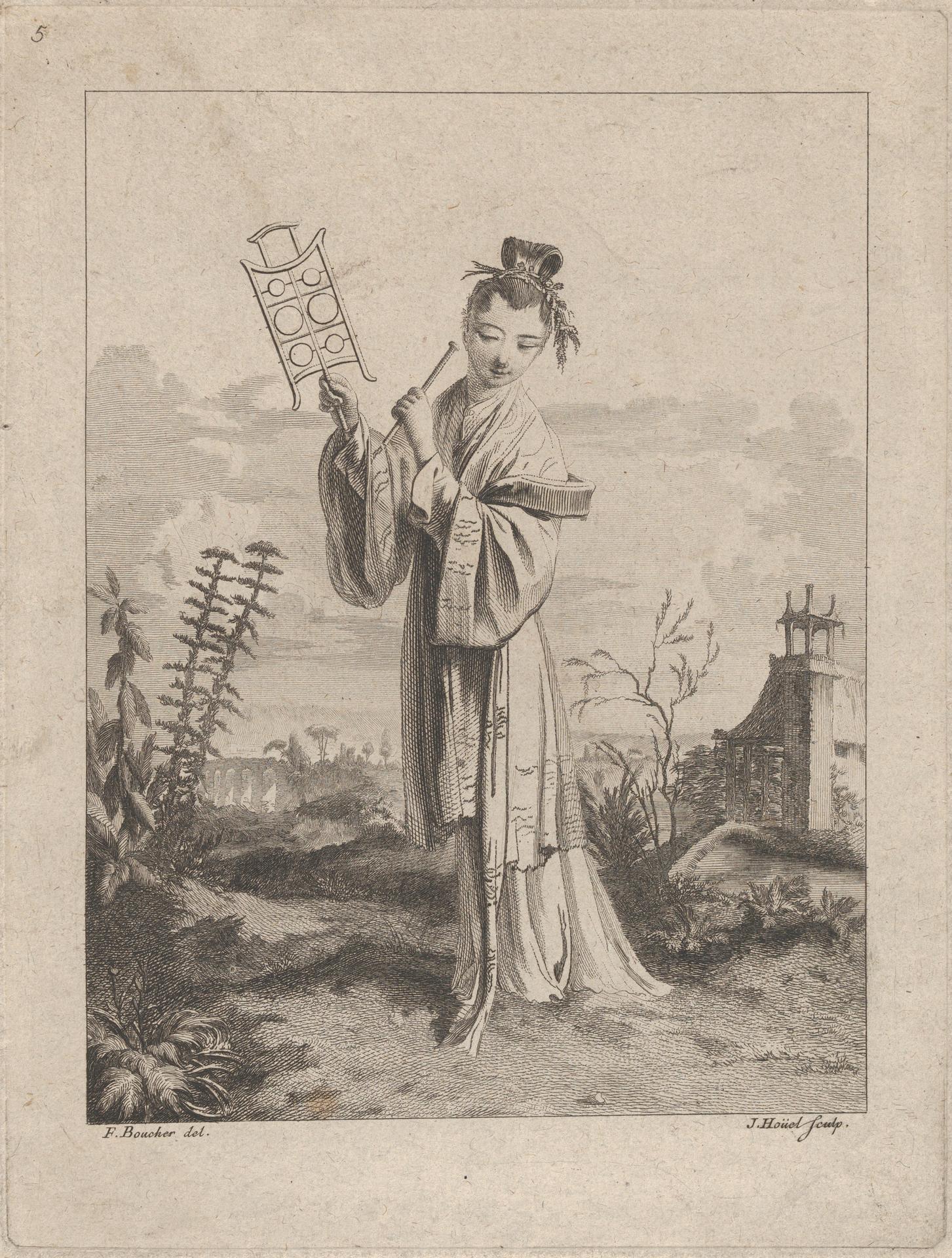
Chinoiserie with a woman playing a musical instrument, from Suite de Figures Chinoises. . .Tiré du Cabinet de Mr. d'Azaincourt
Original title: Chinoiserie with a woman playing a musical instrument, from Suite de Figures Chinoises. . .Tiré du Cabinet de Mr. d'Azaincourt (Series of Chinoiserie Figures. . .From the Chambers of Mr. d'Azaincourt)
kurzbeschreibung
A woman in vaguely Chinese dress sits at the center of this sheet by Jean Pierre Louis Laurent Hoüel, playing a stringed instrument. The etching was made between 1755 and 1776 as part of a series of chinoiserie figures. The print measures 21.2 × 14.4 cm and combines etching with engraving.
Description
The musician holds the foreground and anchors the whole arrangement. Her long patterned gown with wide sleeves and her elaborate coiffure are rendered in detail; her right hand rests on the strings while her gaze drifts slightly to the left. Behind her a wooded landscape opens out, with a Chinese pavilion set among the trees. Even light without hard shadows and the uniform grey tonality give the print its character, as is usual for etchings.
Context
The series was engraved after designs by François Boucher, as the inscriptions 'F. Boucher del.' and 'J. Houel sculp.' indicate. Boucher, a central figure of the Rococo, produced numerous chinoiseries in which European ideas about China took shape. The compilation for the collector Mr. d'Azaincourt points to a courtly or wealthy audience. Dated 1755–76, the sheet falls within the heyday of the chinoiserie fashion in France.
Impact
Elegant and full of detail, the print sits squarely within Rococo taste. Its balanced arrangement radiates a quiet, exotically tinted idyll that answered the period's appetite for distance and fantasy. Delicate lines and even illumination give the view a clear, almost tender quality.
Technique
Etching and engraving are used together, allowing for fine lines and precise detail. The monochrome grey tonality comes from the printing process, in which the etched and engraved lines hold the ink. In the eighteenth century this method was widely used to reproduce paintings and drawings.
AI-generated description text
Source: Metropolitan Museum of Art · Public Domain (CC0 1.0)