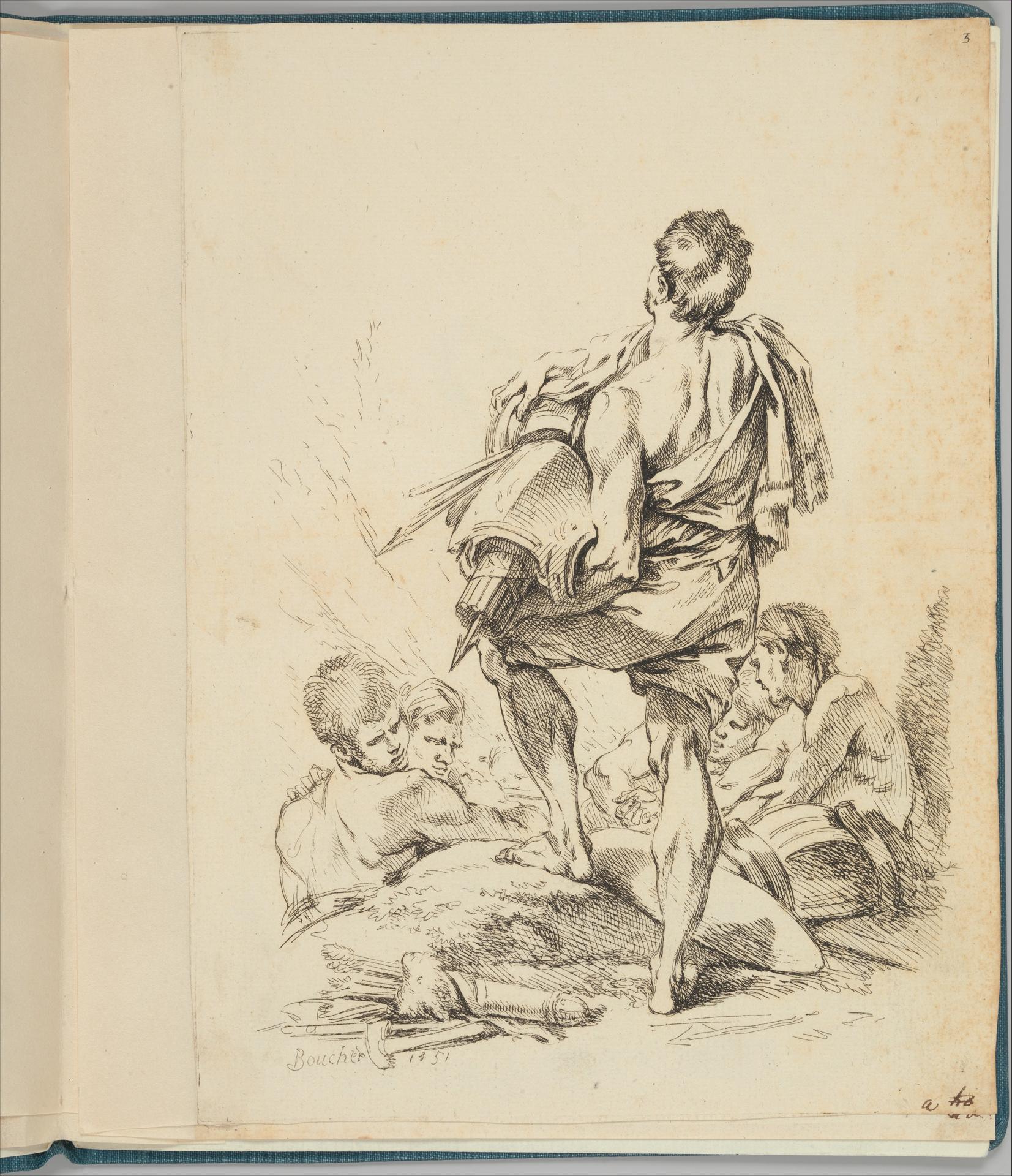
A Man, seen from behind, holding a trophy of arms, from Nouveau Livre de diverse Figures (New Book of Various Figures)
Original title: A Man, seen from behind, holding a trophy of arms, from Nouveau Livre de diverse Figures (New Book of Various Figures)
kurzbeschreibung
An etching made by François Boucher in 1751, showing a man seen from behind, a gun held in his right hand. The sheet belongs to the series "Nouveau Livre de diverse Figures" and survives in the second of two states (Baudicour).
Description
The man stands on a rock, his back to us, the gun in his right hand. He wears a plain garment. Four other figures surround him, some turned toward him, others watching. Several guns lie on the ground in front. The arrangement feels restless and keeps drawing the eye to the central figures, while linework and contrasts of light and dark do the modeling.
Context
By 1751 Boucher was already established as France's leading Rococo artist. The "Nouveau Livre de diverse Figures" was intended as a model book for draughtsmen and art lovers. Boucher drew on a range of stylistic sources; in analyses of the image these are called Etruscan, though that is not certain.
Impact
Because the man turns his back, a curious distance sets in, while the remaining figures carry the tension and the narrative flow. Crisp contours and the play of light and shadow give the sheet graphic sharpness and pull the viewer into the scene.
Technique
Executed as an etching, which can be read in the fine lines and the layering of the shadows. The existence of a second state points to reworking of the plate. The process allows exact rendering of the figures and their surroundings in tones of black and white.
AI-generated description text
Source: Metropolitan Museum of Art · Public Domain (CC0 1.0)