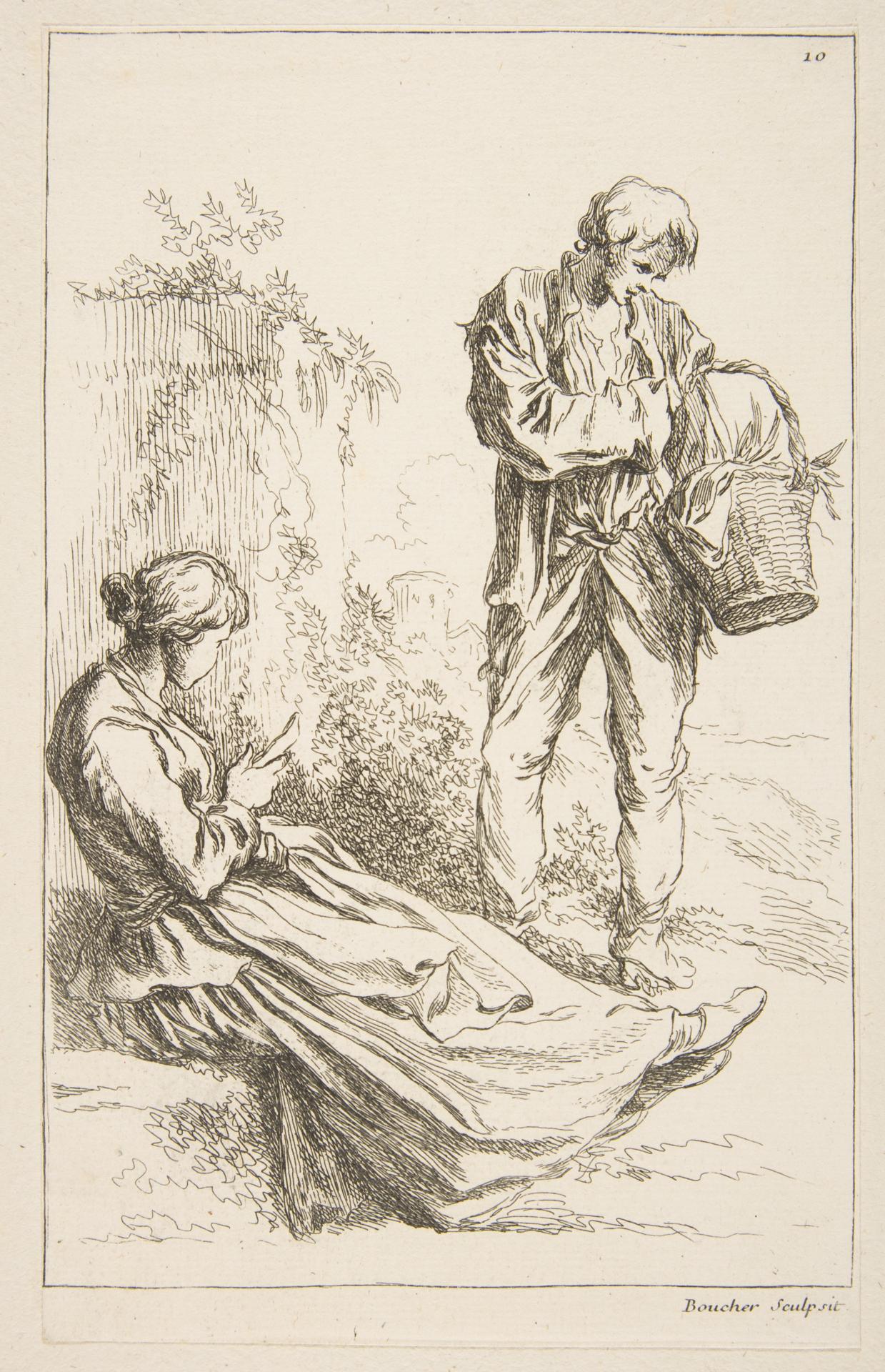
Sheet of Sketches, from "Livre d'étude d'après les desseins originaux de Blomart" (1735, Met-Objekt 6477)
Original title: Sheet of Sketches, from "Livre d’étude d’après les desseins originaux de Blomart"
kurzbeschreibung
This sheet of sketches belongs to François Boucher's 1735 series of etchings after original drawings by Blomart, the 'Livre d'étude d'après les desseins originaux de Blomart'. It shows a woman seated in a garden, reading or writing in a book, and a standing man with a basket at her side. The etching measures 14.2 x 20.7 cm (image).
Description
On the left, a woman in a long, flowing dress is absorbed in a book, while on the right a man in rural clothing stands with a basket, his gaze lowered. Shrubs and plants suggest the garden and contribute to the quiet, natural mood. The image remains monochrome; fine lines and hatching bring out the texture of the garments and foliage. The lighting appears even, as is characteristic of an etching.
Context
By 1735, François Boucher was well established as a Rococo painter and printmaker. This sheet is part of a series of studies etched after models by Blomart, likely intended for art instruction or as a pattern collection. Boucher was known for his elegant figures and sure hand in idyllic scenes. The etching documents his influence on printmaking of those years, which was often produced for collectors and art lovers.
Impact
The scene feels calm and idyllic, almost like a genre picture; the two figures are held in balanced poise. The precise linework and even hatching give the sheet a lightness and elegance typical of Boucher. Viewers are transported into a tranquil garden world that invites them to linger.
Technique
Printed on paper, the etching uses the acid technique to obtain fine lines and shading. The plate shows dense linework with cross-hatching that models the figures' bodies and the depths of the background. Even lines and clear contours are in keeping with 18th-century printmaking.
AI-generated description text
Source: Metropolitan Museum of Art · Public Domain (CC0 1.0)