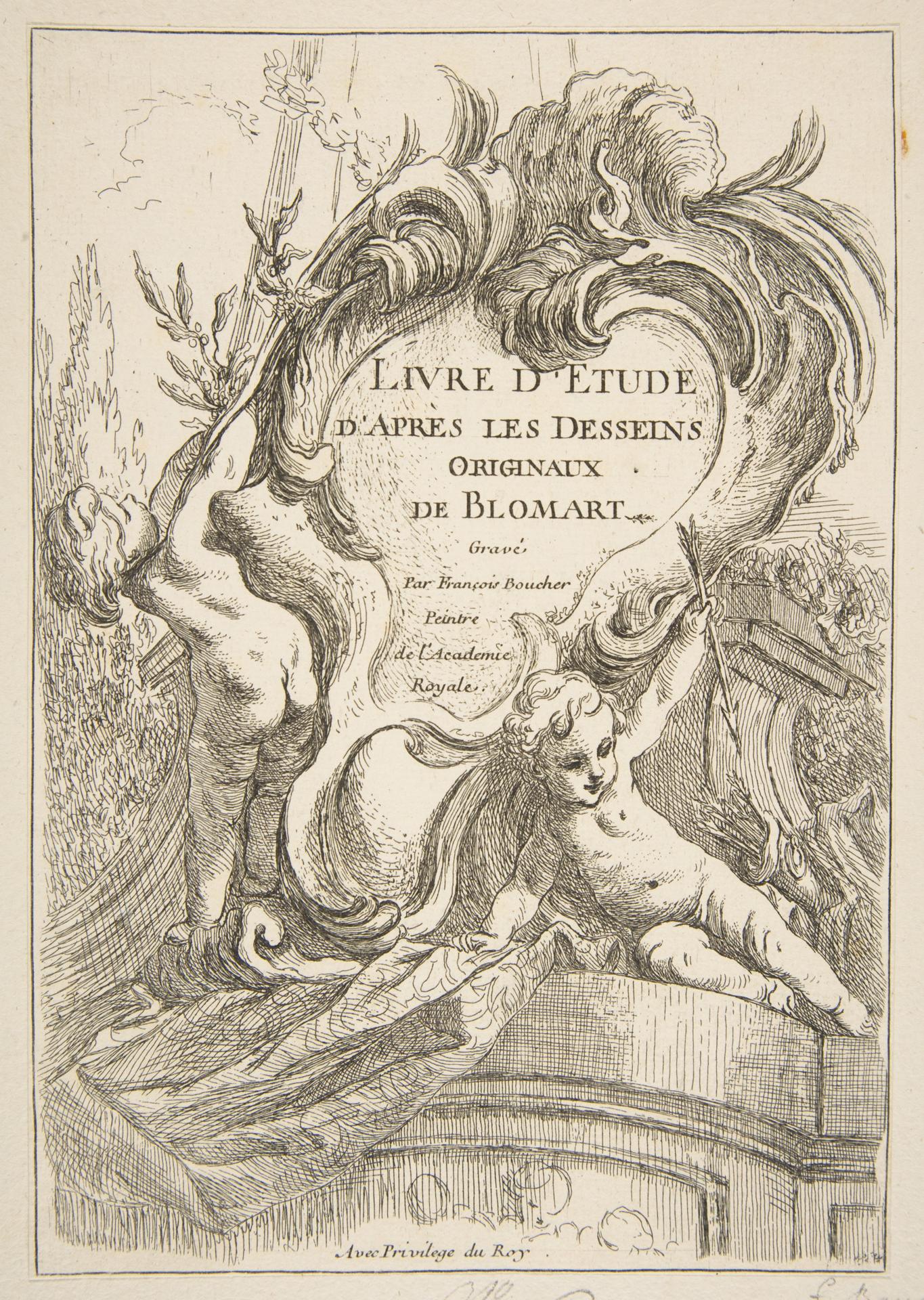
Title Page, from 'Livre d’étude d’après les desseins originaux de Blomart'
Original title: Title Page, from "Livre d’étude d’après les desseins originaux de Blomart"
kurzbeschreibung
This ornamental title page, featuring an oval coat of arms framed by floral tendrils and two lively figures, was created by François Boucher in 1735 as an etching. The print was intended as a frontispiece for a study book of drawings after Blomart.
Description
Your eye is drawn first to the large oval coat of arms at the center, which bears the title and is bordered by stylized flowers and vines. In the upper left, a male figure stretches upward dynamically, holding a branch; on the right, a naked boy stands on a pedestal, also looking up. The folds of the garments and the poses of the limbs emphasize the movement of both figures. Additional plant motifs fill the background, increasing the ornamental density. The etching is monochrome in black and white, with fine shading and precise linework.
Context
By 1735, François Boucher was already an established Rococo artist who regularly produced prints after his own and others' designs. This sheet served as the title page for a study book that collected drawings after Blomart—likely for teaching or as a model collection for art students. During this period, Boucher worked closely with publishers who produced such portfolios for the growing market in art prints.
Impact
The symmetrical layout and ornamental richness make the print appear balanced yet playful, typical of the Rococo. The animated figures and delicate lines give it an elegant lightness that draws the viewer into the world of courtly decoration.
Technique
In etching, the drawing is bitten into a copper plate, creating fine lines and shading. Boucher used this technique to render the details of the ornaments and the movements of the figures precisely, with a clear contrast between light and dark areas.
AI-generated description text
Source: Metropolitan Museum of Art · Public Domain (CC0 1.0)