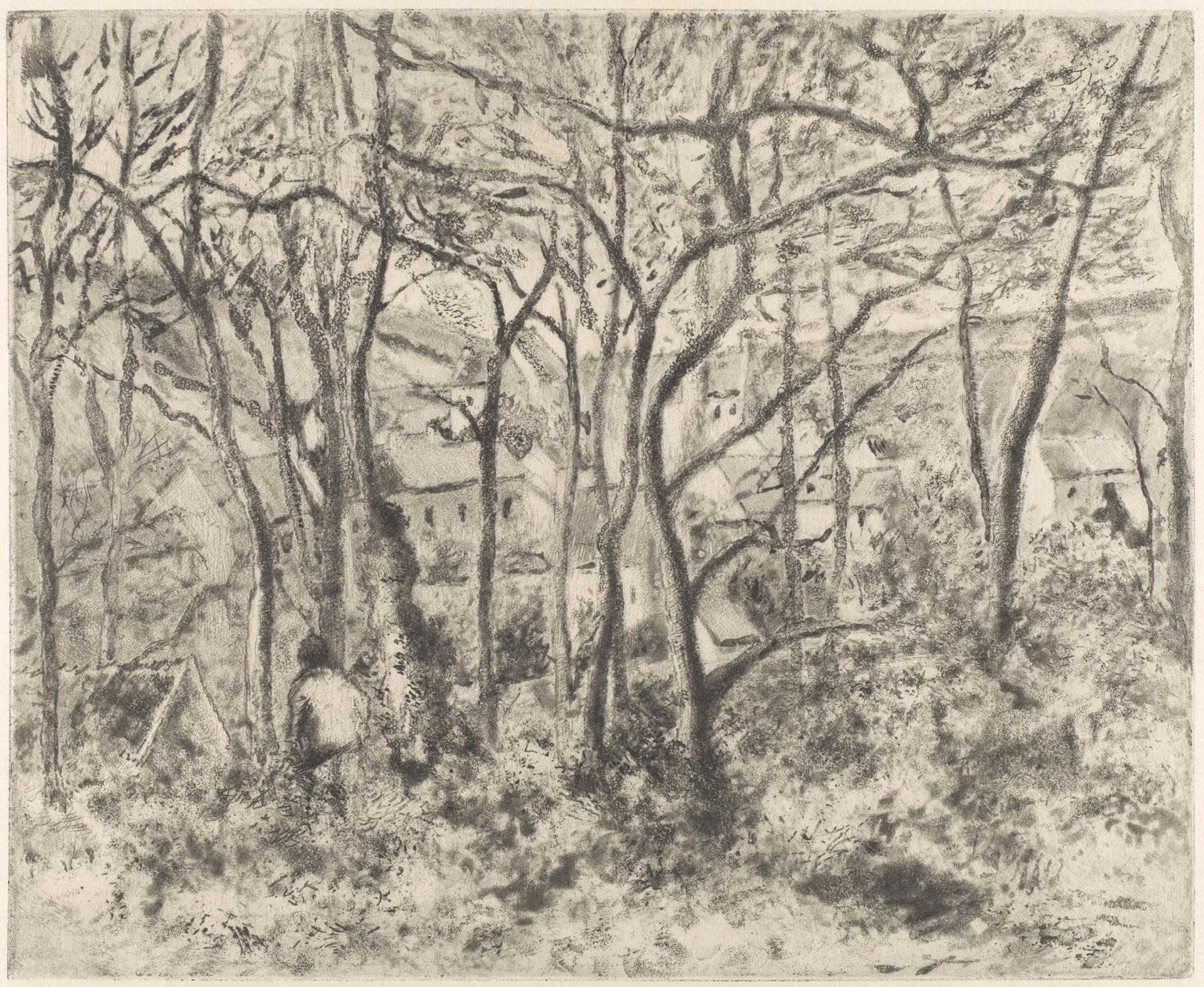
Wooded Landscape at L'Hermitage, Pontoise
Original title: Wooded Landscape at L'Hermitage, Pontoise
kurzbeschreibung
While similar prints often treat the forest as mere backdrop, Camille Pissarro's 1879 etching focuses on the wooded landscape at L'Hermitage in Pontoise as a subject in its own right. Made with soft-ground etching, aquatint, and drypoint on Japanese paper, this impression is the sixth state.
Description
A lone figure crosses the forest, while houses appear among the trees behind. The trunks display intricate branches, and the ground is littered with grass and leaves. Light falls from above, emphasizing the shadows of trees and path. Grays dominate the palette, as the print medium dictates. The structures of trees and path stand out clearly, whereas the background remains slightly blurred, enhancing the sense of depth.
Context
During his stay in Pontoise, which he repeatedly depicted from 1866 onward, Pissarro made this etching. It belongs to a period when he engaged deeply with printmaking techniques, spurred by exchanges with fellow artists such as Edgar Degas. The Impressionists valued Japanese paper for its absorbent, textured surface. The sixth state attests to careful reworking of the plate.
Impact
The delicate lines and tonal aquatint evoke a quiet, intimate mood that draws the viewer into the wooded landscape. Because foreground details are crisp and the background soft, the print gains a painterly quality characteristic of Pissarro's graphic work.
Technique
Pissarro combined soft-ground etching with aquatint and drypoint to achieve both fine lines and flat tones. The plate was revised in six states, revealing a step-by-step development of the image. The impression on Japanese paper highlights the tonal values and the texture of the printed structures.
AI-generated description text
Source: Metropolitan Museum of Art · Public Domain (CC0 1.0)