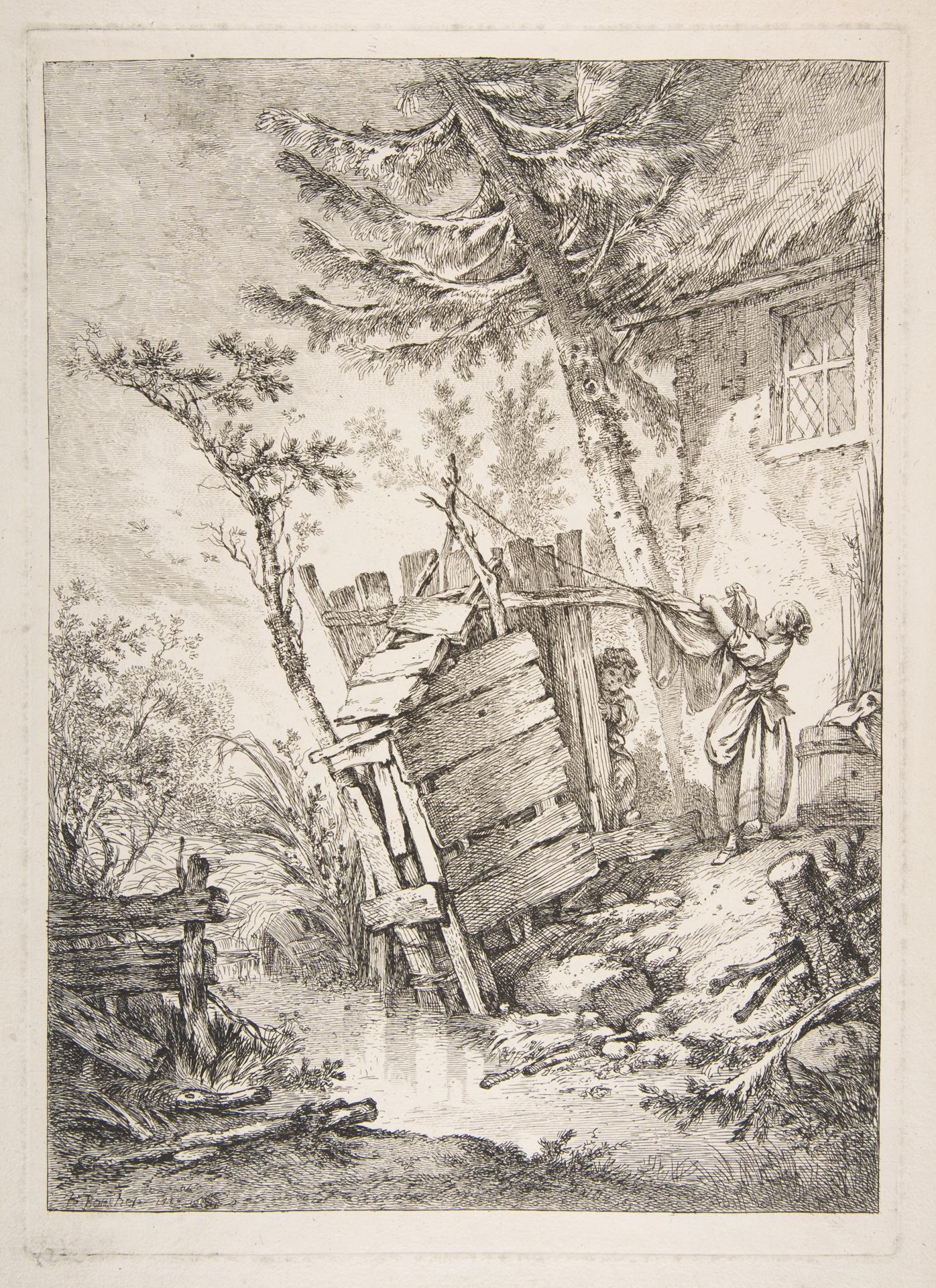
The Laundress (1756)
Original title: The Laundress
kurzbeschreibung
François Boucher's etching Die Wäscherin (The Washerwoman) dates from 1756 and sets a rural scene with a man and a child in front of a wooden building. The subject belongs to Boucher's graphic work, in which he repeatedly took up pastoral and idyllic scenes.
Description
A farmyard forms the outdoor setting. In the foreground stands a wooden structure where work is being done; a man with a long stick or spade is positioned to one side, and a child peeks out from behind a door. An old, broad-spreading tree rises in the background, with more trees and shrubs visible on the left and a building with windows on the right. Light falls from above, bringing out the details vividly.
Context
As a leading representative of the Rococo, François Boucher produced numerous prints alongside his paintings. By 1756, the year of this etching, he was already established as court painter to Louis XV. Rural subjects of this kind were highly popular in the 18th century and reflect an interest in idyllic shepherd and peasant scenes.
Impact
Fine lines and a calm, almost narrative layout characterize the print. Because the rendering remains monochrome, the details of the figures and their surroundings come to the fore, creating an effect that is at once intimate and lively.
Technique
The sheet is an etching printed in shades of gray, with carefully worked line etching. The process allows for fine lines and shading that capture the texture of wood, foliage, and figures with precision. The present example is the first of two states.
AI-generated description text
Source: Metropolitan Museum of Art · Public Domain (CC0 1.0)