Venus and Cupid (1766)
Original title: Venus and Cupid
kurzbeschreibung
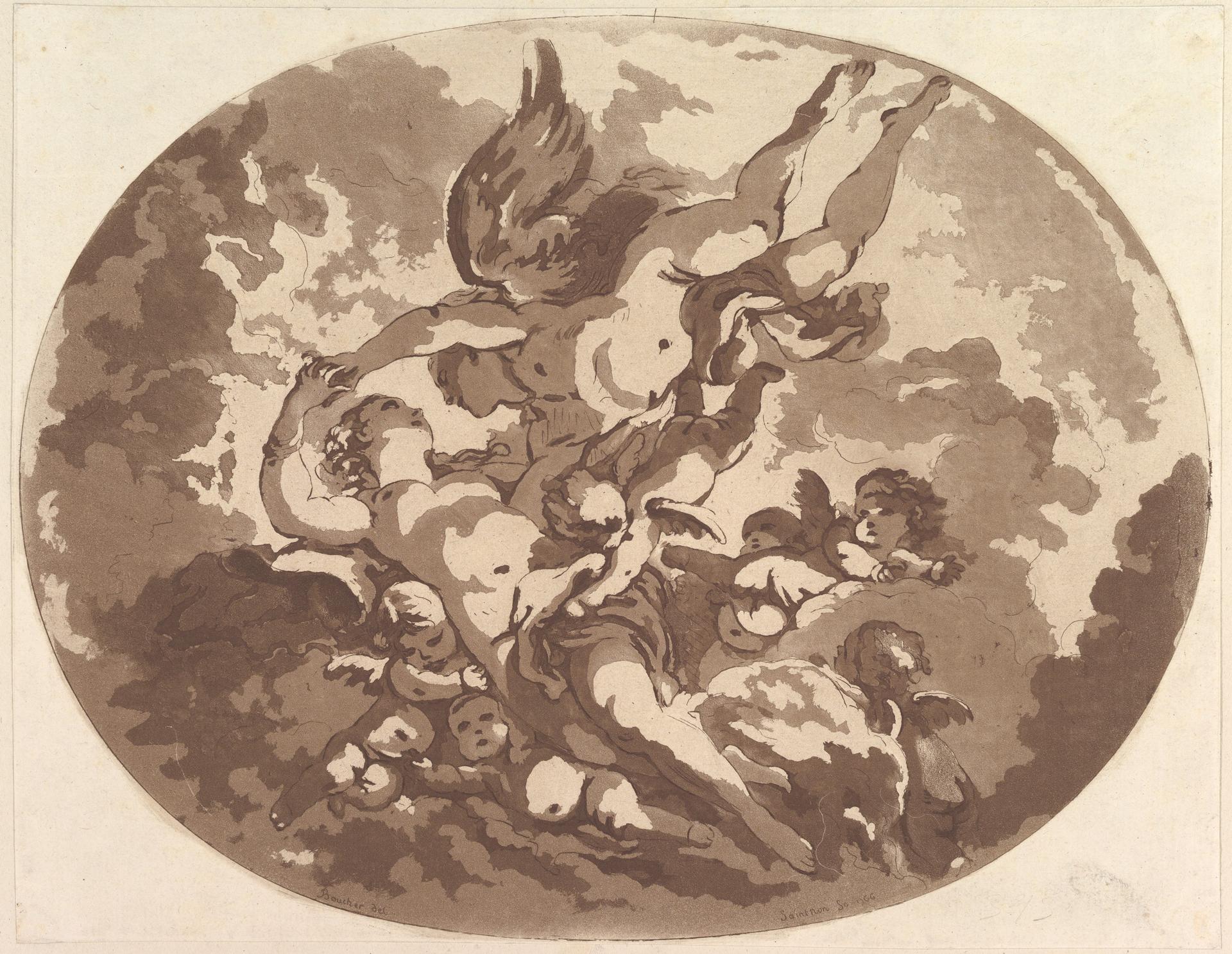
Jean Claude Richard, Abbé de Saint-Non created the aquatint Venus and Amor in 1766, printed in brown ink. The image presents Venus reclining on a cloud, surrounded by floating putti and Amor with his arrow.
Description
At the center of the oval sheet, a female figure—read as Venus—rests with a long garment wrapped around her body, arms outstretched and gaze directed upward. Through the air floats Amor with an arrow, accompanied by several small winged putti in varied poses. Clouds and brown shading fill the background, lending movement to the layout.
Context
The French clergyman and printmaker Jean Claude Richard, Abbé de Saint-Non is known for his aquatint works. This print dates from 1766, when the technique was gaining popularity in France and was often used to reproduce paintings. The mythological pair of Venus and Amor was a common subject in eighteenth-century art.
Impact
The brown ink and soft shading create a warm, intimate mood. The floating figures and dynamic arrangement give the view an airy, almost dreamlike quality, drawing the viewer into the world of myth.
Technique
The sheet was printed as an aquatint, an intaglio process, in brown ink. This method allows for fine tonal gradations and gentle transitions, employed here for the clouds and the modeling of the figures.
AI-generated description text
Source: Metropolitan Museum of Art · Public Domain (CC0 1.0)