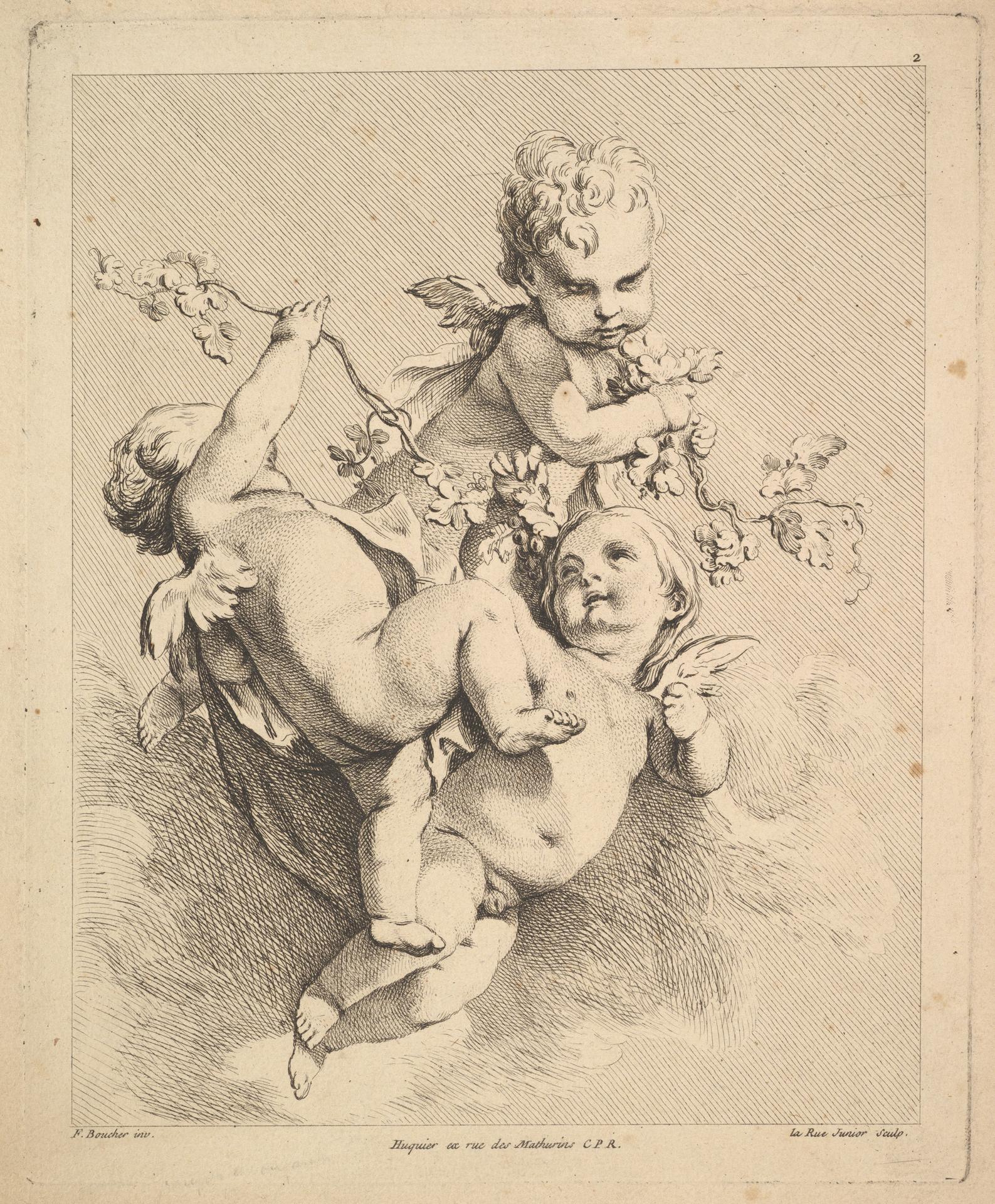
Three Cupids Playing with Vine Branches
Original title: Three Cupids Playing with Vine Branches
kurzbeschreibung
Louis Félix de La Rue made Three Cupids Playing with Vine Branches, a print that presents three winged putti handling vine tendrils in play. An undated impression of an etching and engraving, it measures 30.8 by 25.4 cm on paper. The image stays monochrome, built from delicate lines and graded shading.
Description
The three putti appear in flying, animated poses: one grasps a vine branch while the other two twine around the tendril. Hair, wings and firmly modelled limbs are carefully worked out. Diagonal strokes cover the background, giving it a structured surface. Signature and printing details can be read at the bottom. The whole arrangement has a lively, cheerful character.
Context
The Frenchman Louis Félix de La Rue (1730–1777) worked as a draughtsman and printmaker and was known for ornamental and mythological subjects. His many etchings were made in Paris and often breathe the spirit of the Rococo. Putti and grapes were common motifs of the period, frequently linked with Bacchus, the god of wine. No year of creation is recorded; stylistically the work belongs to the mid-eighteenth century.
Impact
Cheerfulness and lightness emanate from the putti's playful poses, carried by softly drawn lines. Because the print remains monochrome, the fine details of the bodies and vines stand out clearly. All in all, an elegant, ornamental impression emerges, characteristic of Rococo art.
Technique
Etching and engraving are combined here, as seen in the precise, thin lines and the graded shading. This method allows a detailed rendering of the putti and the ornamental parts. The plate measures 27.4 by 22.3 cm and was pulled on paper of 30.8 by 25.4 cm.
AI-generated description text
Source: Metropolitan Museum of Art · Public Domain (CC0 1.0)