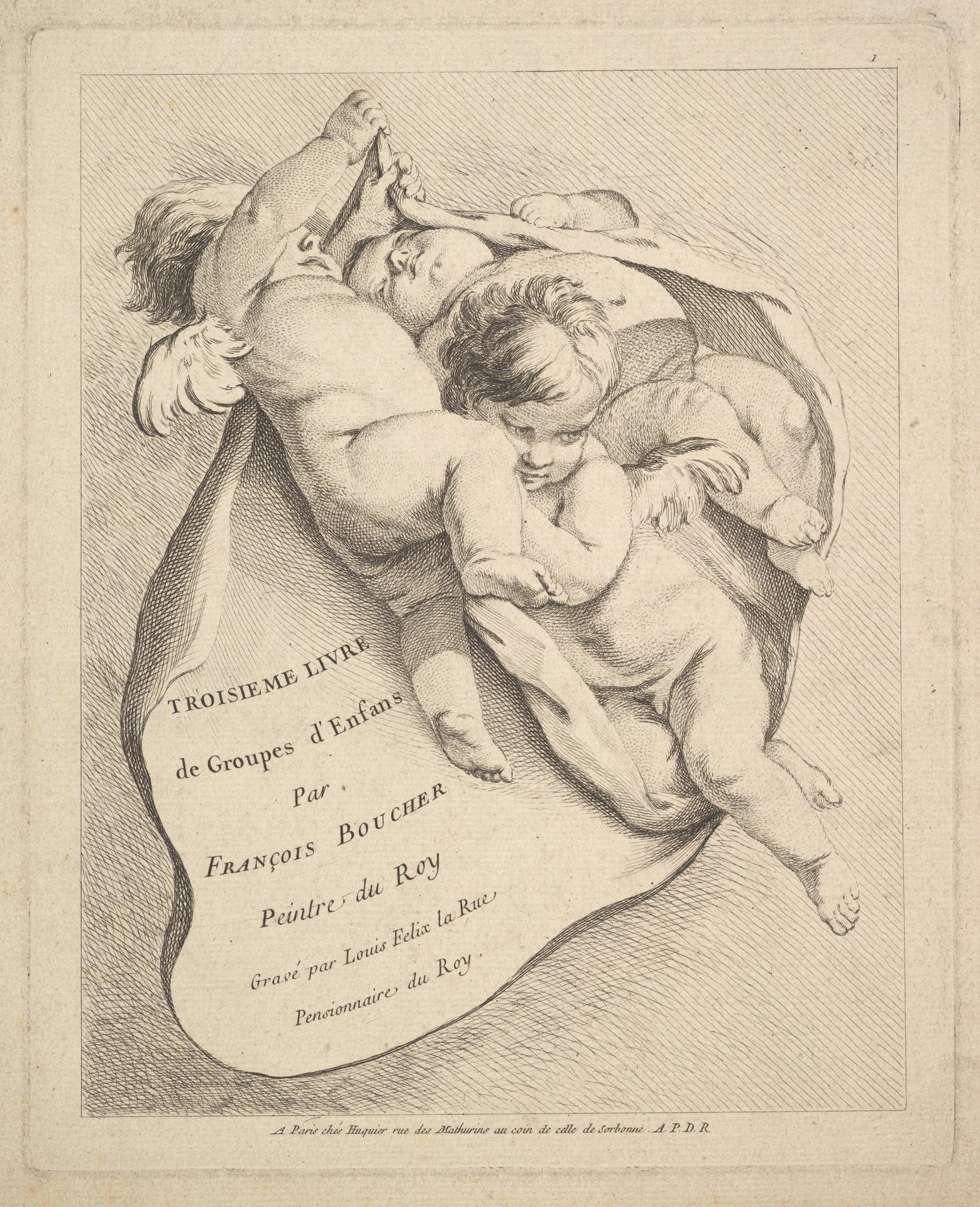
Frontispiece (Etching and engraving)
Original title: Frontispiece
kurzbeschreibung
This frontispiece by Louis Félix de La Rue, after a design by François Boucher, is executed as an etching and engraving. It shows three angels in a lively, playful pose. The print served as the title page for the third book of groups of children.
Description
Three angels dominate the image: two lie on their backs, embracing, while the third sits on them and looks upward. Their bodies are captured in a dynamic, playful moment. The background remains plain and is crossed by diagonal lines, which makes the figures stand out clearly. Below is an oval with the inscription 'TROISIEME LIVRE de Groupes d'Enfans Par FRANCOIS BOUCHER Peintre du Roy Gravé par Louis Felix la Rue Pensionnaire du Roy'. The coloring is monochrome, consisting of various shades of gray created by the line work and shading. The light is evenly distributed, with no visible shadows.
Context
Louis Félix de La Rue engraved this frontispiece after a design by François Boucher. Boucher served as 'Peintre du Roy' (King's Painter), La Rue as 'Pensionnaire du Roy' (King's Pensioner). The print was intended as the title page for the third book of groups of children, a series of prints that disseminated Boucher's depictions of playing children. Such reproductive prints were widespread in the 18th century, making paintings and drawings accessible to a broader public.
Impact
The intertwined poses of the angels convey liveliness and playfulness. The clear line work and calm arrangement give the print an elegant, classical feel typical of 18th-century art.
Technique
The work combines etching and engraving, allowing for fine lines and precise shading. The monochrome execution in gray tones results from the varying depth and density of the lines, which ink the paper in different gradations.
AI-generated description text
Source: Metropolitan Museum of Art · Public Domain (CC0 1.0)