The Savoyard with His Box
Original title: The Savoyard with His Box
kurzbeschreibung
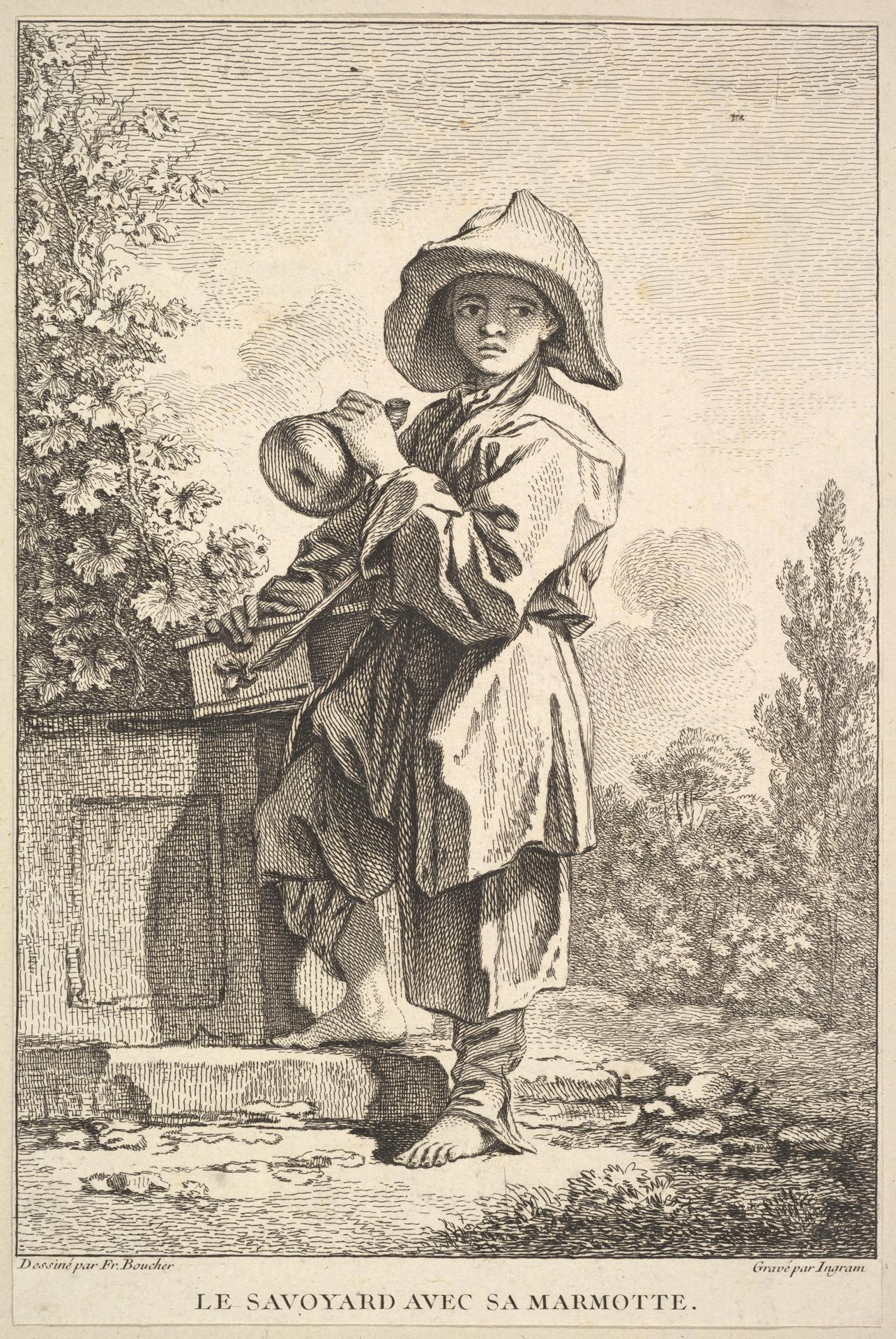
A boy carrying a box for his marmot occupies the heart of this sheet by John Ingram, made between 1741 and 1763 as an etching and engraving. Unlike many related motifs, it focuses less on the animal's performance than on the person who bears it. The subject belongs to the tradition of images of itinerant Savoyard children.
Description
The boy has taken his place on a stone bench within an enclosing wall. A wide-brimmed hat covers his head; he wears a long shirt and trousers, and his feet are bare. Trees and shrubs suggest a rural setting behind him. The image remains black and white, structured by hatching and lines; along the lower edge runs the inscription 'LE SAVOYARD AVEC SA MARMOTTE'.
Context
In the eighteenth century, Savoyard children left their home region and travelled across Europe, earning a living by showing marmots. Such subjects were widespread at the time and belonged to genre painting, which devoted itself to the lives of ordinary people. John Ingram worked as a graphic artist and produced prints after designs by other artists; this one was made between 1741 and 1763.
Impact
The boy's posture seems calm and matter-of-fact, supported by clear linework. Dense hatching runs across the sheet and differentiates the surfaces of stone, fabric, and background. The result is the impression of a documentary portrait of a historical everyday phenomenon, without pleasing additions.
Technique
Etching and engraving are combined here, allowing precise linework. The hatching and lines correspond to eighteenth-century printmaking. The sheet is printed on paper and measures 22.2 x 14.8 cm.
AI-generated description text
Source: Metropolitan Museum of Art · Public Domain (CC0 1.0)