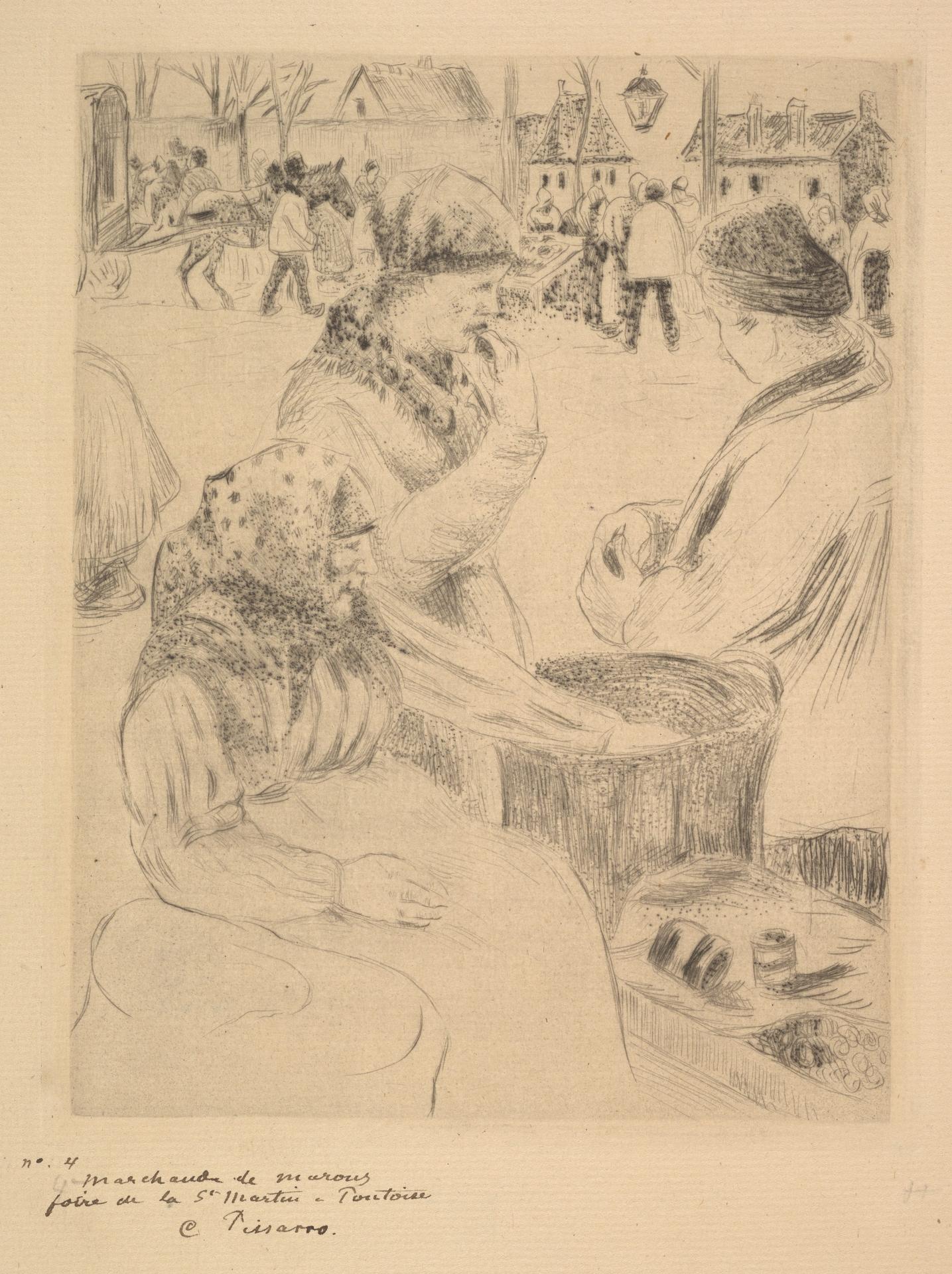
Chestnut Vendor, St. Martin's Market, Pontoise
Original title: Chestnut Vendor, St. Martin's Market, Pontoise
kurzbeschreibung
Camille Pissarro made the drypoint 'Kastanienverkäuferin, Markt Sankt Martin, Pontoise' in 1881. Executed with stippling, this impression is the first state before steelfacing. A woman with a bowl of chestnuts is the main figure, accompanied by a man; behind them are other people, a horse, and a carriage.
Description
In the foreground, a woman sits on a table, holding a bowl of chestnuts; she wears a dotted jacket and a cap. A man stands beside her, facing her, with an object in his hand. Further back, people converse or walk about, and a horse with a carriage is visible. Buildings and trees frame the market. The layout stretches horizontally and directs attention to the two front figures. Drypoint and stippling produce gray tones; the light appears diffuse, giving the scene a calm mood.
Context
Pissarro lived and worked in Pontoise, north of Paris, from 1866 to 1883. The Market of Saint Martin was a real place in Pontoise that he captured repeatedly in prints and paintings. In 1881, he made this drypoint during a phase of intense engagement with printmaking, using techniques such as drypoint and stippling to achieve fine tonal values. That the sheet survives as a first state before steelfacing suggests an early edition.
Impact
A quiet, everyday atmosphere marks the print, brought about by diffuse light and fine stippling. The precise rendering of the figures and the restrained gray scale give it an intimate, almost documentary quality. The arrangement draws the eye to the interaction between the seller and the man, while the background only hints at the lively market activity.
Technique
Drypoint with stippling on yellowish-brown laid paper. The drypoint needle creates soft, velvety lines, while stippling allows for delicate tonal gradations. The sheet measures 43.2 x 31.3 cm (sheet) with a plate of 19.9 x 15.3 cm and is in the first state of two, without steelfacing.
AI-generated description text
Source: Metropolitan Museum of Art · Public Domain (CC0 1.0)