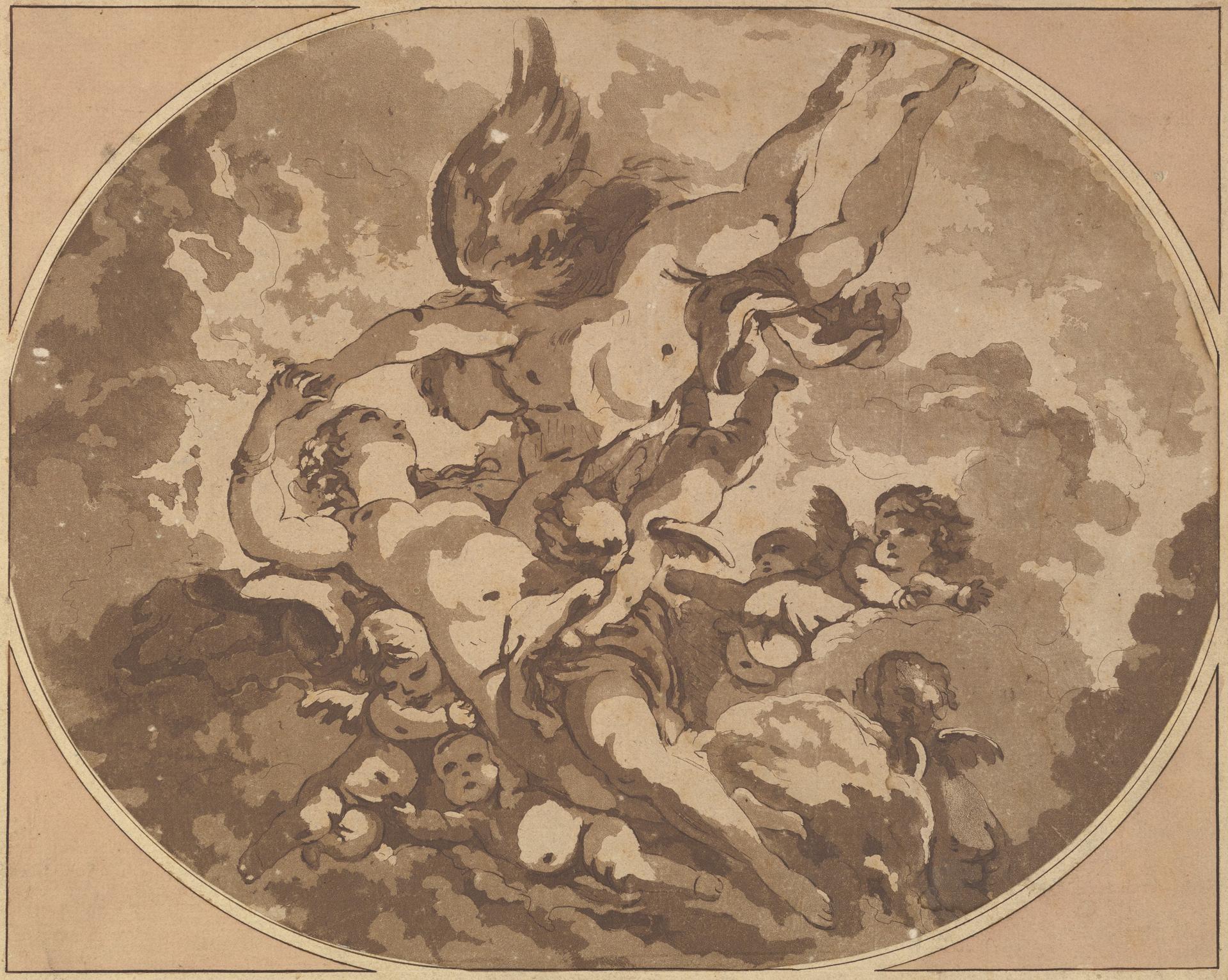
Venus and Cupid (Aquatint in brown ink)
Original title: Venus and Cupid
kurzbeschreibung
What sets this aquatint by Jean Claude Richard, Abbé de Saint-Non apart from related putti prints of the eighteenth century is its wholehearted embrace of warm brown tones. A host of putti appears in a heavenly setting; the aquatint technique with brown ink points to the second half of the eighteenth century. Behind the playful swarm of figures lies an allegorical theme of love, familiar from Rococo and Baroque art.
Description
What distinguishes this sheet from denser figure groups is the loose distribution through space: some putti float freely, others rest on clouds or lie in each other's arms. The arrangement feels animated and cheerful, almost dance-like. Clouds and a softly lit sky form the ground, which the brown ink bathes in a warm, velvety mood. The lines run fluidly and expressively, reinforcing the figures' lightness.
Context
A French draughtsman and engraver of the eighteenth century, Jean Claude Richard, Abbé de Saint-Non is best known for landscapes and reproductive prints. He worked closely with artists such as Jean-Honoré Fragonard and helped spread aquatint in France. The subject of Venus and Cupid belongs to the classical mythological repertoire prized under the Ancien Régime. The exact date of this print is unknown; stylistically it can be placed in the late Rococo period.
Impact
The soft browns and floating figures create an airy, almost dreamlike atmosphere. Because the putti are distributed so playfully, the print feels cheerful and carefree, leading the viewer into an idyllic world. The expressive linework brings a liveliness that seems to reach beyond the static medium of print.
Technique
The image was printed as an aquatint etching in brown ink. This process allows fine tonal gradations and a painterly effect reminiscent of watercolor. Thanks to the brown color, the print gains a warm, unified tone that supports the heavenly scene.
AI-generated description text
Source: Metropolitan Museum of Art · Public Domain (CC0 1.0)