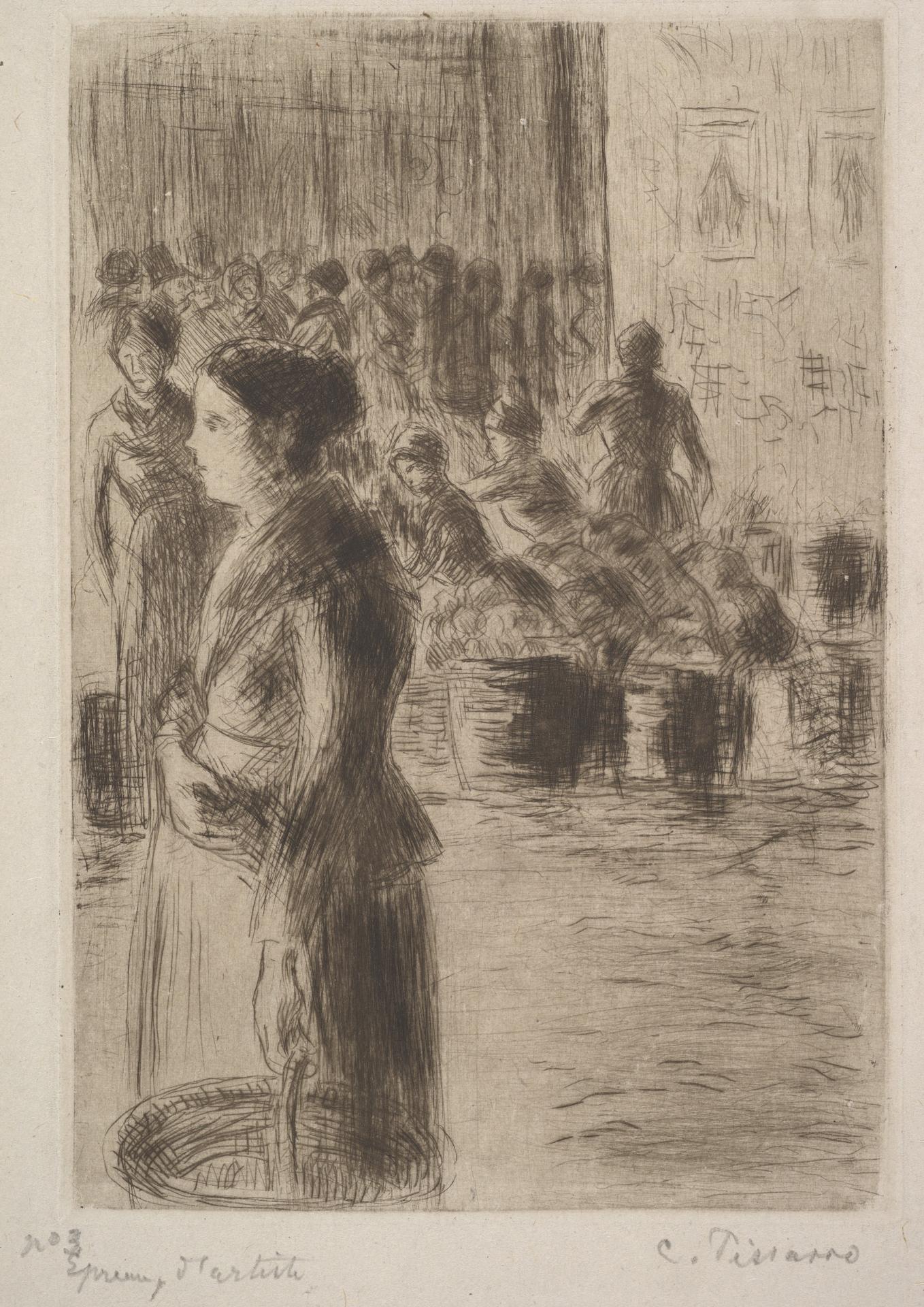
The Maid at the Market
Original title: The Maid at the Market
kurzbeschreibung
Camille Pissarro made the etching "The Maid on the Market" in 1888. It presents a woman seen from behind, carrying a basket and looking out at a busy market scene. The print is a drypoint and etching on China paper and exists in the second of four states.
Description
In the foreground stands a woman in a long dress, her back turned, a basket in her hand. Her posture seems thoughtful, her gaze directed into the depth of the image. Beyond her, a detailed market scene unfolds with many people in motion. The figures in the background are less sharply defined, creating an atmosphere of bustling activity. The monochrome gray scale is built from fine hatching and drypoint burr, while light from the front emphasizes the silhouettes and strengthens the spatial depth.
Context
Pissarro created this etching in 1888, during a period when he was deeply engaged with printmaking. The artist was known for his depictions of rural and urban daily life, often focusing on working people. The market scene takes up a motif that recurs in his work and shows his impressionist approach to capturing everyday moments. The print belongs to a series of four states, indicating a careful working process.
Impact
This etching combines intimate closeness to the main figure with the lively distance of market activity. The woman's calm pose contrasts with the dynamism of the background, producing a quiet, observing mood. The delicate linework and handling of light give the print a serene, graphic elegance.
Technique
The work combines etching and drypoint on China paper, a fine, absorbent paper valued for its soft surface. The second of four states shows that Pissarro reworked the plate several times to achieve the desired depth and density of detail. The monochrome effect comes from varied strokes and drypoint burr, which create soft transitions and textures.
AI-generated description text
Source: Metropolitan Museum of Art · Public Domain (CC0 1.0)