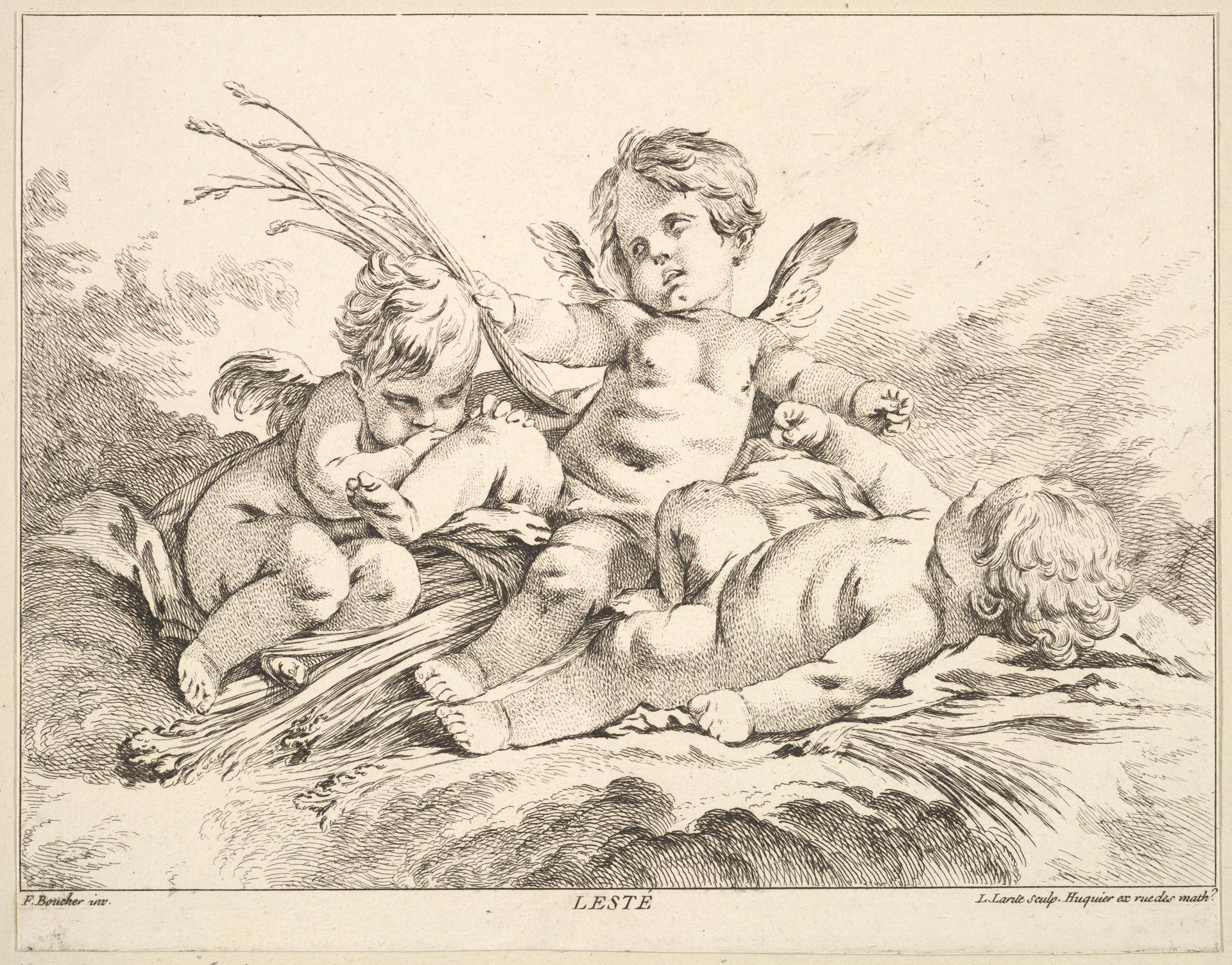
Summer (Etching, engraving and drypoint)
Original title: Summer
kurzbeschreibung
Four putti enliven the rural scene of Louis Félix de La Rue's etching "Summer." The undated sheet, a mixed technique of etching, engraving, and drypoint, belongs to the collection of the Metropolitan Museum of Art. Classical forms meet Rococo elements, and the season appears as a carefree idyll of figures.
Description
One putto lies on his back in the foreground, a second sits on a stone, and a third holds a stalk of wheat in the background. The naked, barefoot figures are loosely distributed across the horizontally oriented picture surface. Flowing brushstrokes suggest a landscape, and diffuse light from the front emphasizes the contours. The monochrome gray-scale view enhances the drawing-like character.
Context
Louis Félix de La Rue, an 18th-century French draftsman and printmaker, created ornamental and mythological depictions. The motif of the seasons as putti was widespread in the Rococo and allegorically personified natural cycles. The sheet presumably originated in this context. The Metropolitan Museum of Art preserves it as a public-domain work and makes it available digitally.
Impact
Fine lines and soft shading give the sheet an elegant, playful note. The calm, horizontal arrangement of the putti creates an idyllic, harmonious mood. The viewer feels transported to a cheerful summer landscape.
Technique
Etching, engraving, and drypoint were combined to achieve fine lines and nuanced gray tones. The etching provides the basic structure, the engraving ensures precise contours, and the drypoint creates soft, velvety shadows. The paper format measures 20.1 by 25.7 centimeters.
AI-generated description text
Source: Metropolitan Museum of Art · Public Domain (CC0 1.0)