Spring (Etching, engraving and drypoint)
Original title: Spring
kurzbeschreibung
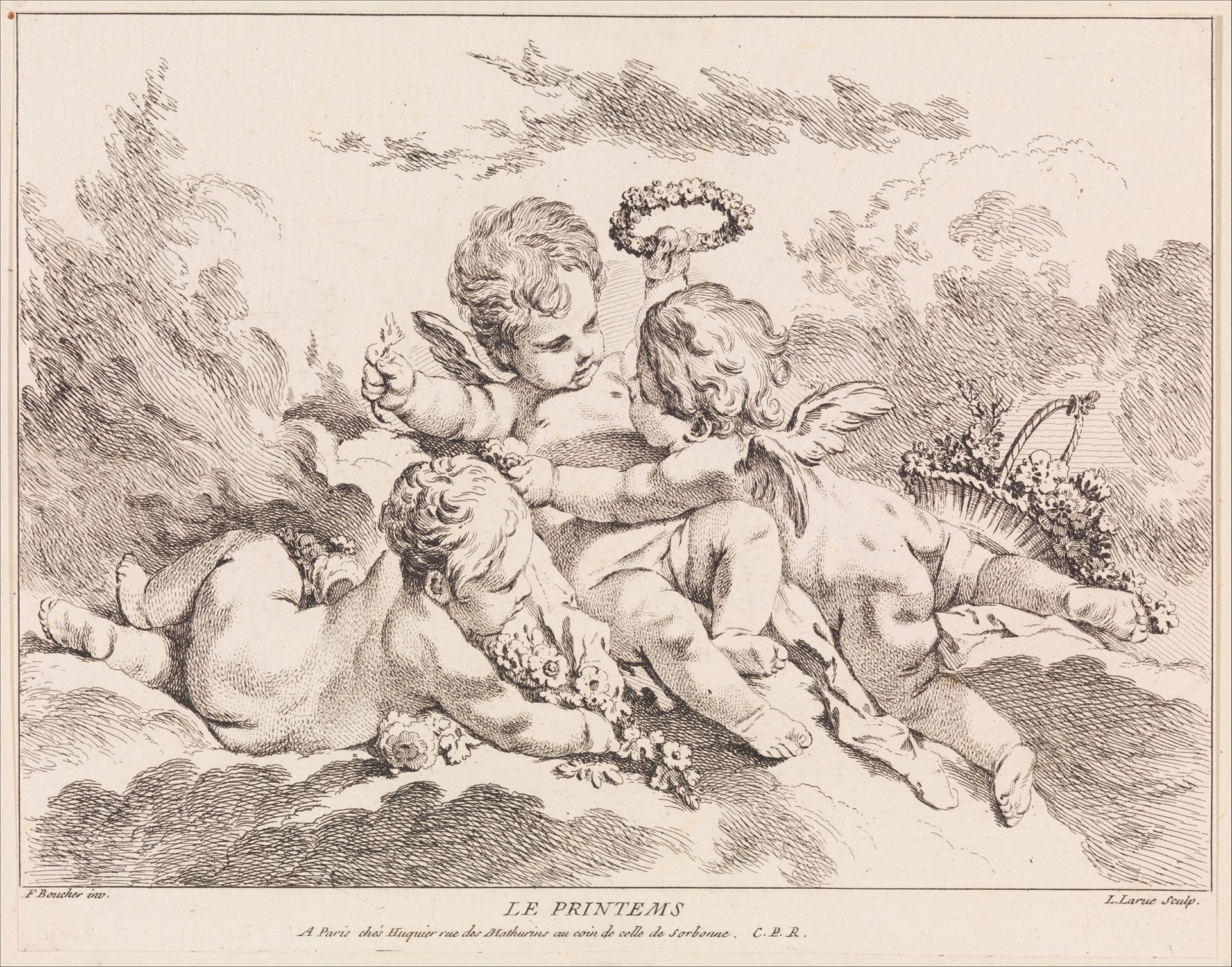
Louis Félix de La Rue's etching "Spring" belongs to the circle of eighteenth-century seasonal or allegorical series. It shows three putti reclining on a cloud, surrounded by flowers. The sheet is undated and was executed in etching, engraving and drypoint; it measures 20.2 by 25.7 centimetres.
Description
Three putti have settled on a cloud. The one in front holds flowers and looks down, the middle one has something in his hand and kisses his companion, while the right-hand putto, wearing a wreath of flowers on his head, gazes at him. Sketched clouds and trees frame the action. Kept in monochrome, the image lives from fine, detailed linework.
Context
Louis Félix de La Rue, an eighteenth-century French draughtsman and engraver, became known for ornamental and mythological works. "Spring" probably belonged to a series of seasons or allegories, as were common in the Rococo. The combination of drypoint and engraving suggests it was made in the artist's mature period; he worked in Paris and later in London.
Impact
The playful putti and soft clouds evoke a cheerful, springlike mood. Thanks to the fine linework, the sheet appears elegant and almost delicate, as is characteristic of Rococo prints.
Technique
Etching, engraving and drypoint come together here, allowing linework that is at once precise and lively. The drypoint leaves fine, burred lines that give leaves and clouds a texture of their own. Printing was presumably on laid paper, as was usual in the eighteenth century.
AI-generated description text
Source: Metropolitan Museum of Art · Public Domain (CC0 1.0)