Peasant Crossing Water
Original title: Peasant Crossing Water
kurzbeschreibung
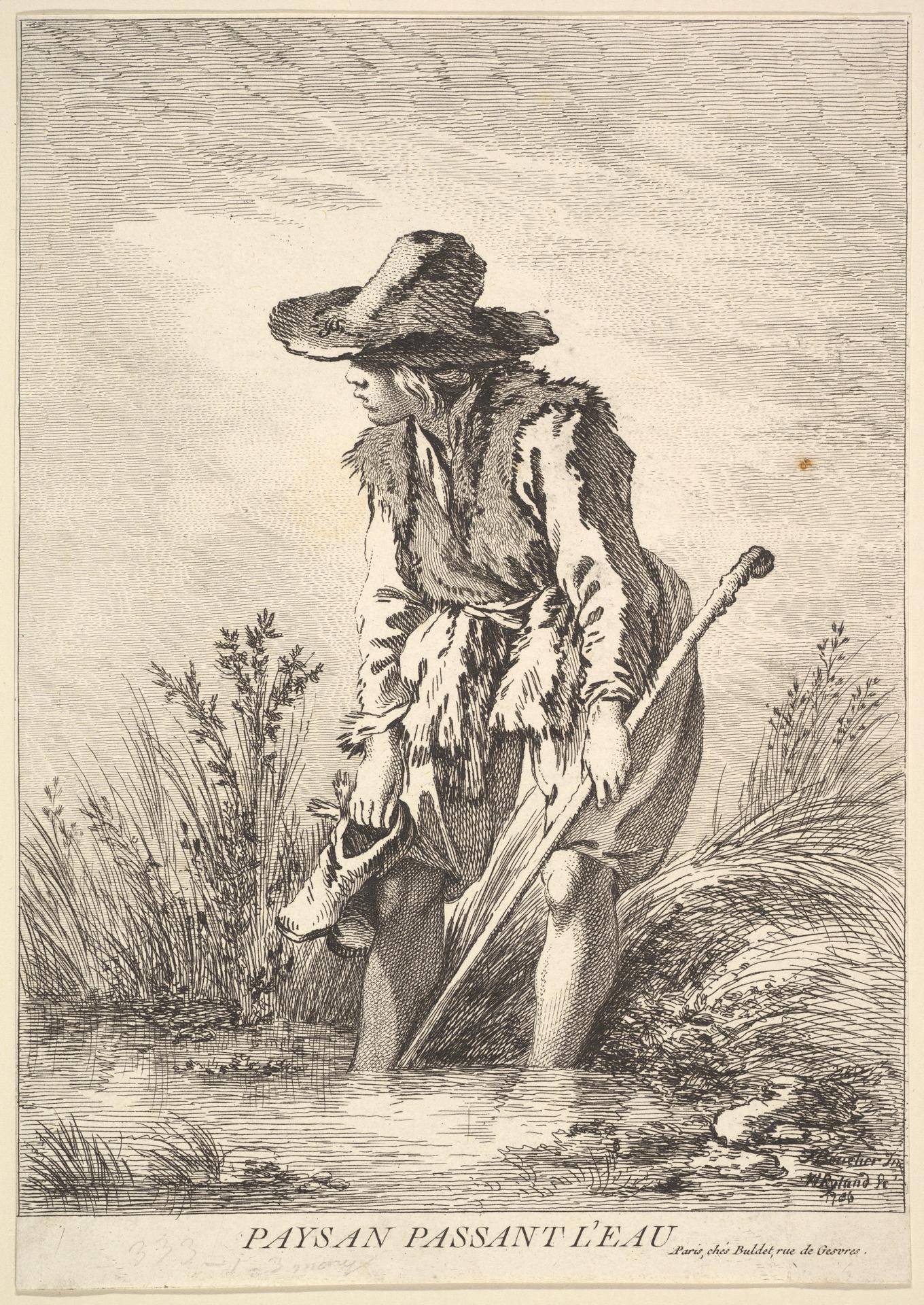
A farmer wades through a shallow body of water, lifting one shoe clear of the flood. William Wynne Ryland captured this motif in 1786 in an etching with engraving. The paper measures 24.2 x 17 cm.
Description
Ankle-deep in the water, the man raises a shoe with his left hand while his right grips a stick. A broad, flat cap sits on his head; a jacket with fur trim and trousers complete his clothing. Grasses and bushes line the rear of the image, and the sky remains an area of hatching. The sheet stays monochrome throughout, black and white with no color.
Context
Ryland ranks among the English printmakers of the 18th century whose reputation rests on reproductive engravings. This sheet was made in 1786, when rural subjects were in demand in printmaking. The artist often drew on models by others; which source served here is not recorded.
Impact
The layout feels calm and unhurried, and the dense hatching lends the whole an idyllic quality. Because color is absent, the eye turns to the lines and to an everyday moment that avoids pathos.
Technique
Etching and engraving interlock, visible in the delicate strokes and the cleanly laid hatching. Both processes allow surfaces such as the fur trim or the water's surface to be rendered in detail.
AI-generated description text
Source: Metropolitan Museum of Art · Public Domain (CC0 1.0)