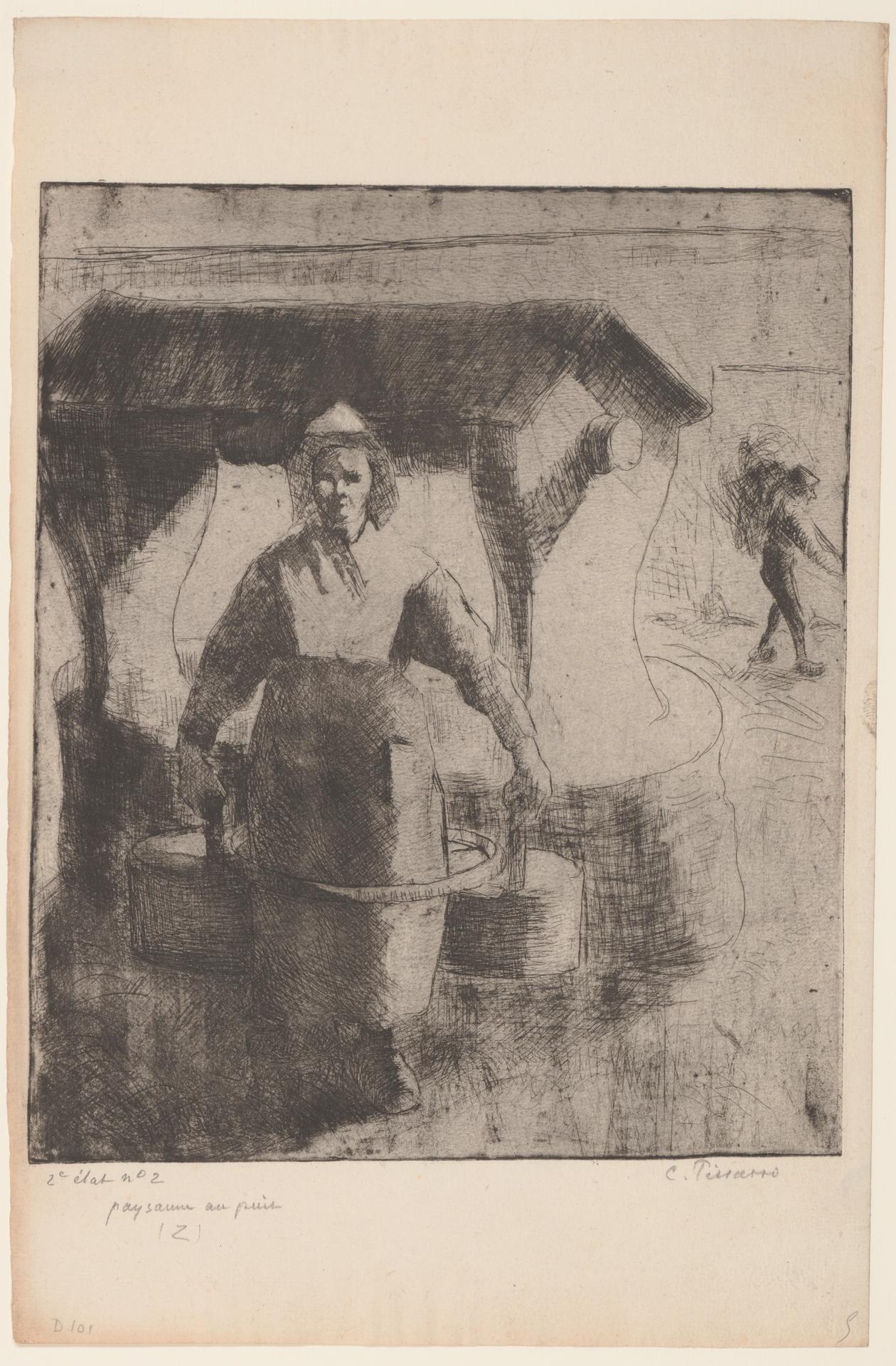
Woman at a Well
Original title: Woman at a Well
kurzbeschreibung
Camille Pissarro made this etching, Woman at a Well, in 1891. It depicts a woman in traditional dress standing at a well and holding a bucket. The print is an etching with aquatint on laid paper and is the second state of three.
Description
Your eye is first drawn to the woman in a headscarf and jacket standing at a well in the foreground, carrying a bucket. Behind her, another well with a person is visible, along with a third figure moving from left to right. The view is set in a rural environment with simple buildings and nature. The layout is horizontally oriented, with the woman as the central point in the foreground. Black and white dominate, and the light is evenly distributed without strong shadows.
Context
Pissarro created this etching in 1891, a time when he was deeply engaged with printmaking and was part of the Impressionist group. The motif of a woman at a well takes up a traditional rural subject that was widespread in the 19th century. The artist was living in Éragny, a village in Normandy, and often drew inspiration from scenes of peasant life.
Impact
The print feels calm and everyday, emphasized by the even distribution of light and the simple arrangement. The realistic style with Impressionist touches gives the scene a lively but restrained atmosphere.
Technique
The etching with aquatint was executed on laid paper. This technique allows for fine lines and subtle tonal gradations, which are used to render light and shadow. The second state of three shows reworking of the plate that refined the details.
AI-generated description text
Source: Metropolitan Museum of Art · Public Domain (CC0 1.0)