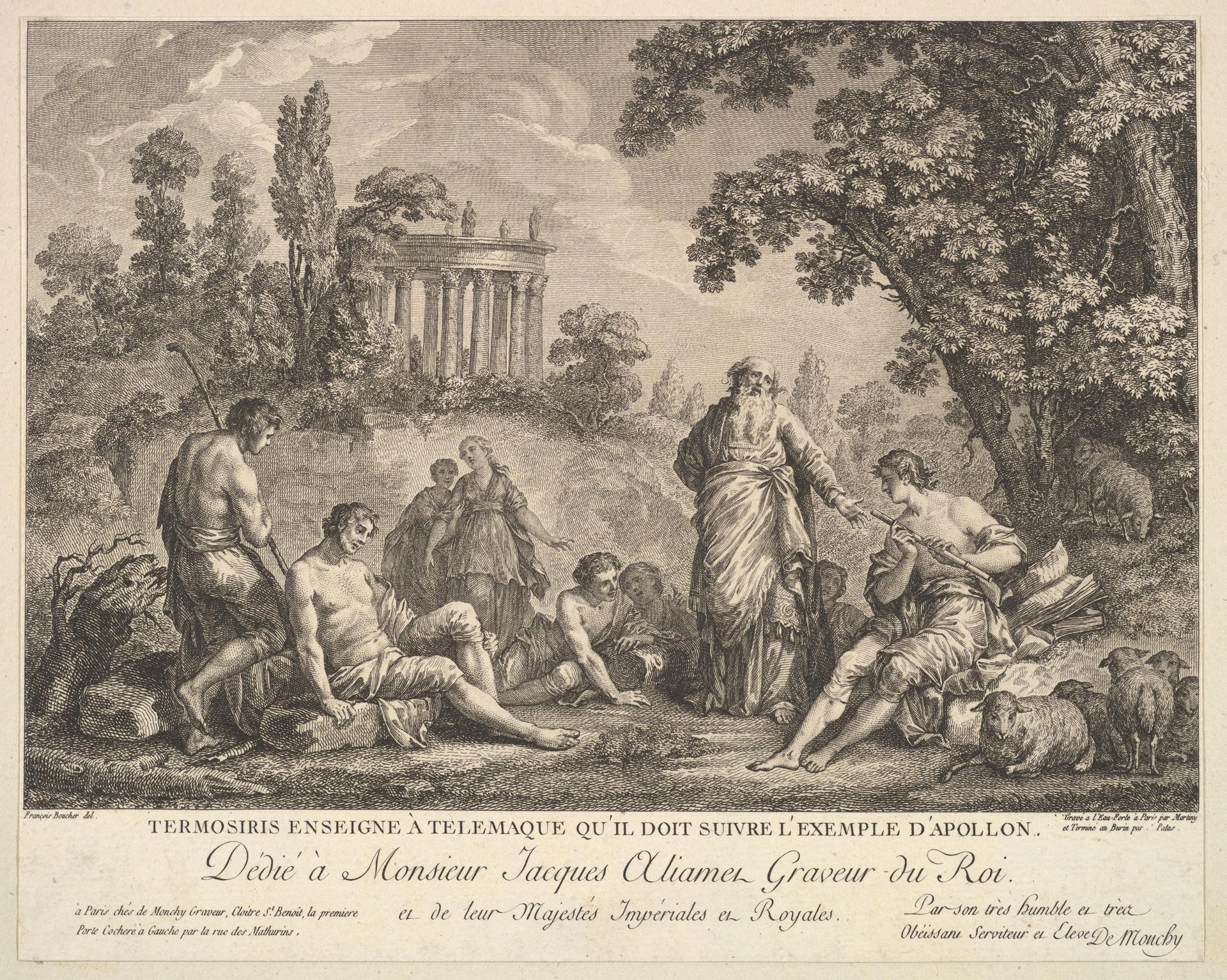
Termosiris Teaching Telemachus to Follow the Example of Apollo
Original title: Termosiris Teaching Telemachus to Follow the Example of Apollo
kurzbeschreibung
Where related prints present a single figure in isolation, Pietro Antonio Martini sets a teaching episode from François Fénelon's Les Aventures de Télémaque against an Arcadian backdrop: the priest Termosiris instructs the young Telemachus to follow the example of Apollo. Telemachus sits on the ground, attentive. This etching with engraving likely dates from the eighteenth century.
Description
Termosiris holds the middle ground, barefoot and wrapped in a long tunic gathered at the hips; his right hand is raised, his left rests on Telemachus's shoulder. The youth sits on the ground in a short, sleeveless tunic, looking up at his teacher. At the rear left stands a woman in a long robe, while two sheep-like animals lie down on the right; an archer watches from the left. A columned temple framed by trees rises behind them. Everything in the layout leads toward the two principal figures, the light falls evenly, and the print's greys give the scene a calm mood.
Context
Made after a design by Charles-Nicolas Cochin the Younger, as the inscription along the lower margin records, the sheet reproduces an episode from Fénelon's novel of 1699, which circulated widely in the eighteenth century. Martini, an Italian engraver, worked mainly in Parma and London and produced reproductive prints after contemporary works. The etching probably served as a book illustration or as a separate sheet for collectors.
Impact
Careful linework and a quiet, symmetrical arrangement lend the scene a dignified, almost instructive tone. The contrast between the gesturing teacher and the seated pupil stresses the intellectual lesson, while the Arcadian landscape evokes an idealized antiquity.
Technique
Etching and engraving are combined here, evident in the fine, precise lines and the detailed rendering of figures and architecture. Working only in line and hatching, the monochrome print builds volume and depth. Trimmed, the sheet measures 18.7 x 23.3 cm and carries a French title inscription along the bottom.
AI-generated description text
Source: Metropolitan Museum of Art · Public Domain (CC0 1.0)