The Blessed Virgin
Original title: The Blessed Virgin
kurzbeschreibung
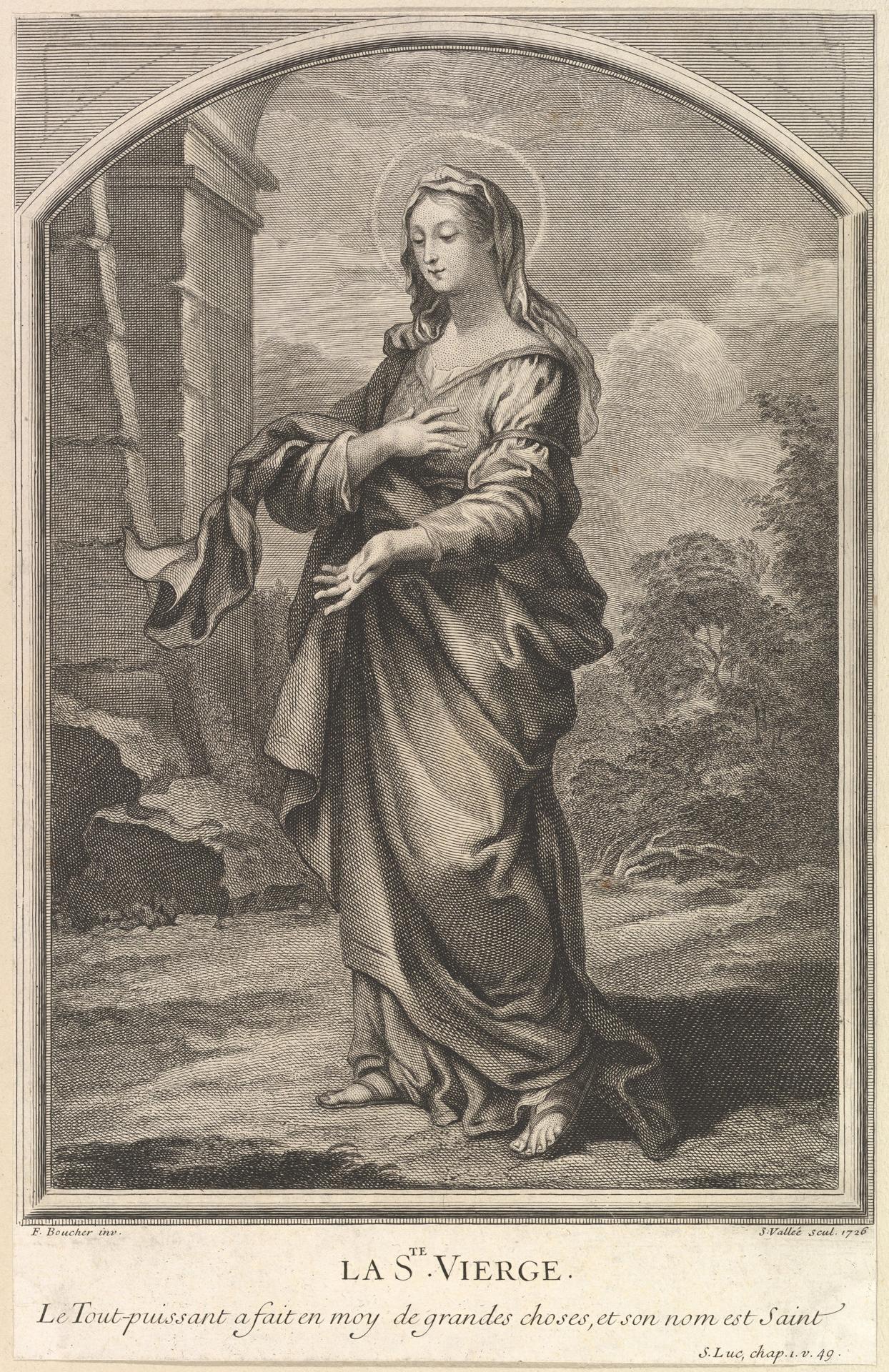
Mary, the Holy Virgin, appears in this 1726 print within a semicircular frame. Simon de la Vallée combined etching and engraving for the motif; trimmed, the print measures 34 × 21.8 cm. Shown is the praying Mary in a landscape, surrounded by symbolic elements.
Description
At the center, within a semicircular frame reminiscent of church architecture, stands the Virgin. A long garment envelops her, and a head covering partly veils her face. Her hands are folded before her breast, her gaze directed upward and expressing reverence or wonder. Trees and a cloud-covered sky form the landscape background. The layout is symmetrical, the light falls diffusely from the front, and the colouring remains monochromatic in shades of grey. At the lower margin of the sheet appear the title 'LA S. VIERGE' and a biblical quotation.
Context
Simon de la Vallée, a French artist of the 18th century, is biographically only sparsely documented. The sheet was created in 1726, in an era when religious printmaking was widespread in France and served private devotion. With folded hands and gaze turned heavenward, Mary follows the Baroque iconography of the 'Madonna in Devotion'. The appended biblical quotation suggests a didactic function. Such prints were often produced in series and used in Bibles or prayer books.
Impact
Devotional and solemn is the effect of the sheet, through the symmetrical arrangement and the calm, inward posture of Mary. Serious and contemplative is the mood conveyed by the monochromatic grey tonality; the diffuse light reinforces this impression. The semicircular frame recalls an altarpiece and thus emphasizes the sacred character.
Technique
Etching and engraving are combined here, allowing fine lines and precise hatching. From this technique arise various shades of grey that serve the plastic modelling of the figure and the depth effect of the background. Presumably the plate was etched several times and then reworked with the burin to bring out details such as the facial features and the landscape.
AI-generated description text
Source: Metropolitan Museum of Art · Public Domain (CC0 1.0)