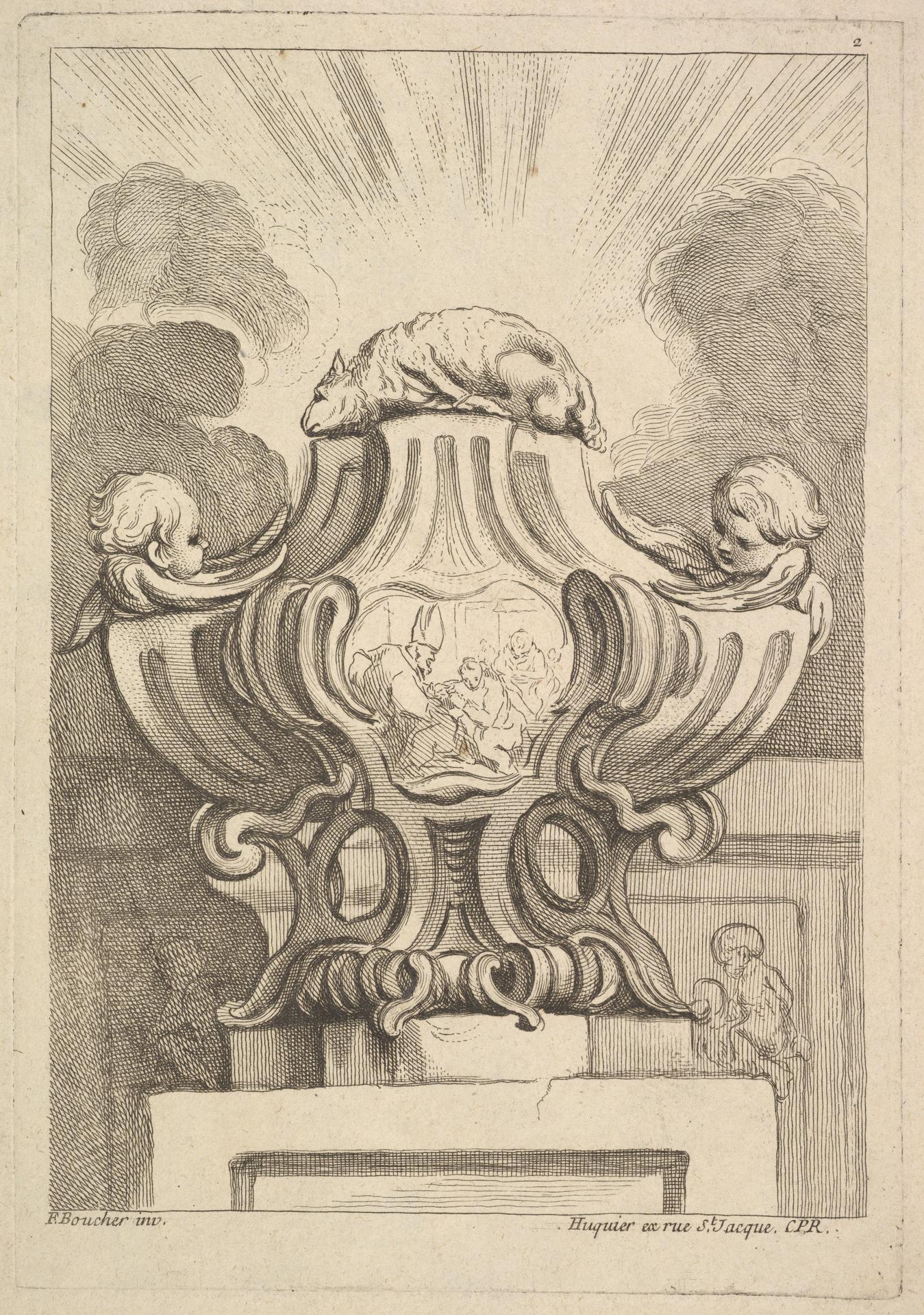
Design for an Urn
Original title: Design for an Urn
kurzbeschreibung
Between 1725 and 1772, Gabriel Huquier etched this design for an urn. The vessel is lavishly ornamented and set between two putti. On its front, a scene with numerous figures unfolds, while a beast crouches atop the lid.
Description
The arrangement is strictly symmetrical, with the urn anchoring the center. Floral and ornamental patterns cover the body, and its front face contains a multi-figure interior scene. Above the urn rises a wolf-like animal. Cloudy patches and rays in the background lend a celestial atmosphere. Lines are drawn with detailed precision, and the image remains monochrome.
Context
Huquier worked in eighteenth-century France as an ornament engraver and publisher, known for his Rococo designs. This print belongs to a series of ornamental etchings that served craftsmen as models. Such designs were often used in making furniture, metalwork, and ceramics. The span 1725–72 matches Huquier's active career.
Impact
The etching combines symmetrical rigor with playful elements characteristic of the Rococo. Floral ornaments, putti, and the celestial lighting give the sheet an elegant yet theatrical presence. The precise linework invites close inspection of the details.
Technique
This etching is an intaglio process in which lines are bitten into a metal plate. The fine, exact lines suggest careful execution. The plate measures 21.3 × 14.8 cm; the print was pulled on larger paper of 35.4 × 25 cm.
AI-generated description text
Source: Metropolitan Museum of Art · Public Domain (CC0 1.0)