The Traveling Children
Original title: The Traveling Children
kurzbeschreibung
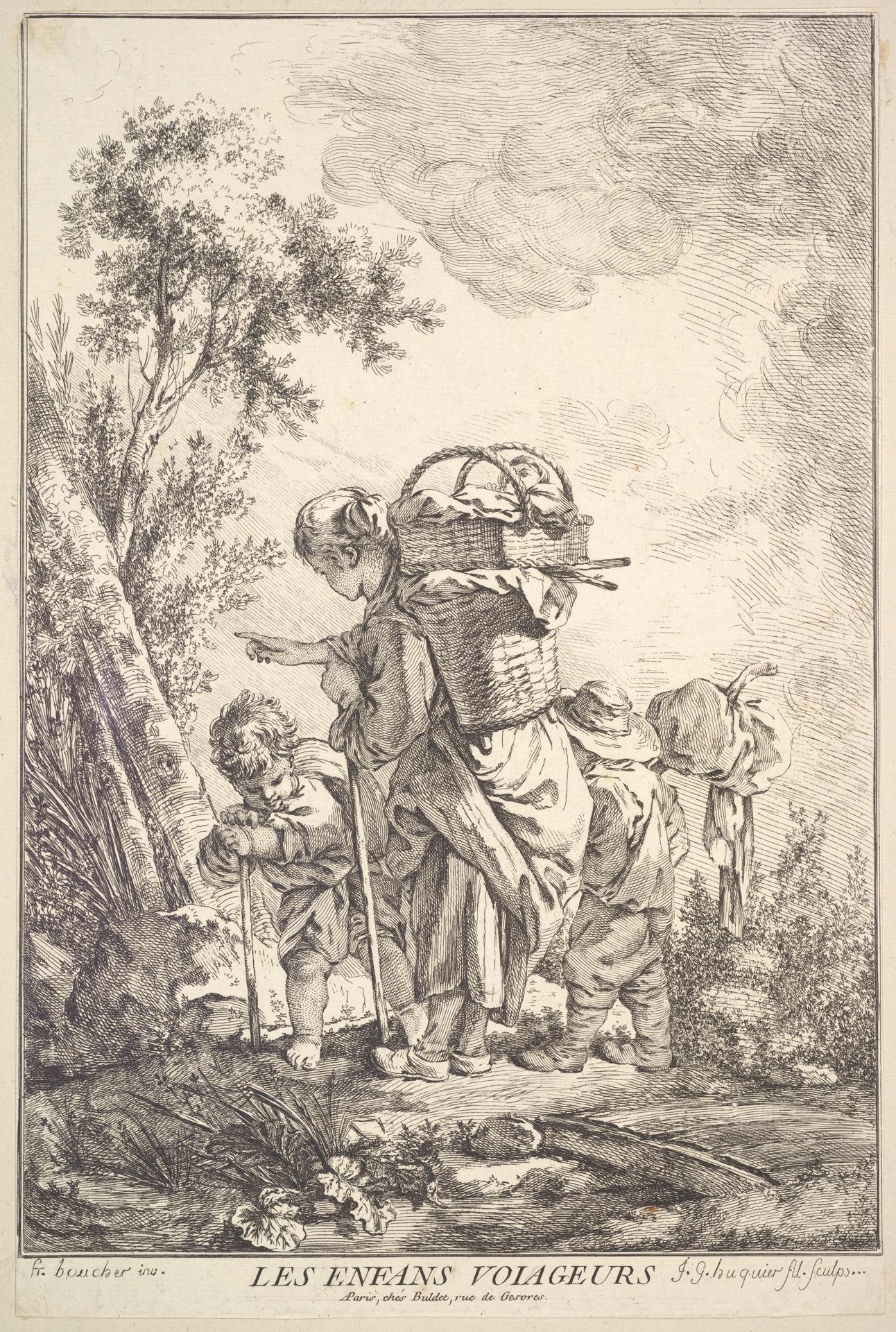
Jacques Gabriel Huquier’s etching “Die reisenden Kinder” captures a group of children on a path through the countryside; the print dates from between the mid and late 18th century. Everyday life is described here with close observation, as was common in the art of those years.
Description
The layout stretches wide, with three children in the foreground: one drags a large basket on his back, a second holds a stick and points ahead, a third stops at the edge of the path with a basket. Trees and shrubs suggest a wooded rural area behind them. Above it all lies a cloudy sky with soft, scattered light that radiates calm. A tree at the left edge frames the image. The view remains monochrome, as is unavoidable in an etching.
Context
Huquier, a French artist of the 18th century, was known primarily for his prints. In that period, scenes of everyday life and travel became more frequent in art. Huquier often worked from designs by other artists, presenting country life in an idealized form. Who commissioned the print or for what occasion it was made is not recorded.
Impact
Because the light is so soft and the surroundings so natural, the print feels quiet and almost idyllic. The children seem to pause in their movement, giving the image a narrative quality. Since everything is in one color, the eye is drawn to details of clothing and baskets.
Technique
The work was produced as an etching, an intaglio process: the drawing is scratched into a metal plate, which is then etched with acid. The lines are fine and precise, clearly bringing out figures and landscape. The sheet was trimmed, as the dimensions of 31.6 × 21.2 cm suggest, indicating later handling.
AI-generated description text
Source: Metropolitan Museum of Art · Public Domain (CC0 1.0)