The Caravan
Original title: The Caravan
kurzbeschreibung
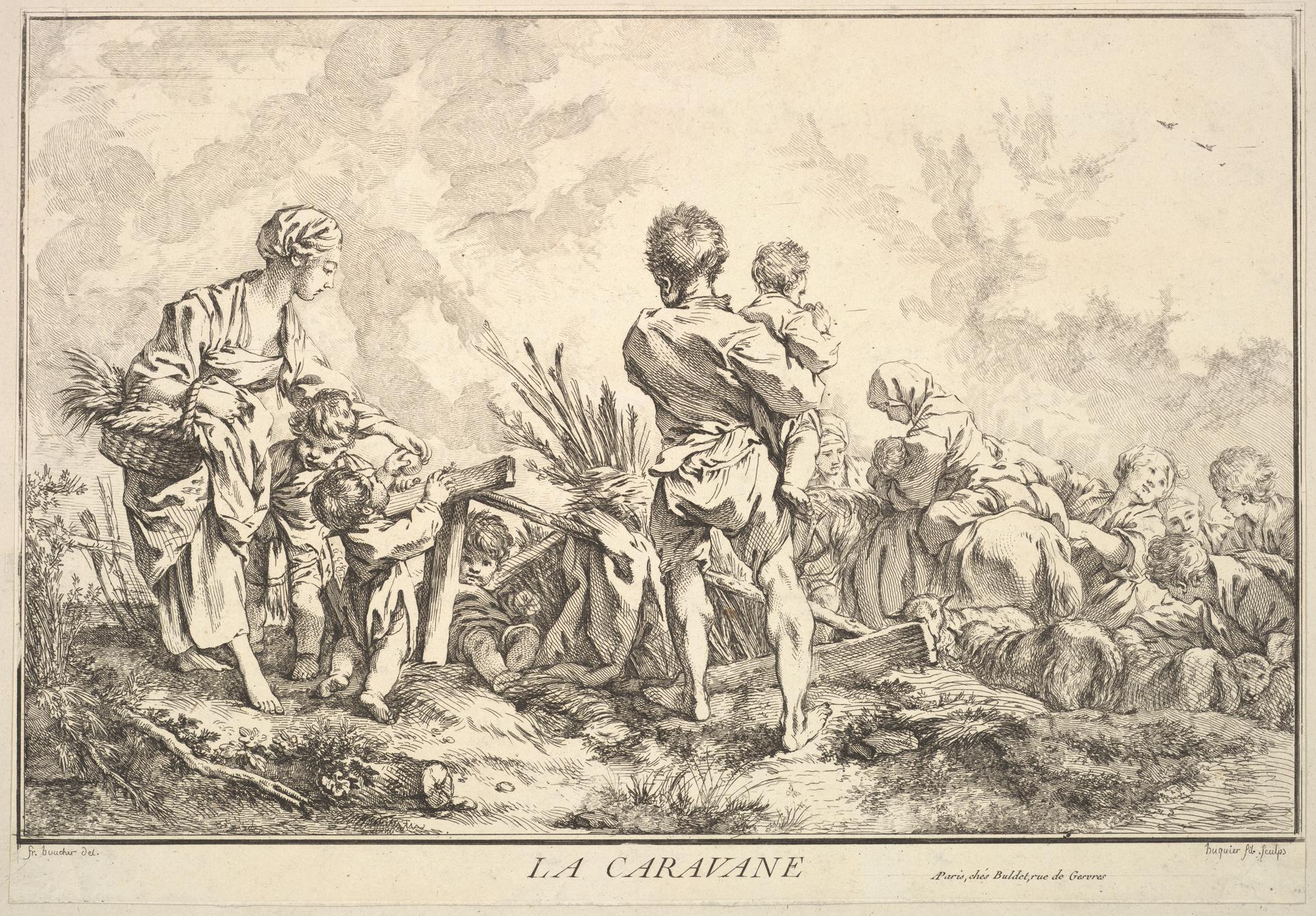
In his etching "Die Karawane," Jacques Gabriel Huquier presents a rural group, dated to the mid to late 18th century. A woman carrying a basket full of ears of grain anchors the foreground; children play around her while other figures move in a loose sequence behind them.
Description
The layout runs horizontally and tilts slightly to the right. Up front, a woman with her basket dominates the image; she turns toward a child while several children sit, lie, or stand on the ground. Behind her, a scattered group of people has gathered. The subject feels everyday and calm, with even light and no harsh shadows. This black-and-white etching relies on detailed linework that brings out the figures and their contact with one another.
Context
The Frenchman Jacques Gabriel Huquier, active in the 18th century, is known for his etchings and ornament prints. This sheet appeared at a time when rural genre scenes were thriving in art. The title "Karawane" may point to travel or market scenes, subjects often taken up in that period. Huquier also worked as a publisher and circulated his prints across Europe.
Impact
The balanced distribution of figures gives the etching a quiet, idyllic feel. Precise linework draws the eye to the interaction between the woman and the children, creating an intimate mood.
Technique
The print was made as an etching, an intaglio process in which the drawing is scratched into a wax layer on a copper plate and then bitten with acid. Fine lines and even lighting match 18th-century printmaking. The sheet has been trimmed to 23.3 × 34 cm.
AI-generated description text
Source: Metropolitan Museum of Art · Public Domain (CC0 1.0)