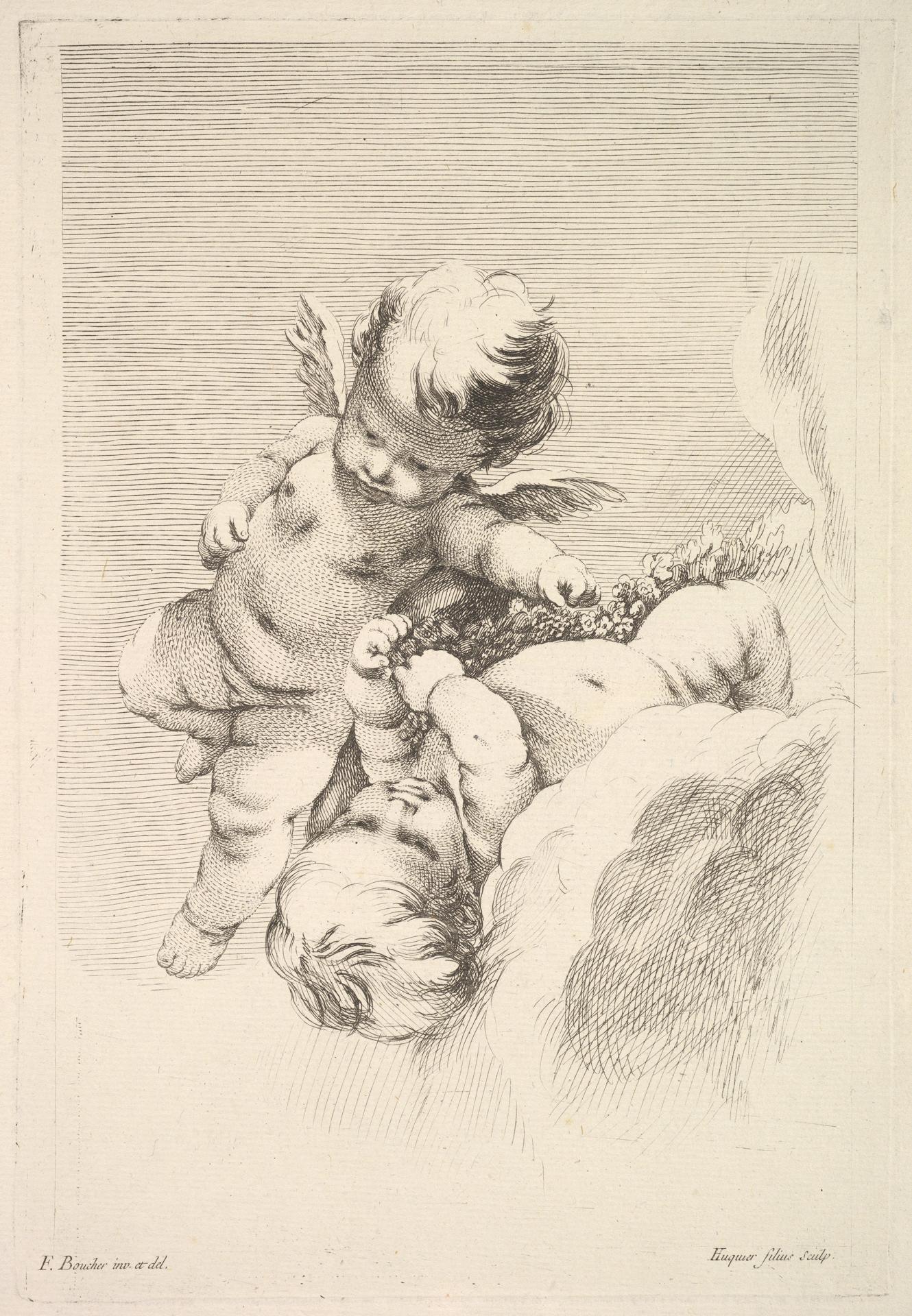
Two Cupids, One Holding a Wreath
Original title: Two Cupids, One Holding a Wreath
kurzbeschreibung
Jacques Gabriel Huquier made this print, "Two Cupids, One Holding a Wreath," between the middle and the end of the 18th century. It presents two winged putti in a playful pose. The etching and engraving, whose plate measures 27.3 × 18.5 cm, belongs to the Metropolitan Museum of Art's collection of prints.
Description
Two naked winged putti fill the sheet: the upper one appears to hover and wears a crown, while the lower one lies on the ground and looks up at him. Both are barefoot and caught in light, shifting poses. Horizontal strokes give the backdrop a plain texture. Everything is printed in a single color, in gray tones modeled into volume by delicate lines and hatching.
Context
Jacques Gabriel Huquier (1730–1805) was a French draftsman and engraver known above all for ornamental prints and reproductive engravings. This work dates from the late Rococo, a period that prized mythological and decorative motifs with cupids. It may have belonged to a series or stood alone as a sheet for print collectors. Etching combined with engraving was widely used in the 18th century for fine graphic work.
Impact
Delicate lines and the putti's playful bearing give the sheet a light, almost dancing grace. Plain as it is, the monochrome print reads as elegant and underlines the graphic quality of its execution. The exchange between the two figures creates an intimate, cheerful mood that draws the viewer into the scene.
Technique
Etching and engraving together produce the fine, partly hatched lines visible here. Etching allows soft, flowing contours, while engraving adds precise detail and firm accents. The single-color effect comes from varying the density and direction of the strokes, which model light and shadow.
AI-generated description text
Source: Metropolitan Museum of Art · Public Domain (CC0 1.0)