Two Cupids, One Holding Torches
Original title: Two Cupids, One Holding Torches
kurzbeschreibung
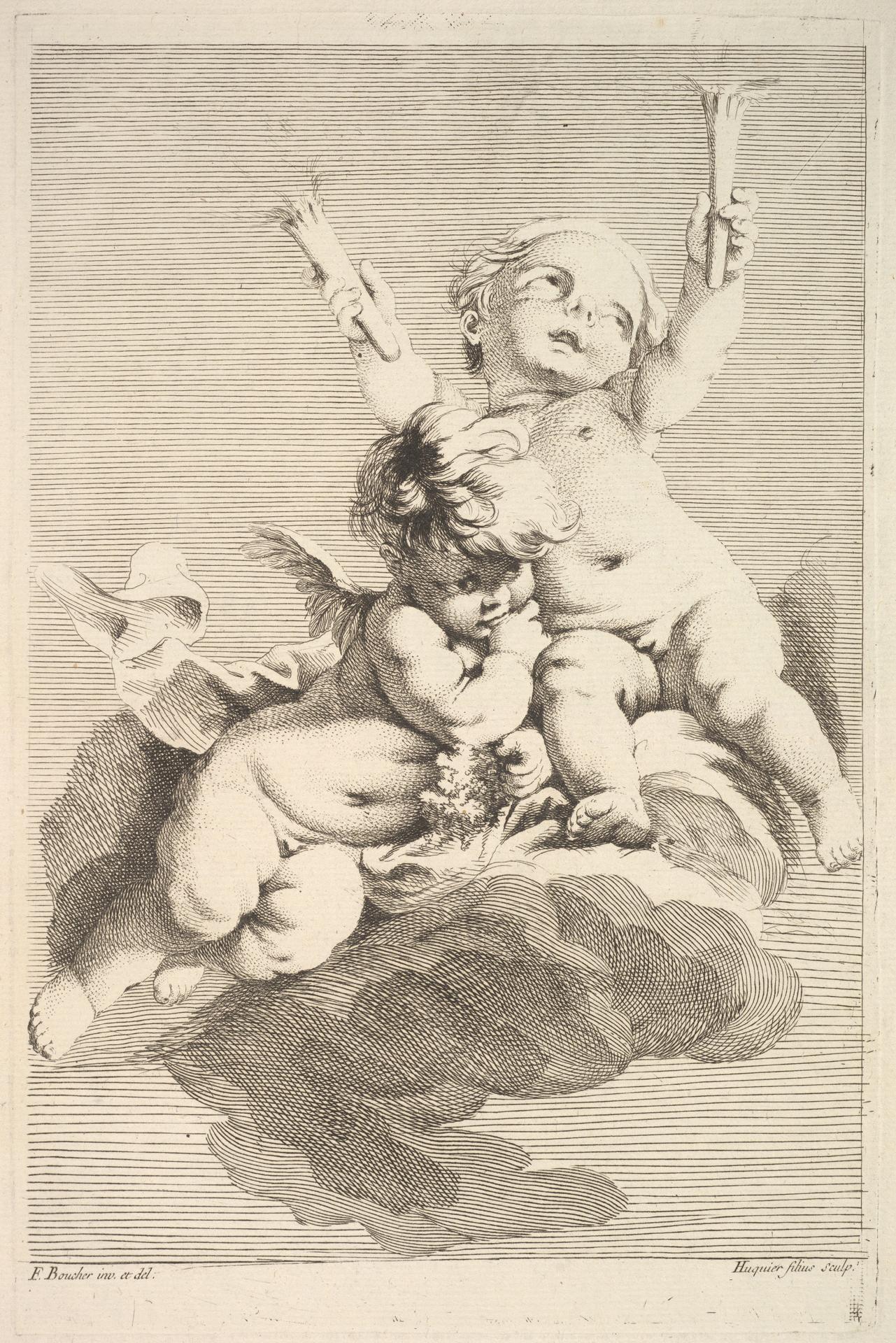
A bundle of arrows raised in the right hand, a single arrowhead in the left: that is one of the two putti in Jacques Gabriel Huquier's print Zwei Amoretten, eine Fackeln haltend, made as an etching and engraving in the second half of the 18th century. His companion holds a flower instead. Both sit on a cloud. Such decorative prints were widespread in the Rococo.
Description
Two naked putti have settled on a cloud. The left figure stretches its right hand upward with a bundle of arrows, while its left grasps a single arrowhead. The right figure holds a flower. Short hair, bare feet, bodies built up with shaded lines. Even hatching fills the background and reveals the etching technique. Black and white, without any color, define the entire sheet.
Context
Huquier (1730–1805) worked as a French copperplate engraver and publisher; he became known above all for reproductive prints after designs by, for example, François Boucher. In the Rococo period, mythological and allegorical scenes with amoretti were highly popular. Prints of this kind served as models for decorations or found their way into collections. Who commissioned the sheet and what purpose it was to serve are not recorded.
Impact
The two putti are paired with each other, the lines remain soft, and so a playful, balanced impression emerges. Because color is absent, the fine shading and delicate details of the bodies stand out clearly. The whole breathes a cheerful lightness, as belongs to the aesthetics of the Rococo.
Technique
Two printing processes come together here. The evenly hatched areas of the background come from etching, the shaded lines of the figures from engraving. Both techniques allowed fine gradations and were often combined in a single sheet in the 18th century. The plate measures 28 × 18.4 cm, the sheet 45.3 × 30.3 cm.
AI-generated description text
Source: Metropolitan Museum of Art · Public Domain (CC0 1.0)