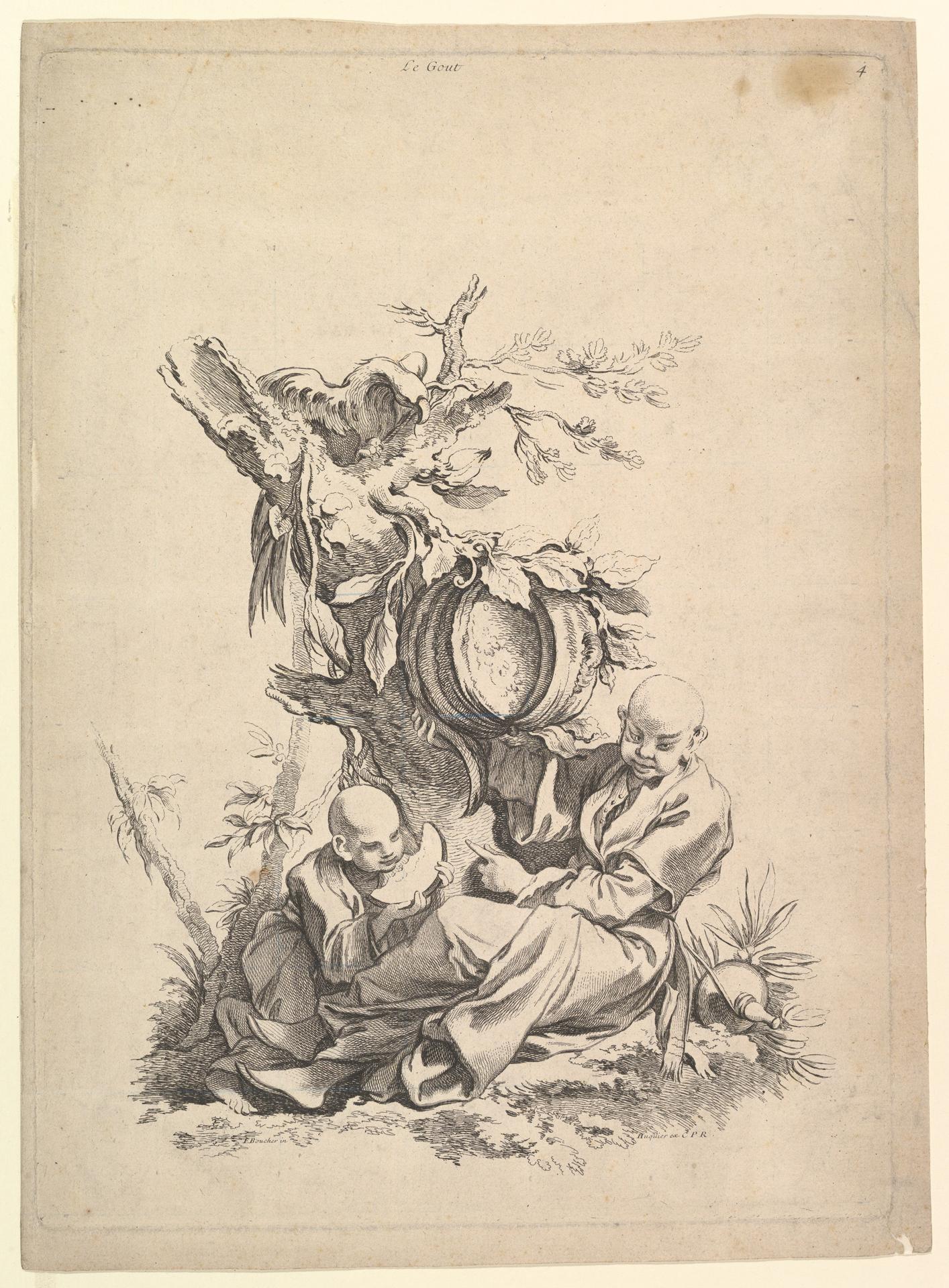
Le Gout
Original title: Taste
kurzbeschreibung
Unlike many contemporary depictions of the sense of taste, this print by Chez Huquier from the 18th century opts for a quiet scene: two figures in Asian-inspired dress sit in a naturalistic landscape, their attention fixed on an oval object attached to a tree trunk. Etching and engraving combine an exotic subject with fine line work.
Description
Two figures face each other, engaged in conversation. Their garments appear traditional and Asian-inspired. Trees, branches, and leaves frame the scene, with a large, stylized tree trunk forming the backdrop. On this trunk rests a large oval object, surrounded by leaves and twigs, drawing the figures' gazes. The ground is covered with grass and plants. The entire view is monochrome, with delicate shadows and clear contours.
Context
Chez Huquier created this print in the 18th century as an etching and engraving. It belongs to a series on the five senses, in which 'Le Gout' allegorically represents the sense of taste. Asian-inspired motifs were widespread in Europe at the time through the Chinoiserie style. Exactly how the work was made is not fully documented.
Impact
The calm arrangement and fine line work create a meditative mood. Figures and nature appear harmonious and exotic, in keeping with Chinoiserie aesthetics. Precise shading gives a sense of volume that draws the viewer into the scene.
Technique
Etching and engraving come together here, allowing for high detail. Etched lines and engraved passages combine to produce fine shading and contours. Careful tool handling is evident, for example, in the precise details of plants and fabrics.
AI-generated description text
Source: Metropolitan Museum of Art · Public Domain (CC0 1.0)