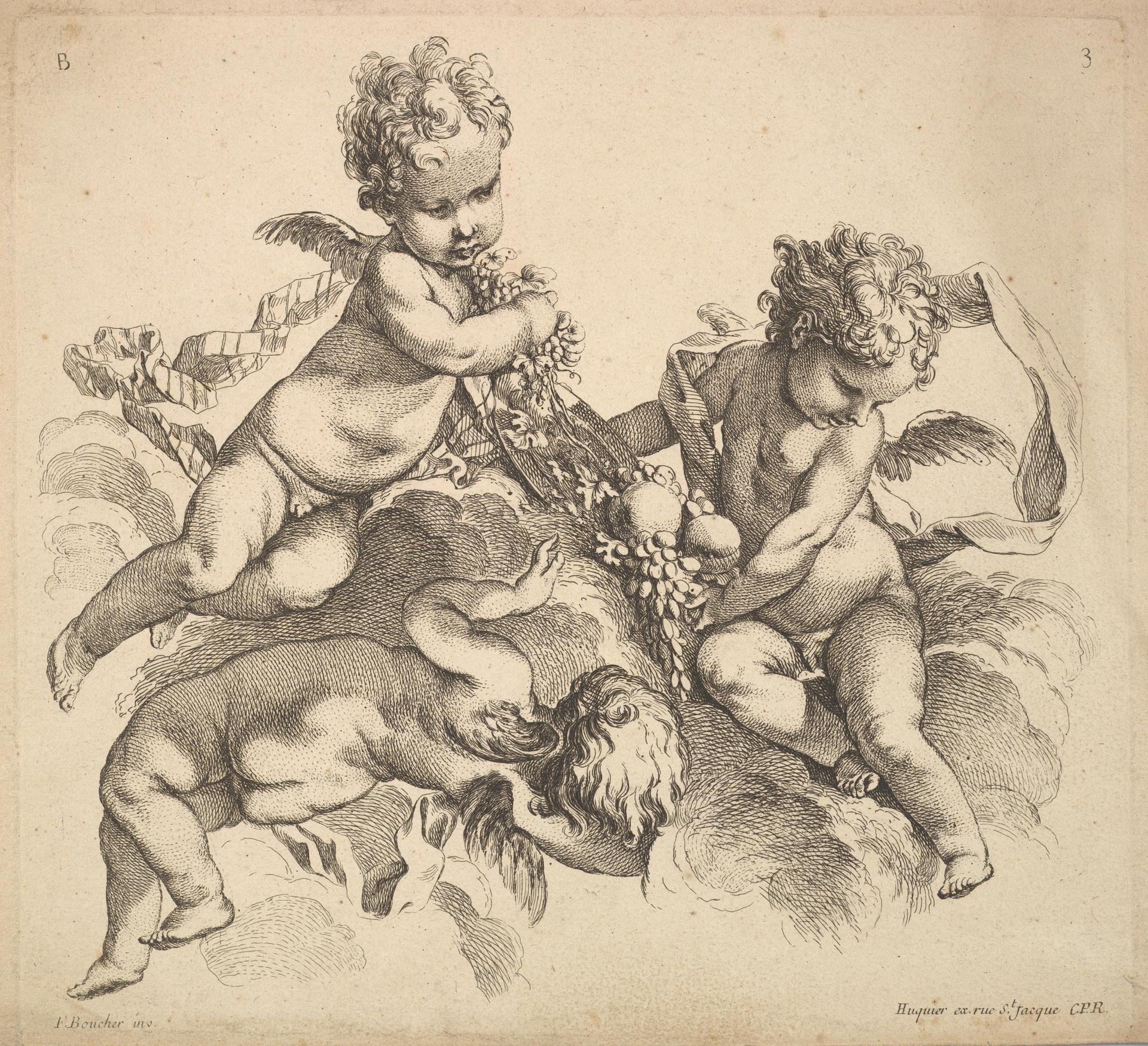
Three Children with a Fruit Plate
Original title: Three Children with a Fruit Plate
kurzbeschreibung
Gabriel Huquier's print Three Children with a Fruit Bowl was made between 1738 and 1745 as an etching with engraving. It pictures two winged, naked putti against a backdrop of clouds. Such motifs belong to the standard repertoire of Baroque printmaking and link childish innocence with a playful mood.
Description
Two naked, curly-haired putti with wings sit on a bed of clouds. The one on the left holds a garland of flowers and fruit, the one on the right carries a single piece of fruit in his hand. At the figures' feet a bearded dog lies resting. The layout is evenly balanced, while the children's poses feel lively and relaxed. The sheet is executed in a single colour with even lighting; delicate lines and hatching divide up the surfaces.
Context
Huquier worked in eighteenth-century France as a printmaker and publisher and became known above all for reproductive engravings and ornamental patterns. This sheet falls in the late Baroque, when prints were widely circulated and made art available to a broader public. Putti and dogs were common pictorial formulas at the time and often stood for innocence and fidelity.
Impact
Calm and liveliness reach the viewer at the same time: the even arrangement of the figures gives the eye a resting point, while their playful poses bring movement into the image. Fine strokes of the burin give an elegant, richly detailed surface that draws the gaze into the cheerful scene.
Technique
Etching and engraving combine here into very precise linework with delicate hatching. This method allows textures and contours to be reproduced in detail, as can be seen in the wings and the dog's fur.
AI-generated description text
Source: Metropolitan Museum of Art · Public Domain (CC0 1.0)