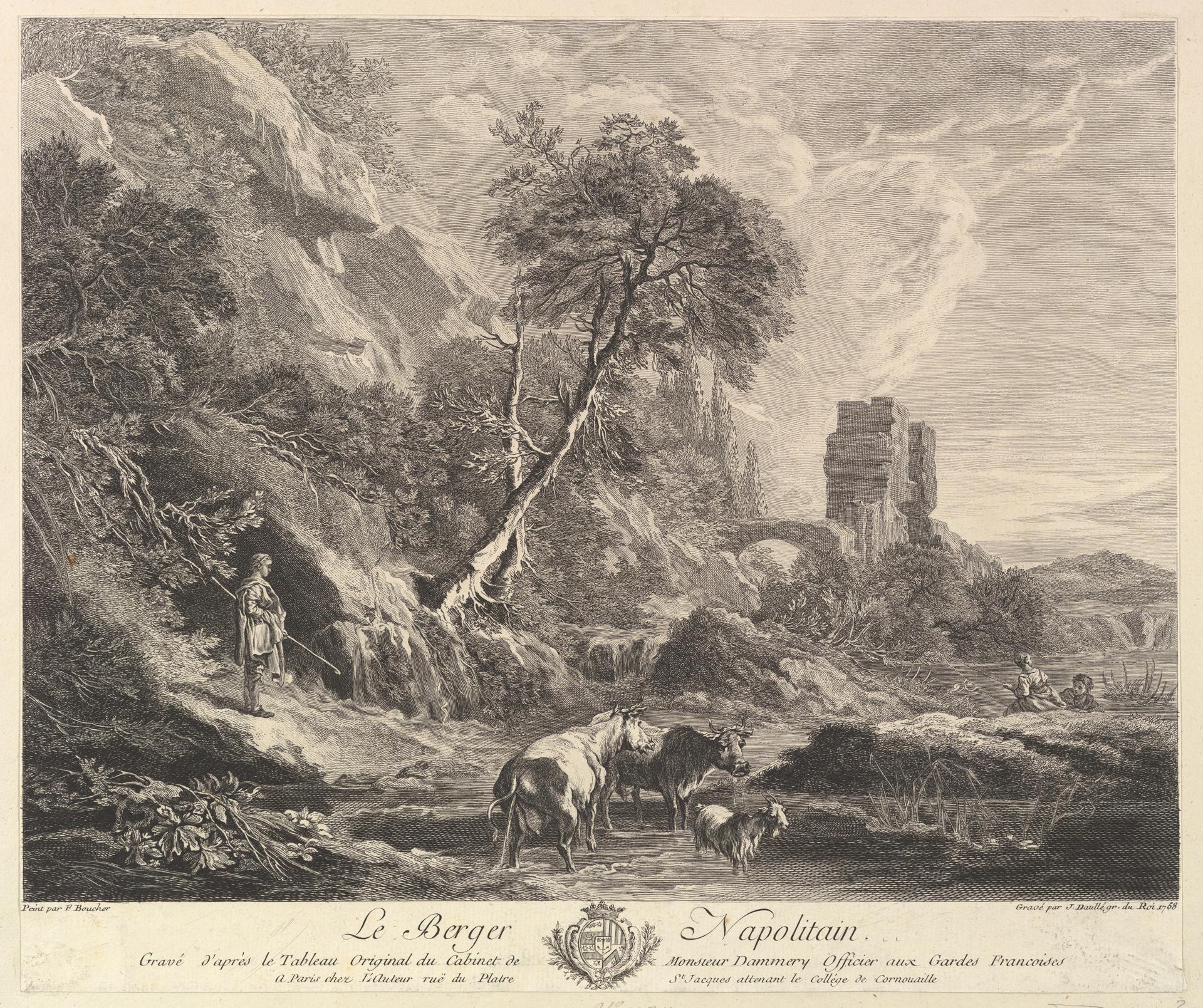
Neapolitan Shepherd
Original title: Neapolitan Shepherd
kurzbeschreibung
Jean Daullé made this print, titled Neapolitanischer Hirte, in 1758. It is an etching and engraving that presents a shepherd with animals in a rural setting. The work belongs to 18th-century French art and pairs graphic precision with a pastoral subject.
Description
A shepherd stands at the left, holding a stick and keeping an eye on his animals. Sheep and goats rest in the middle of the picture by a stream or river, seemingly washing themselves. Mountains, trees and a ruin close off the distance, setting the action within an idyllic landscape. The horizontal layout draws the eye to the man and his flock. The monochrome etching softens the tonal values and reinforces the calm character of the view.
Context
Daullé, an 18th-century French engraver, was known mainly for reproductive prints. He produced this sheet in 1758, at a time when French art was shaped by idyll and closeness to nature. The motif of the shepherd with his herd takes up the pastoral landscape, a theme popular during the Enlightenment.
Impact
The print radiates a peaceful quiet that arises from the muted tones and balanced arrangement. The viewer is transported to a rural idyll that invites a pause.
Technique
Etching and engraving come together here: the etched lines lay down the basic structure, while the burin refines details and provides precise hatching. This creates fine gradations in the rendering of nature and animals. The trimmed sheet measures 30.1 × 35.8 cm.
AI-generated description text
Source: Metropolitan Museum of Art · Public Domain (CC0 1.0)