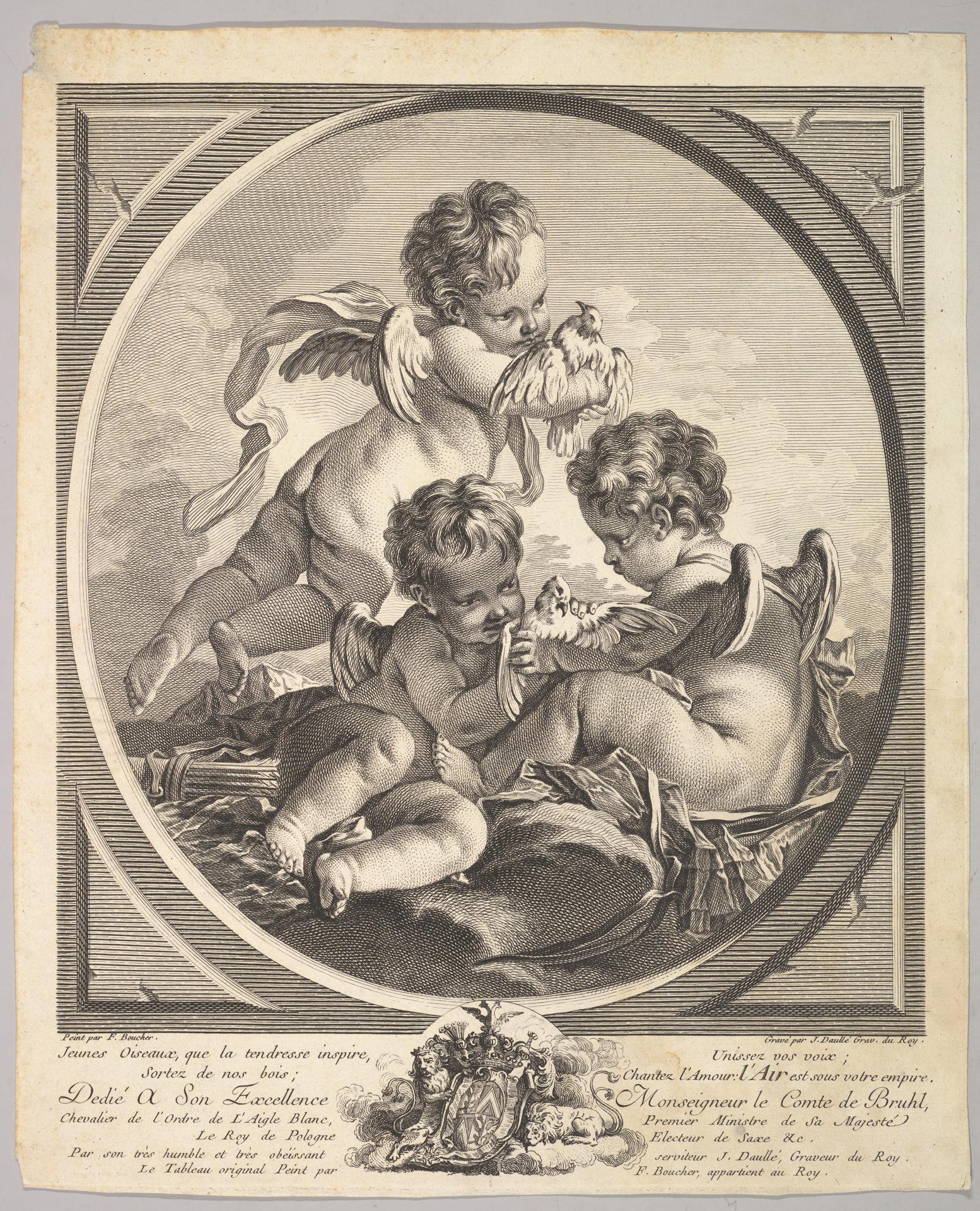
Air (ca. 1748)
Original title: Air
kurzbeschreibung
This copperplate print by Jean Daullé, made around 1748, gathers three putti within a circular field. Executed in etching and engraving, the sheet belongs to the collection of the Metropolitan Museum of Art.
Description
Three naked winged putti fill the image; two hold birds in their hands, while the third has settled on a cushion. The figures are modeled realistically with finely graded shading that gives flesh and fabric a sculptural presence. Clouds and a patch of sky behind them lend the view a floating quality. A round frame encloses the motif, with a coat of arms and text below. Tonal values remain confined to grays, as is usual for prints.
Context
In eighteenth-century France, Daullé ranked among the engravers known chiefly for reproductive prints. This sheet fits the fashion around 1748 for allegorizing the four elements. Birds and putti as emblems of air accord with the pictorial tradition of the time. Whether the work formed part of a series or was made independently for the art market cannot be determined with certainty.
Impact
The circular layout, together with the soft shading, gives the sheet a buoyancy that suits the theme of air. Delicate details in the putti and birds add an elegant, playful touch and draw the eye into the airy scene.
Technique
Etching and engraving work together here, allowing both fine lines and precise hatching. Light and shadow can thus be rendered with nuance, lending the figures physical presence. The paper, trimmed to 32 × 26.3 cm, suggests the original plate size.
AI-generated description text
Source: Metropolitan Museum of Art · Public Domain (CC0 1.0)