Water (ca. 1748)
Original title: Water
kurzbeschreibung
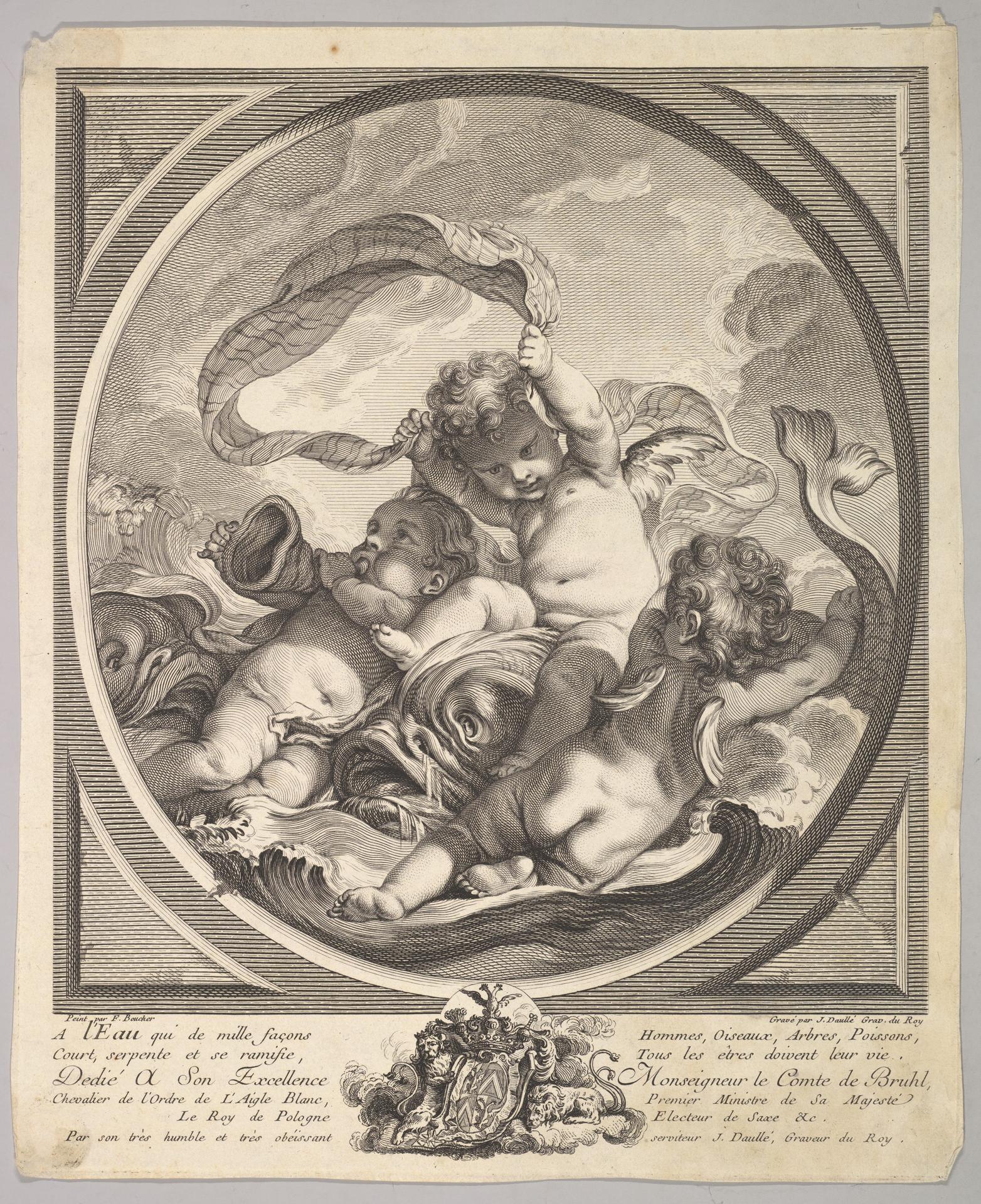
Three putti romp on a wave – Jean Daullé captured this motif around 1748 in etching and engraving. The sheet measures 32.4 × 26.7 cm and belongs to the Baroque and Rococo period.
Description
Two of the putti have settled on a carefully worked wave, while the third stands above and lets a ribbon flutter, snaking toward the sky. The figures' bodies are classically formed and caught in flowing movement. Behind them, clouds and a suggested sky structure remain more restrained. A coat of arms with Latin inscriptions sits at the lower edge, referring to the engraver and possibly to a patron. The whole remains black and white; brightness arises solely through hatching and line patterns.
Context
Daullé worked as a copper engraver in 18th-century France and made a name for himself primarily with reproductive prints. This sheet was created around 1748, when Rococo set the tone there. Putti as embodiments of the elements were a common pictorial motif at the time. The inscriptions at the bottom fit the graphic practice of those years, in which dedications and references to commissioners were customary.
Impact
The putti exude a dance-like lightness that gives the sheet something cheerful and playful. Clear lines and a balanced composition ensure an elegant, decorative effect characteristic of the Rococo.
Technique
Etching and engraving interlock here; together they allow fine lines and precisely graded shadows. Waves and figures can thus be rendered in detail, and the lighting effect arises from the varying strength and density of the strokes.
AI-generated description text
Source: Metropolitan Museum of Art · Public Domain (CC0 1.0)