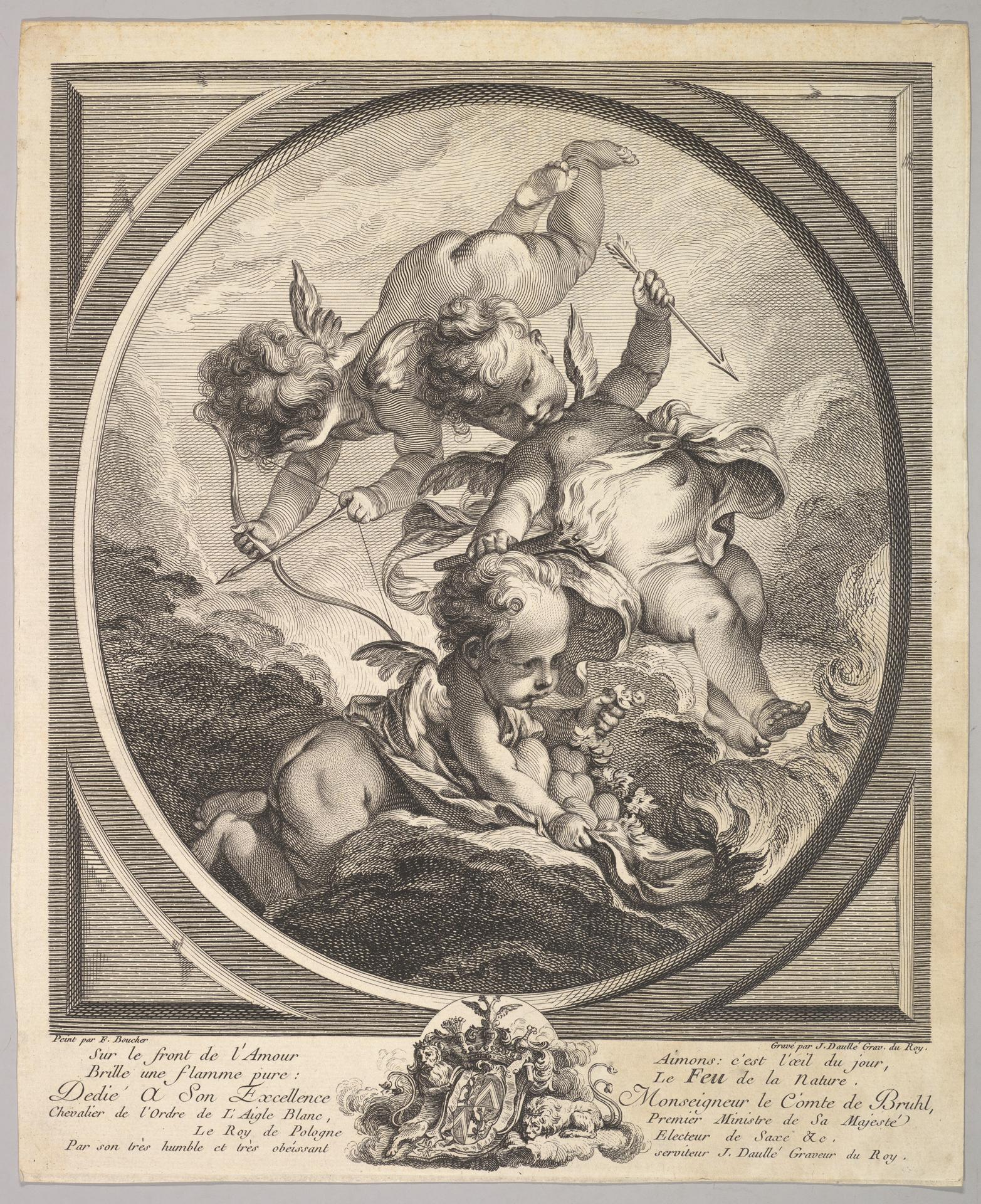
Fire (ca. 1748)
Original title: Fire
kurzbeschreibung
This print titled "Feuer" (Fire) by Jean Daullé, made around 1748, combines etching and engraving. Three putti frolic within a circular frame, wielding an arrow, a bow, and a flower; behind them, clouds and a mountain suggest the setting. The lower edge features a coat of arms with a crown and eagle, accompanied by French text.
Description
Three putti fill the circular image field, arranged in lively, playful poses. One putto in the middle holds an arrow and bowstring, another on the left grasps an arrow, and one on the right holds a flower, gazing downward. Clouds and a mountain motif form the backdrop; below, a coat of arms with a crown and eagle appears. The layout is symmetrical, with the figures centered. The palette remains monochrome in shades of gray, created by lines and hatching, and the light appears evenly distributed.
Context
Jean Daullé (1703–1763) was a French engraver known for his reproductions after paintings. The print "Feuer" was made around 1748, when printmaking held great artistic and commercial importance in France. It may belong to a series of the four elements, a common theme in the Baroque era. The coat of arms with eagle and crown suggests an aristocratic patron who valued such prints as representative artworks.
Impact
The scene feels playful and elegant, entirely in the Rococo taste. The symmetrical arrangement and delicate linework create a calm, balanced aesthetic. The monochrome gray tones emphasize the drawing's precision and the ornamental character of the print.
Technique
Etching and engraving are combined here, allowing for fine and detailed linework. The gray tones are produced by various hatching patterns incised into the metal plate. The print was made on paper; the sheet is trimmed to 32.5 × 26.4 cm.
AI-generated description text
Source: Metropolitan Museum of Art · Public Domain (CC0 1.0)