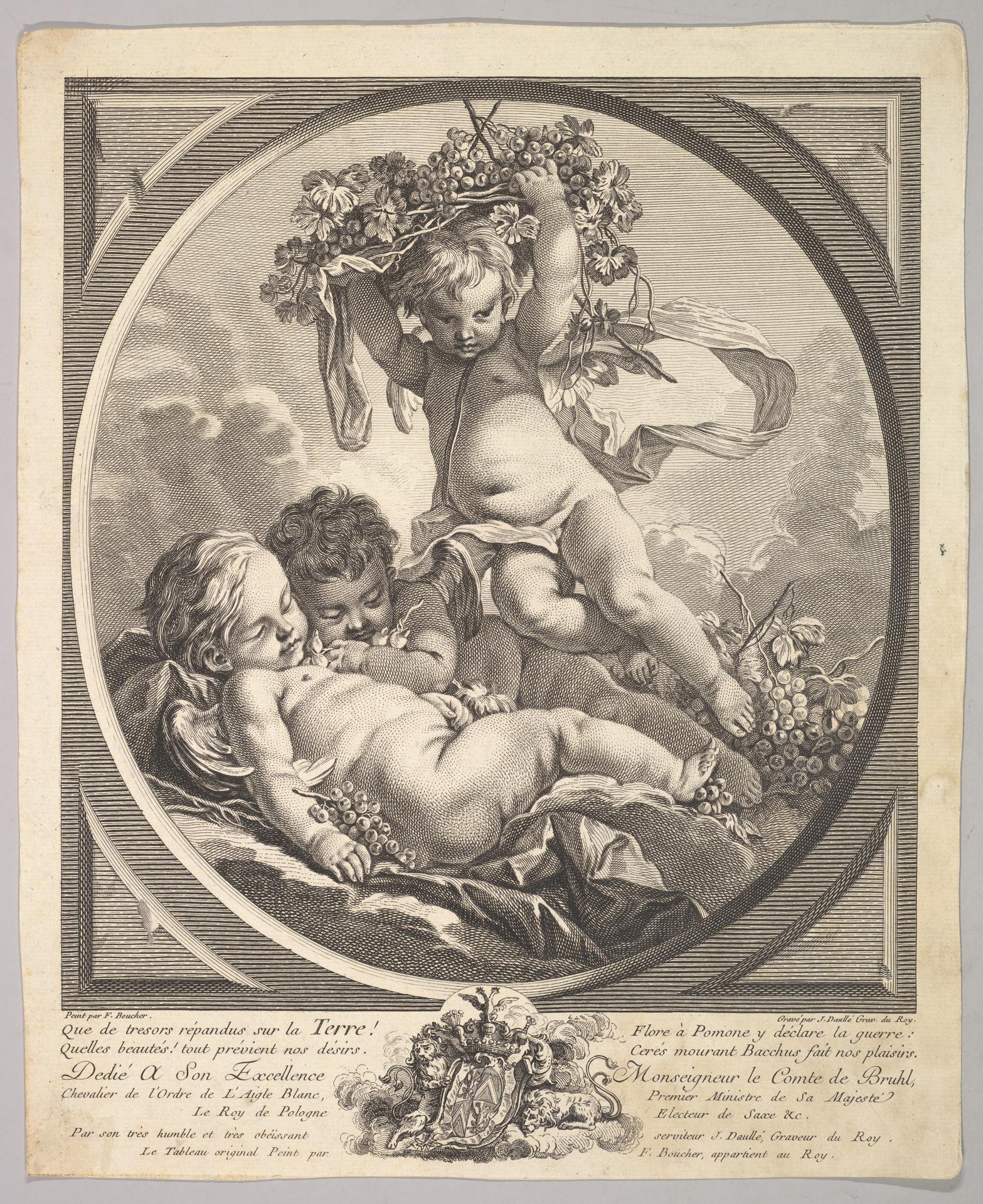
Earth (ca. 1748)
Original title: Earth
kurzbeschreibung
Jean Daullé's etching Erde dates from around 1748. Three putti fill the circular image field: two recline along the lower edge, while a third stands higher up, carrying a jug of flowers. The sheet probably belongs to a series on the four elements.
Description
The layout feels balanced: the standing putto provides a calm anchor, with the other two placed below. Clouds behind the scene give it spatial depth. Fine, dense hatching models the etching's grey tones. At the bottom edge appear a coat of arms with an eagle and crown, and a text panel with dedications.
Context
Jean Daullé, an 18th-century French copperplate engraver, was known mainly for reproductive prints. The sheet was made around 1748, when allegorical depictions of the elements were widespread in art. The dedication at the bottom suggests a patron or sponsor.
Impact
The putti convey a cheerful, playful mood, supported by the balanced arrangement and the cloudy backdrop. The etching's delicate linear structure gives the print an airy texture and draws the eye into the allegorical scene.
Technique
In etching, lines are bitten into a metal plate with acid, allowing fine and precise strokes—used here for the detailed rendering of the putti and clouds. This impression has been trimmed, which points to later framing or mounting.
AI-generated description text
Source: Metropolitan Museum of Art · Public Domain (CC0 1.0)