Summer (1735–86)
Original title: Summer
kurzbeschreibung
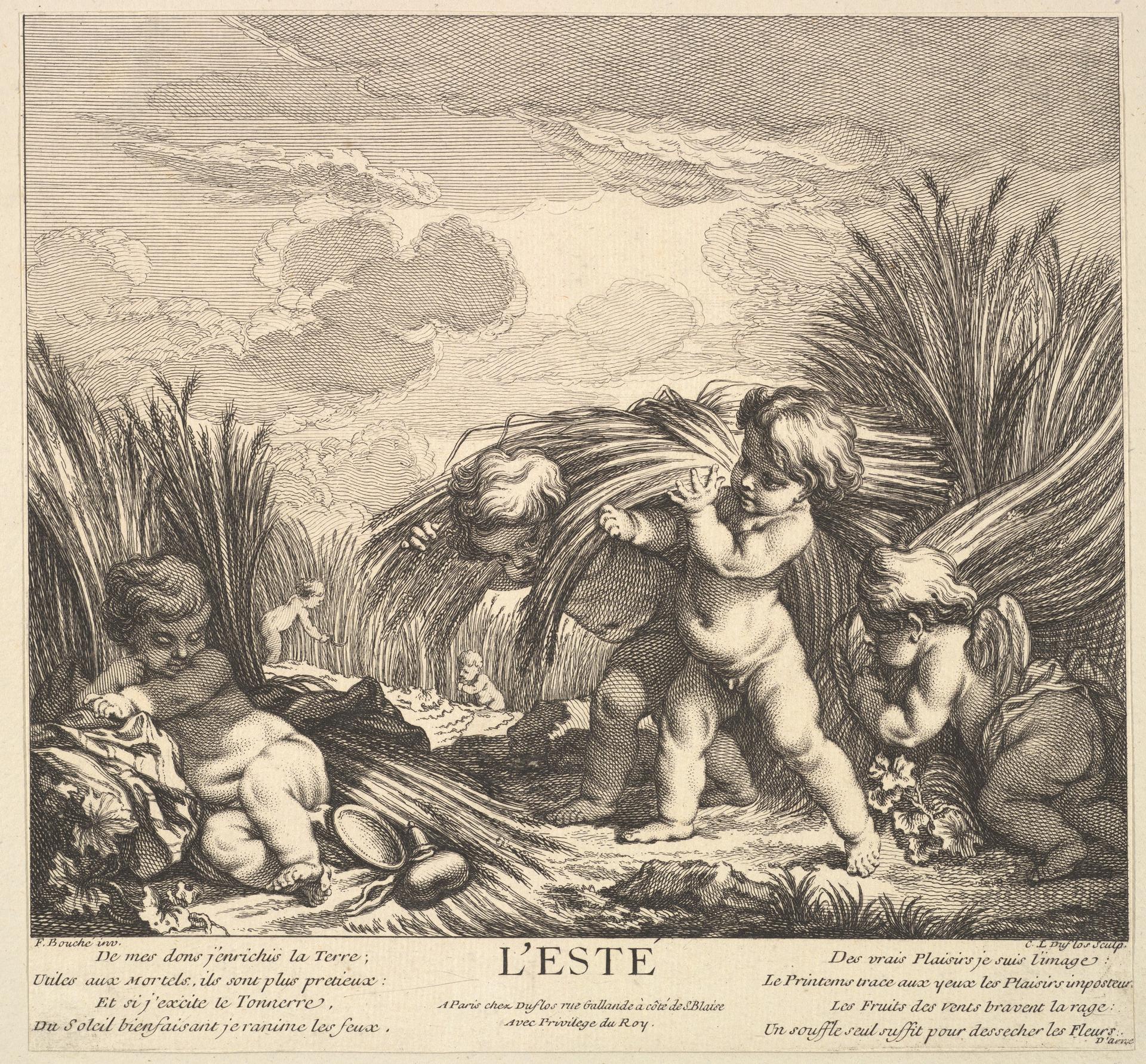
Unlike related prints of the seasons, this etching by Claude Augustin Duflos le Jeune presents summer not as a harvest thanksgiving but as an intimate scene of field work with putti. Made between 1735 and 1786, the work combines etching and engraving and belongs to a series depicting the four seasons.
Description
Several naked putti move barefoot across the field, gathering or bundling ears of grain; tall stalks frame them and evoke summertime. To the side, further figures can be seen working in the distance, beneath a cloudy sky. The layout feels balanced: the putti form the centre, while the other figures are distributed along the edges. Greys and whites dominate the monochrome sheet, with light spread evenly across the scene.
Context
The Frenchman Claude Augustin Duflos le Jeune worked as a copperplate engraver in the 18th century, producing mainly fine reproductive prints. This sheet was likely made as part of a series of allegories of the seasons, as were prized in the Rococo and Neoclassical periods. The combination of putti and rural motif draws on the bucolic tradition widespread in French art of that era.
Impact
An idyllic, cheerful mood emanates from the print, carried by the innocent putti and the rural setting. The balanced arrangement and precise linework create a calm aesthetic that invites lingering.
Technique
Etching and engraving are combined here; the fine lines and hatching produce graduated greys and give the motif depth. The sheet was printed on paper and has been trimmed to 23 × 24.4 cm.
AI-generated description text
Source: Metropolitan Museum of Art · Public Domain (CC0 1.0)