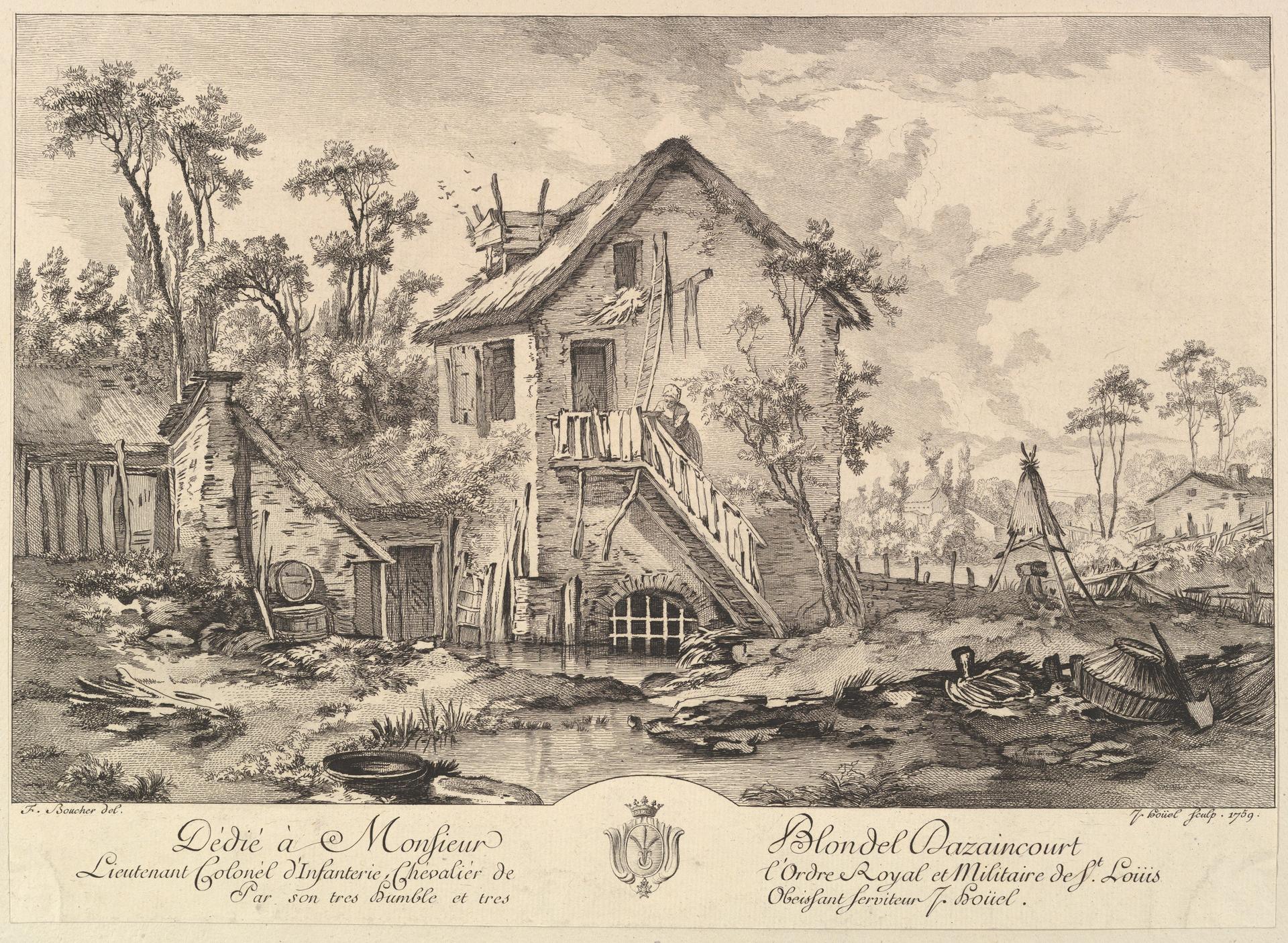
Landscape (1759, Met-Objekt 6358)
Original title: Landscape
kurzbeschreibung
Jean Pierre Louis Laurent Hoüel created the etching Landschaft in 1759, showing a desolate rural view with a dilapidated house, trees, and a tent. The sheet measures 25.5 × 36.4 cm and is executed in the etching technique.
Description
A ruined house with a steep roof dominates the foreground; a staircase leads up to a balcony. To its left lies a small well, while to the right stand woodpiles and a tent. Further trees and a seemingly abandoned building appear under a cloudy sky. The layout is asymmetrical, with the house as the focal point surrounded by nature. Gray tones create depth and texture; the lines are detailed and emphasize structures.
Context
Jean Pierre Louis Laurent Hoüel (1735–1813) was a French painter and printmaker known for his landscapes. The etching was made in 1759, when the artist was working in Paris. Such landscape etchings were popular in the 18th century and often served as reproductions or independent artworks. The motif of the abandoned house reflects the contemporary idea of picturesque ruin romanticism.
Impact
The cloudy sky and dilapidated buildings give the etching a gloomy and melancholic mood. The delicate lines and monochrome palette create a calm, contemplative atmosphere. The viewer is drawn into a silent, deserted landscape.
Technique
The etching is an intaglio process in which the drawing is scratched into a wax layer on a metal plate and then etched. The lines are fine and differentiated, with hatching for shading. The prints were made on paper, and the sheet was trimmed.
AI-generated description text
Source: Metropolitan Museum of Art · Public Domain (CC0 1.0)