The Soap Bubble
Original title: The Soap Bubble
kurzbeschreibung
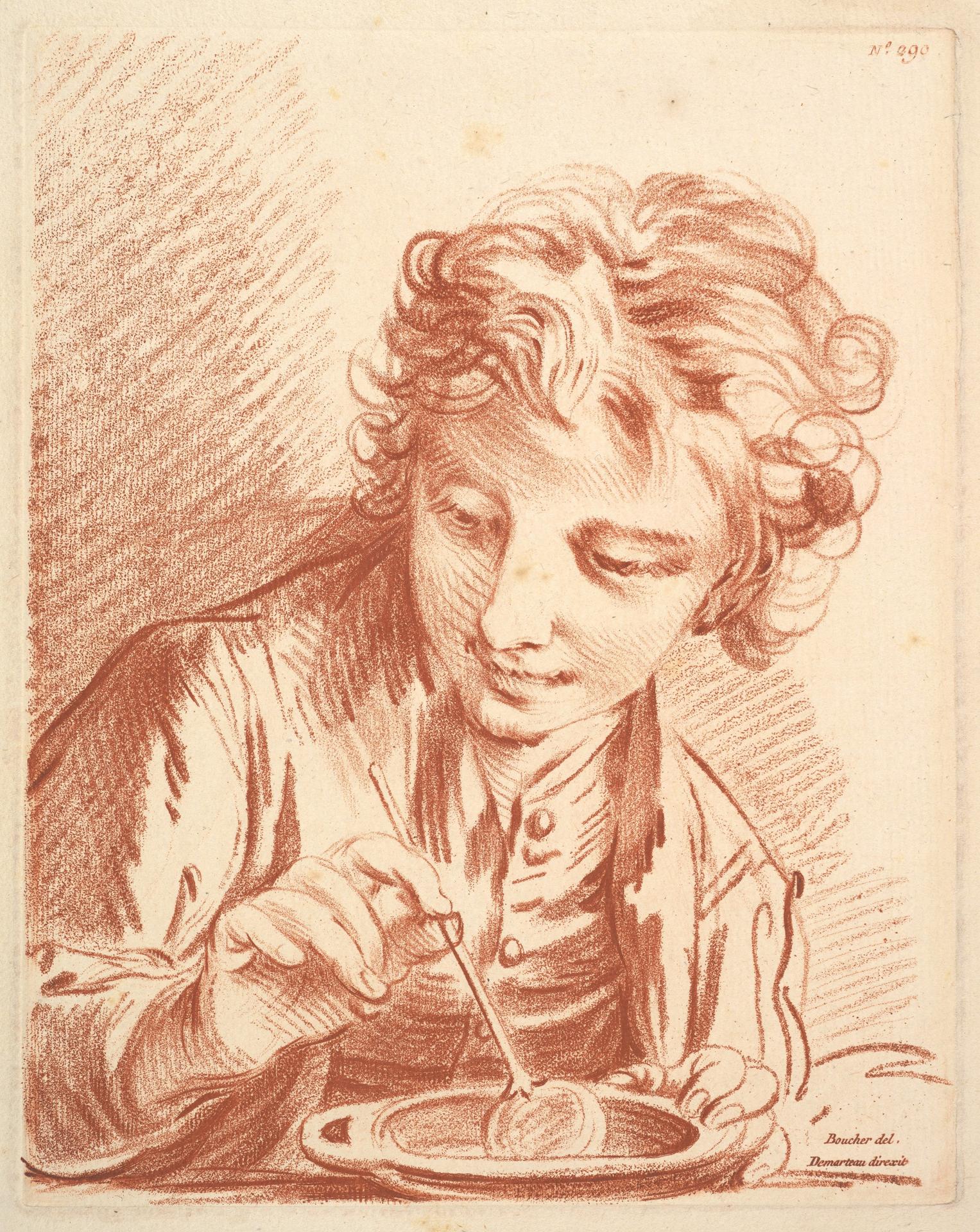
Gilles Demarteau produced the engraving Die Seifenblase at some point between 1756 and 1776. It pictures a young man leaning over a bowl, a spoon in his hand. The image was executed as a crayon manner engraving printed in brown ink.
Description
A young man with curly hair, wearing a buttoned shirt and a jacket, bends forward over a bowl. He holds a spoon as though about to eat from it or to inspect its contents more closely. Upright strokes behind him suggest a wall or a similar surface. Drawn in a realistic manner and kept mostly in shades of brown, the sheet carries a signature in the lower right that points to the artist.
Context
The Frenchman Gilles Demarteau worked as a copperplate engraver in the eighteenth century and became known for his crayon manner technique, with which he imitated chalk drawings. This sheet dates from the Rococo period, when genre scenes and everyday subjects were held in high regard. A work by Jean-Baptiste Huet or another artist of the time probably served as the model.
Impact
The brown ink and the chalk-like handling of line give the sheet a warm, familiar mood. The young man comes across as relaxed and ordinary, which draws the viewer close to what is happening.
Technique
This sheet is a crayon manner engraving, a process that mimics the look of a chalk drawing on paper. It was printed in brown ink reminiscent of sepia or red chalk. The plate measures 23.5 × 18.7 cm; the sheet format is larger.
AI-generated description text
Source: Metropolitan Museum of Art · Public Domain (CC0 1.0)