Leapfrog
Original title: Leapfrog
kurzbeschreibung
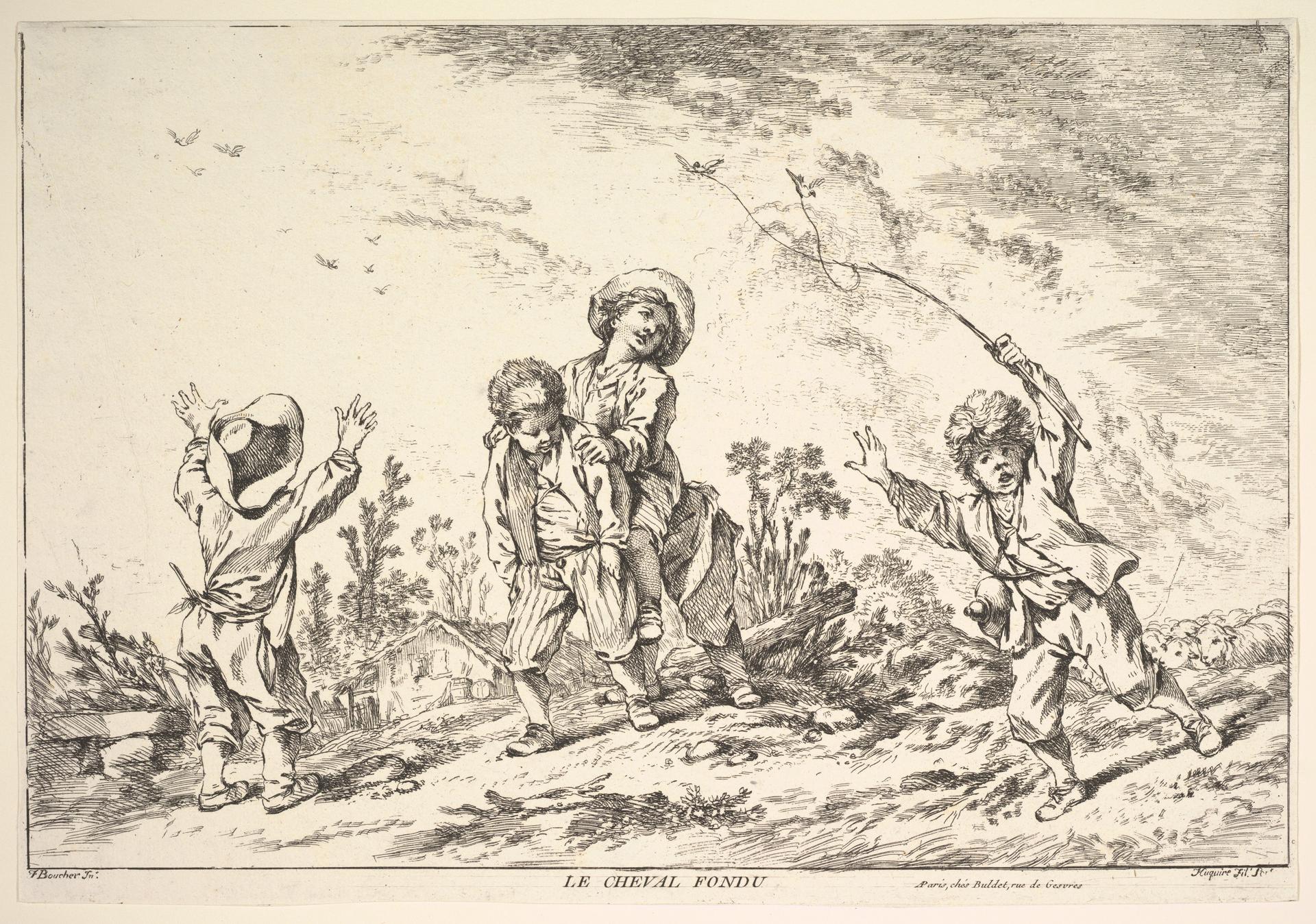
Jacques Gabriel Huquier's etching Bockspringen, made between the mid and late 18th century, captures four children absorbed in a rural game. The graphic technique conveys the momentum and high spirits of the youthful scene.
Description
Two children in the foreground are caught mid-leap, their postures full of motion. A third stands slightly apart, watching with raised arms. Another holds a stick or string pointing straight up. Trees, a small building and a sky with drifting clouds and birds form the rural backdrop.
Context
The Frenchman Jacques Gabriel Huquier worked in the 18th century as an artist and printmaker, producing etchings after his own designs and those of others. Children's games and country-life scenes were widely popular in this period and were seen as expressions of carefree pleasure and pastoral idyll. Such prints were often included in collections of graphic art and reached a broad audience.
Impact
The eye goes at once to the leaping children, whose movement carries over to the viewer. Lines of varying fineness distinguish the figures from the calmer landscape, creating a tension between energy and ease. The print radiates lightness and vivacity without becoming restless.
Technique
For this etching, lines were bitten into a metal plate that had first been coated with an acid-resistant ground. Varying stroke thickness produces depth and texture, as is typical of the process. The black-and-white rendering underlines the graphic clarity of the motif.
AI-generated description text
Source: Metropolitan Museum of Art · Public Domain (CC0 1.0)