Glass Blower
Original title: Glass Blower
kurzbeschreibung
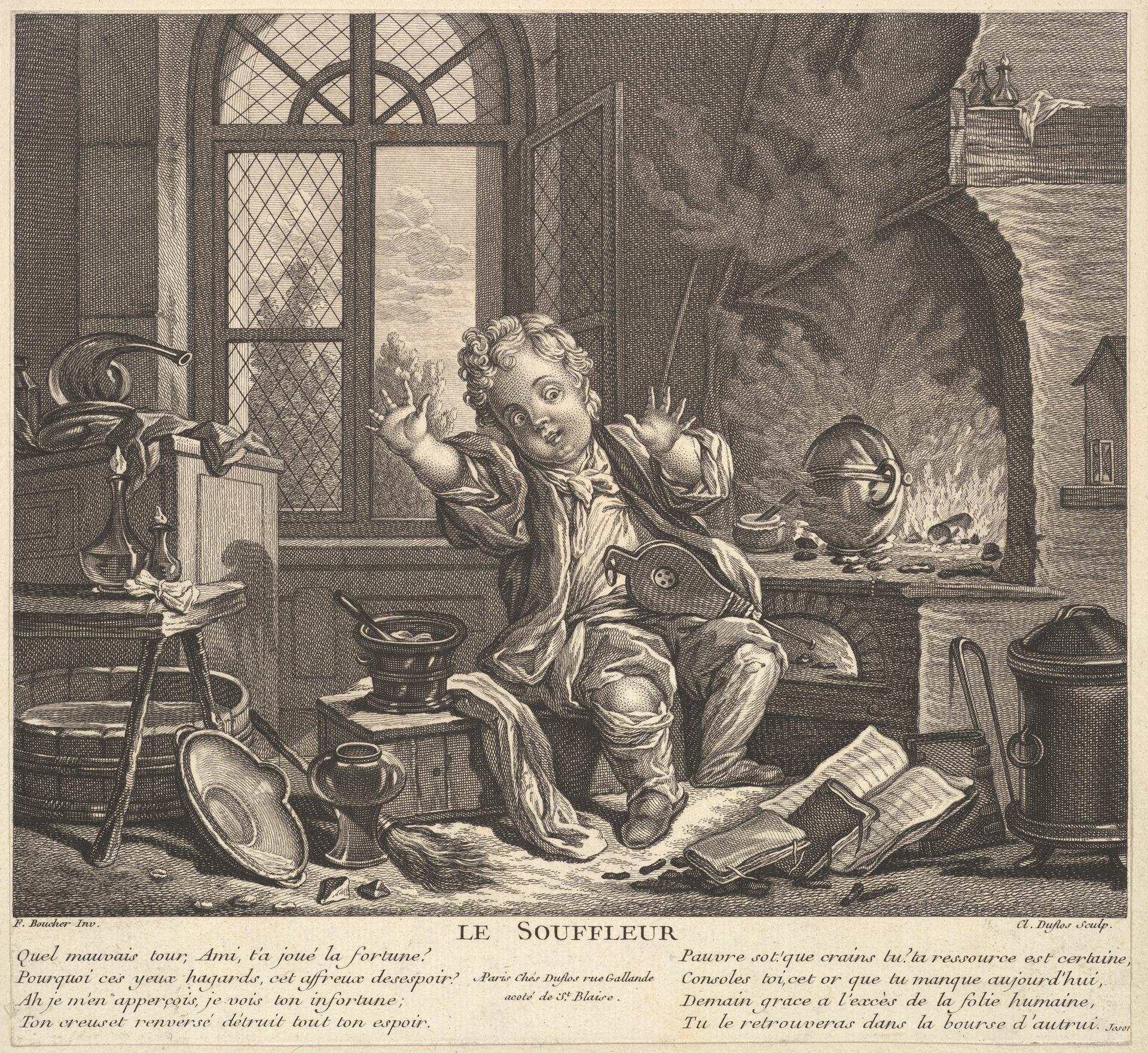
Claude Augustin Duflos le Jeune produced Der Glasbläser — originally titled Le Souffleur — around 1753 as an etching with engraving, and what sets it apart from plain workshop scenes is the way it places a child in the middle of an overflowing setting: a broken plate, a book and a stove all crowd around the figure.
Description
Where calm child portraits keep their stillness, this print runs on restlessness. A child crouches on a wooden board at floor level, dressed in shirt and trousers, eyes wide, one hand raised, the look on the face close to fright. A broken plate, a book, a jug, a globe and a stove with burning wood lie scattered about. Daylight comes in through a barred window, and the arrangement draws the eye toward the figure, which stands out from the rest of the room through the greys of the etching.
Context
Like other French genre pieces of the period, this sheet belongs to a phase in which scenes with children were taken up often in the country's art. Duflos le Jeune worked as a copperplate engraver and frequently reproduced the work of other artists, above all Jean-Baptiste Greuze. Showing a child in a craftsman's surroundings matched the era's interest in everyday life and social milieus.
Impact
What separates this print from more harmless scenes of childhood is the tension between the startled expression and the disordered surroundings. Delicate lines and deliberate lighting steer attention to the central figure and lend the image a dramatic note.
Technique
Etching and subsequent engraving interlock here, allowing fine lines and a precise rendering of shading. The greys arise from the differing depth of the etched lines and from the ink applied afterward.
AI-generated description text
Source: Metropolitan Museum of Art · Public Domain (CC0 1.0)