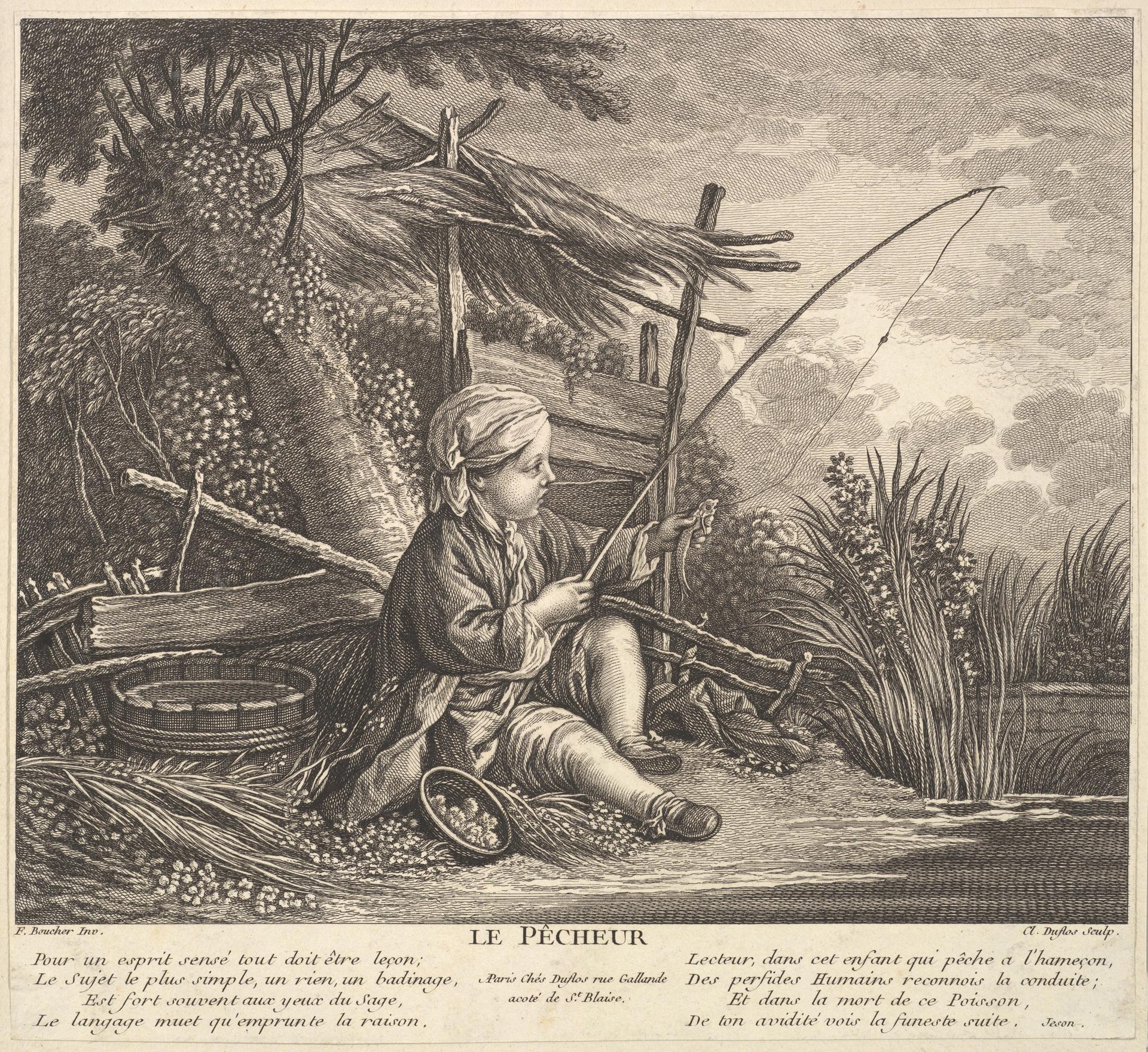
Le Pêcheur (The Fisherman)
Original title: Fisherman
kurzbeschreibung
Around 1753, Claude Augustin Duflos le Jeune captured a fisherman in etching and engraving: a man on the bank of a body of water, set within a quiet rural surroundings. The print conveys a tranquil scene of everyday life and belongs to the tradition of reproductive printmaking after designs by other artists.
Description
A fisherman crouches at the water's edge, rod in hand; he wears a headscarf and a jacket of the kind common in the countryside. A basket and net lie ready beside him. A thatched cottage, surrounded by trees and bushes, closes off the background. The broad layout shows the man turned slightly to the left, giving the sheet a calm mood. Fine lines and restrained shading, entirely in gray tones, create depth and a sense of space.
Context
France was the place of origin of this print around 1753, at a time when rural genre scenes were in demand with the public. Duflos le Jeune worked as a copperplate engraver and often produced reproductions after paintings by other artists, here after a design by Jean-Baptiste Greuze. Prints of this kind helped circulate such images beyond private collections.
Impact
The calm arrangement and spare linework evoke an idyllic, peaceful impression. Through graduated shading the sheet feels spatially convincing and draws the eye into the landscape.
Technique
Etching and engraving work together: the burin allows precise contours, while etching softens areas. The overall gray tonality arises from the varying density and depth of the lines, which model light and shadow.
AI-generated description text
Source: Metropolitan Museum of Art · Public Domain (CC0 1.0)