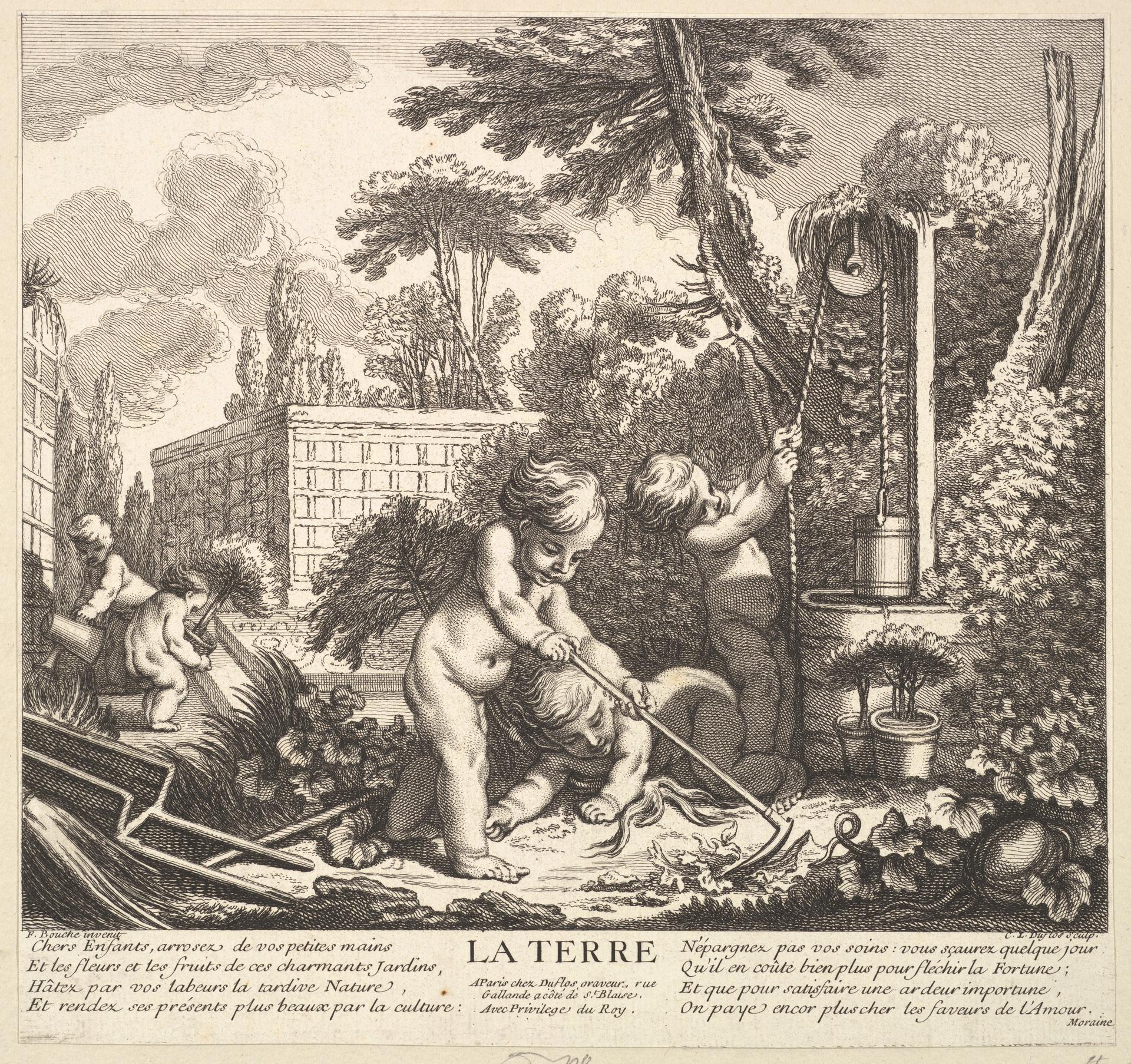
Earth (18th century)
Original title: Earth
kurzbeschreibung
Claude Augustin Duflos le Jeune made the etching Erde in the 18th century. It pictures barefoot children at work and play in a garden, dressed in plain cloth and occupied with plants and a spade, while one child sits on the ground and watches. Trees, shrubs and a well with a chain fill out the setting.
Description
Several children occupy the foreground of a garden. They go barefoot, some only partly wrapped in simple fabric; one holds a plant, another works a spade, and a third sits on the ground observing the others. Trees and shrubs close off the scene at either side. On the left a well with a chain catches the eye, on the right a platform from which a child looks through a window. The arrangement is balanced, with the children at its heart and nature all around them. A French inscription runs along the bottom edge, and the sky carries light clouds.
Context
The etching dates from the 18th century, a period when allegorical cycles of the four elements were common in art. Claude Augustin Duflos le Jeune, a French engraver, was known for his finely detailed prints. Children personifying abstract ideas such as the earth were a familiar motif. This sheet probably belonged to a series devoted to the four elements.
Impact
The children's playful occupations and the natural surroundings give the scene a quiet, peaceful mood. A balanced layout and the delicate etched line lend the sheet an ordered, almost idyllic quality. Printed in monochrome, it draws attention to the details of the figures and the landscape.
Technique
Etched lines and hatching allow for precise, richly detailed rendering, and that technique is put to work here on textures such as cloth and foliage. The sheet measures 23 × 24.4 cm and is printed in black and white.
AI-generated description text
Source: Metropolitan Museum of Art · Public Domain (CC0 1.0)