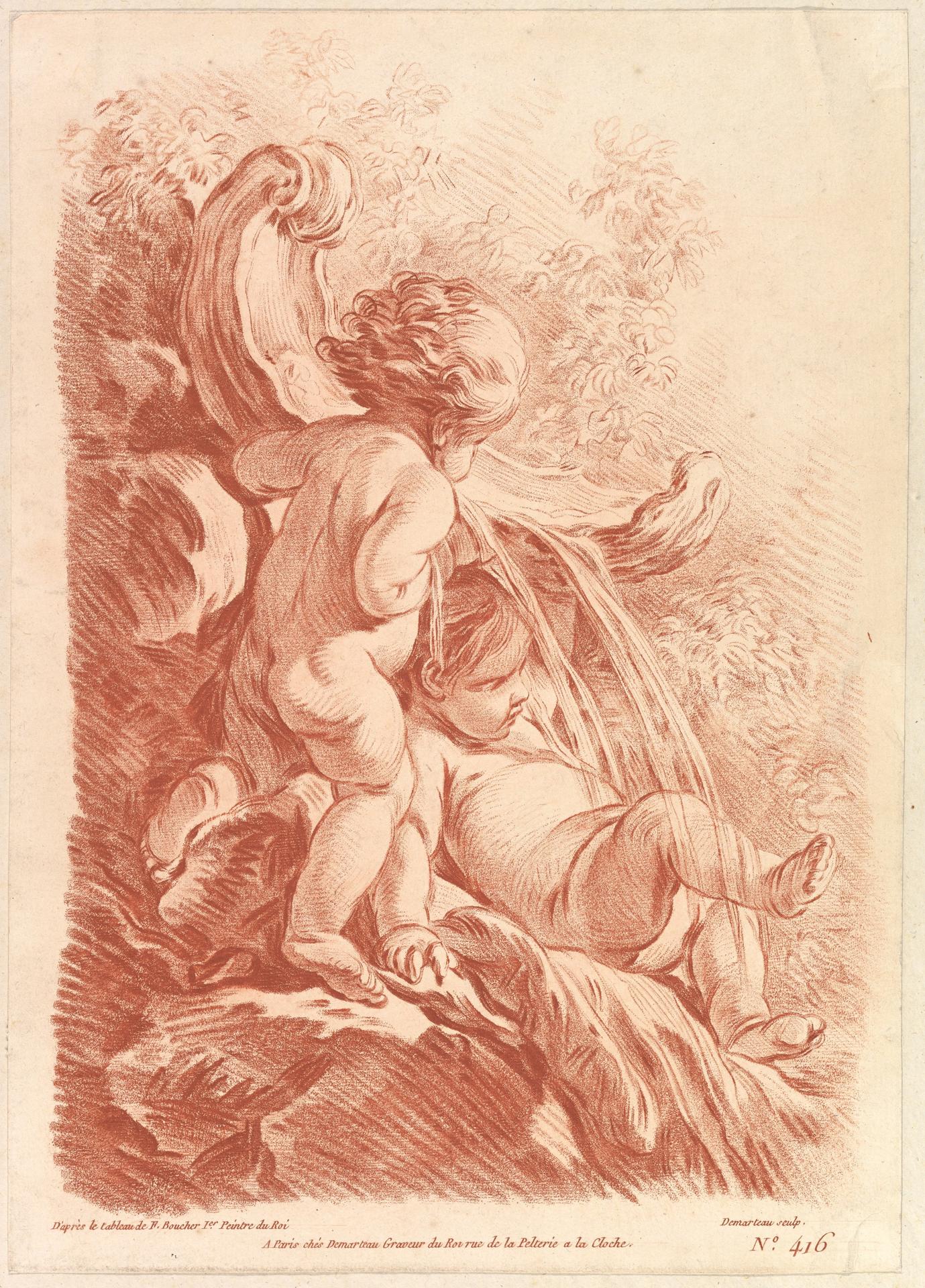
Fountain with Two Cupids
Original title: Fountain with Two Cupids
kurzbeschreibung
Two putti rest beside a fountain in a rural setting — Gilles Demarteau captured this peaceful gathering around 1773 as a crayon manner engraving in brown ink. The sheet belongs to eighteenth-century French printmaking.
Description
One putto crouches on a rock, looking downward; the second has settled on a leaf and leans toward it. Both are barefoot, their clothing plain. Trees and plants frame the action, giving it an air of stillness and seclusion. Brown tones dominate the palette, modelled through graduated shading; light falling from above picks out the contours of the figures and their surroundings alike.
Context
Demarteau, a French engraver, specialised in the crayon manner, a process that imitates the look of chalk drawings. The sheet was made around 1773, when Rococo and Neoclassicism were both in force. Demarteau often translated designs by other artists into print; for this motif a model by Jean-Honoré Fragonard may have served, with whom he frequently collaborated.
Impact
The rural setting and the softly graded browns lend the sheet a quiet, idyllic mood. The irregular layout draws the eye to the two figures and creates a familiar, almost tender closeness. Whoever looks at the sheet is carried into a cheerful Arcadian world.
Technique
The sheet is executed in the crayon manner, a process that uses dotted and hatched lines to evoke the impression of a chalk drawing. It was printed in brown ink on paper to mimic the tone of chalk. In eighteenth-century France this method was widespread, since it allowed drawings to be reproduced.
AI-generated description text
Source: Metropolitan Museum of Art · Public Domain (CC0 1.0)