Head of a Man Wearing a Turban
Original title: Head of a Man Wearing a Turban
kurzbeschreibung
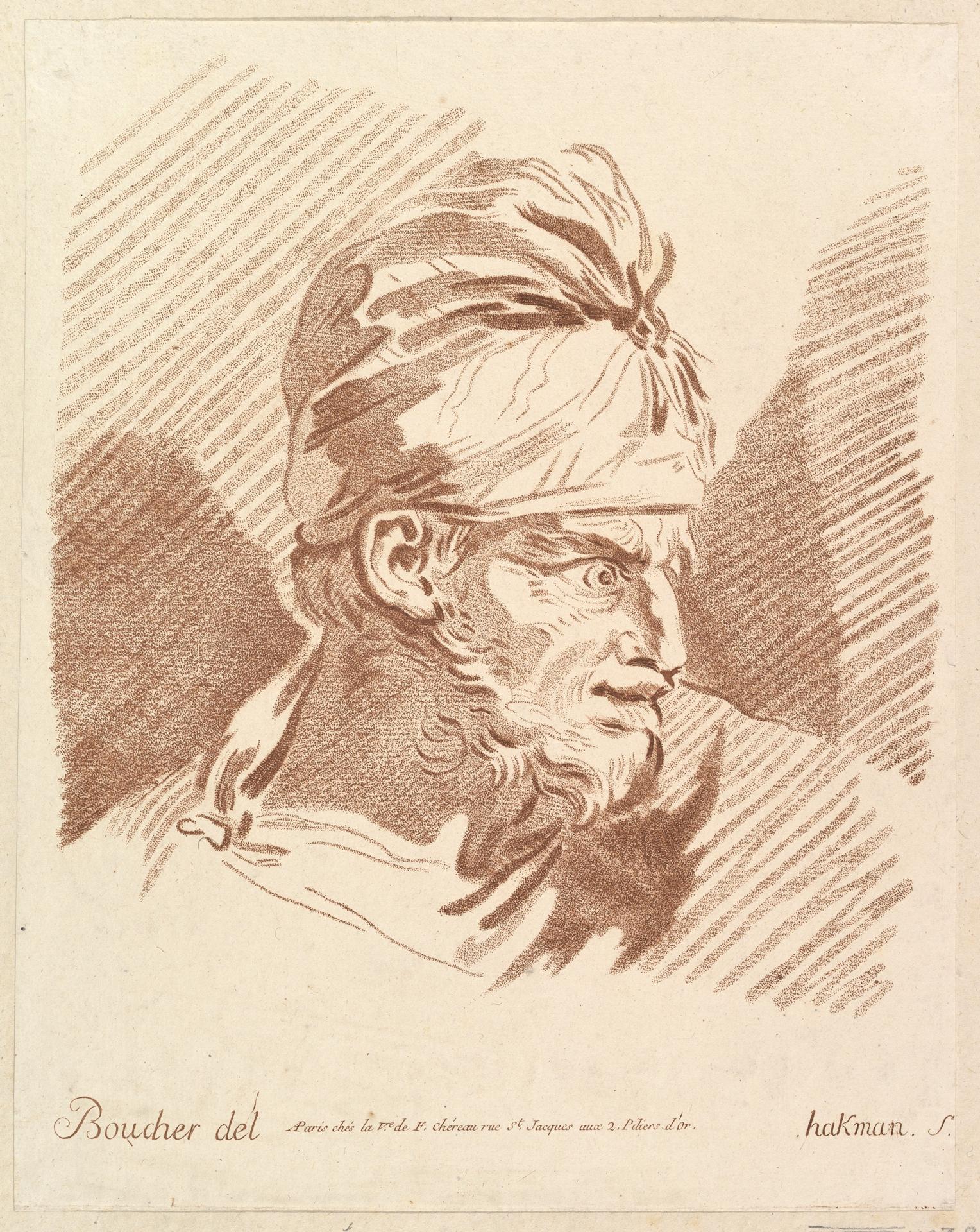
Hakman's Kopf eines Mannes mit Turban is a portrait made in the second half of the 18th century as a crayon manner engraving in brown ink. The subject is the profile of a turban-wearer whose features look thoughtful and slightly somber. The crayon manner imitates the appearance of a pencil or red chalk drawing.
Description
A man appears in profile, his head wrapped in a turban. A prominent forehead and a carefully shaped beard and mustache define the face; the gaze seems pensive and a little darkened. The background stays plain and dark, with diagonal strokes breaking it up and giving the sheet spatial depth. Brown tones predominate, as in a pencil drawing. At the bottom one reads the inscriptions "Boucher del" and "Hakman S.", indicating the designer and the engraver.
Context
Between the mid and late 18th century, the crayon manner was a valued reproductive technique for making drawings widely known. The signature "Boucher del" points to François Boucher, the famous Rococo painter whose model is reproduced here. Hakman, active as an engraver or printer, provides with this sheet evidence of the period's practice of transferring works by renowned artists into print. A man with a turban was one of the common motifs in the 18th century that took up exotic or oriental echoes.
Impact
The brown ink and soft lines create a warm, almost familiar mood. The pensive gaze and the dark background give the portrait a serious, contemplative air. Because the engraving imitates a pencil drawing, the image remains lively and personal despite its print origin.
Technique
The crayon manner engraving relies on treating the printing plate so that the lines take on the soft, grainy character of chalk or red chalk drawings. It was printed in brown ink on paper; the sheet is trimmed to 28 × 22.3 cm. In this way the original drawing could be reproduced in detail while preserving a painterly, handwritten impression.
AI-generated description text
Source: Metropolitan Museum of Art · Public Domain (CC0 1.0)