The Poet
Original title: The Poet
kurzbeschreibung
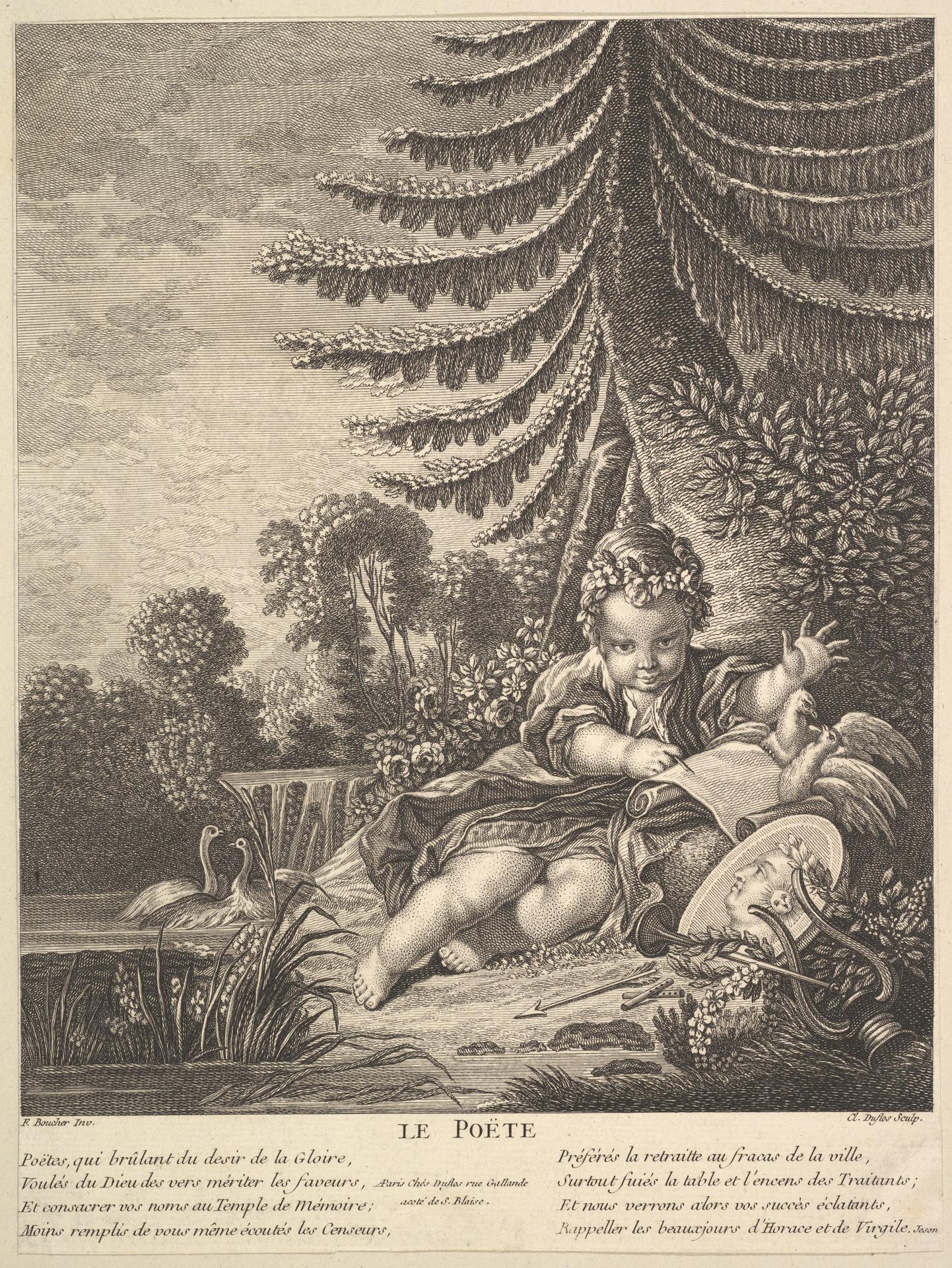
Claude Augustin Duflos le Jeune made 'Der Dichter' around 1753 as an etching and engraving. The trimmed sheet measures 26.9 × 20.3 cm and shows a barefoot boy sitting on a rock and writing; beside him rests a reclining figure with a small crown.
Description
A young boy with flowers in his hair has settled on a rock and is noting something on paper. His garment is simple. Next to him lies a figure with a small crown on its head, appearing asleep or dead. Trees, shrubs, a waterfall and ducks form the background under a cloudy sky. Flowers and grasses fill the foreground. The rendering remains monochrome and relies on carefully drawn lines.
Context
Created around 1753, the print falls into an era when printmaking in France was highly valued both artistically and commercially. Duflos le Jeune belonged to a respected family of engravers and worked as a reproductive engraver. A poet in an Arcadian landscape matched the period's taste for bucolic themes and classical references. Prints of this kind served as collectibles or for illustrating published editions.
Impact
The writer's calm posture and the natural setting give the image an idyllic, poetic note. Finely drawn lines and the precise rendering of plants and animals create a harmonious, almost narrative mood. The encounter between the writing boy and the reclining figure lends the whole a mysterious, symbolic touch.
Technique
Etching and engraving were used together: etching provided soft lines, engraving precise details. In the monochrome print, fine hatching models shadows and textures. By combining both processes, a high degree of detail was achieved in the rendering of nature and figures.
AI-generated description text
Source: Metropolitan Museum of Art · Public Domain (CC0 1.0)