Spring (1735–86)
Original title: Spring
kurzbeschreibung
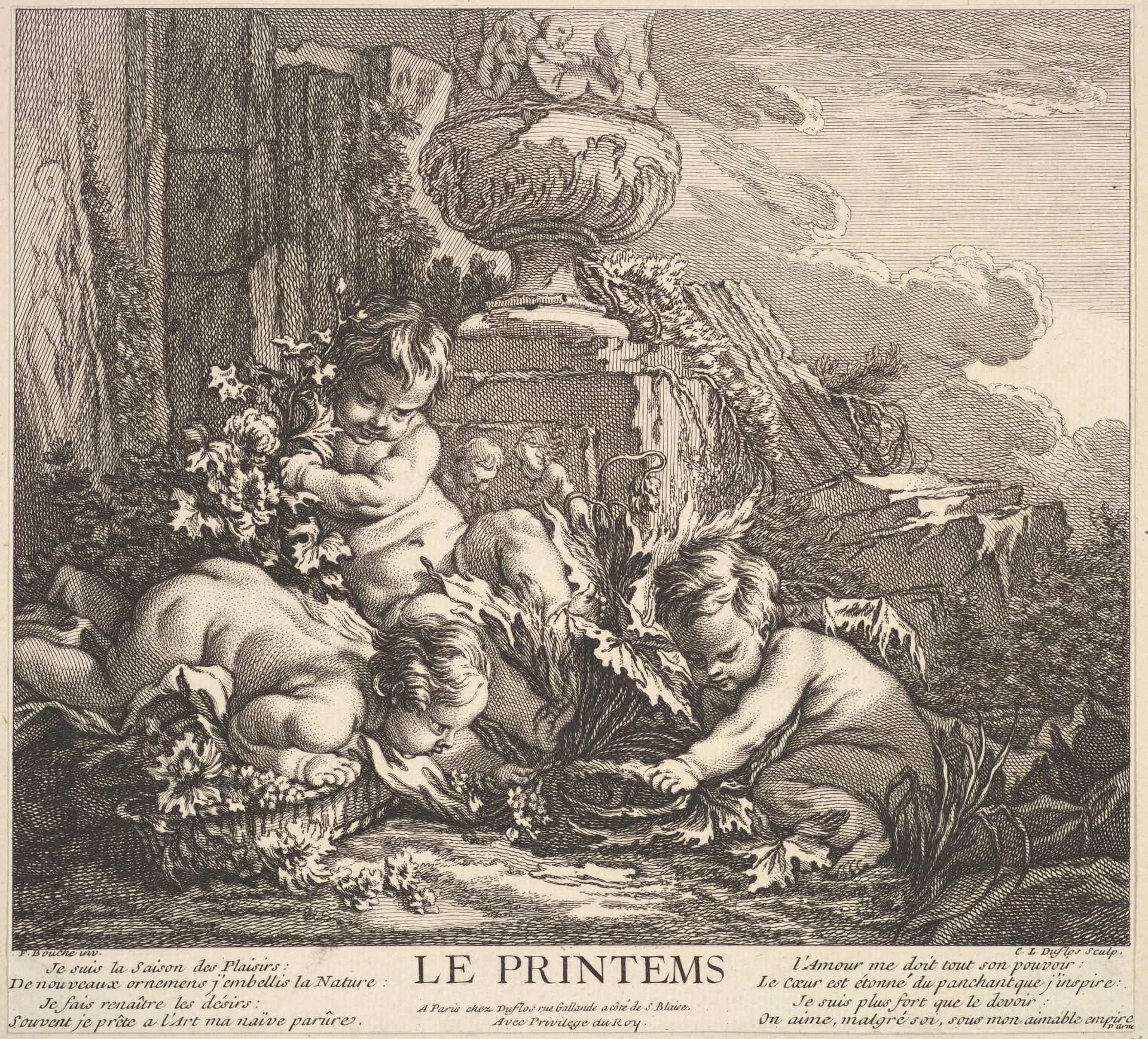
Unlike other prints from comparable seasonal series, this etching by Claude Augustin Duflos le Jeune gives centre stage not to a single figure but to a whole troop of putti. Made between 1735 and 1786, the sheet shows the children playing around a large flower vase, and it combines etching with engraving. Within Baroque allegory it thus takes a more narrative than symbolic position.
Description
A clear layout carries the view: several putti crowd around a large vessel in the middle, filling it with flowers and plants. Behind them appears a building element with a column, framed by a wreath of blossoms and foliage. Trees, rocks and a clouded sky form the landscape; the light stays soft and the rendering monochrome.
Context
As an eighteenth-century French engraver, Duflos le Jeune was known above all for carefully executed reproductive prints. His work falls in the Rococo period, when allegories of the four seasons were often collected and printed. Sheets of this kind frequently served as part of series or as wall decoration in interiors.
Impact
The print gives off a calm, cheerful mood, carried by the playing children and the abundance of flowers. Confident linework and balanced arrangement produce an orderly, almost decorative effect, typical of eighteenth-century printmaking.
Technique
Etched and engraved lines interlock here, so that etching and engraving work together. This method allows graduated shading and precise reproduction of figures and plants. The trimmed sheet measures 22.3 × 24.5 cm.
AI-generated description text
Source: Metropolitan Museum of Art · Public Domain (CC0 1.0)