Winter (1735–86)
Original title: Winter
kurzbeschreibung
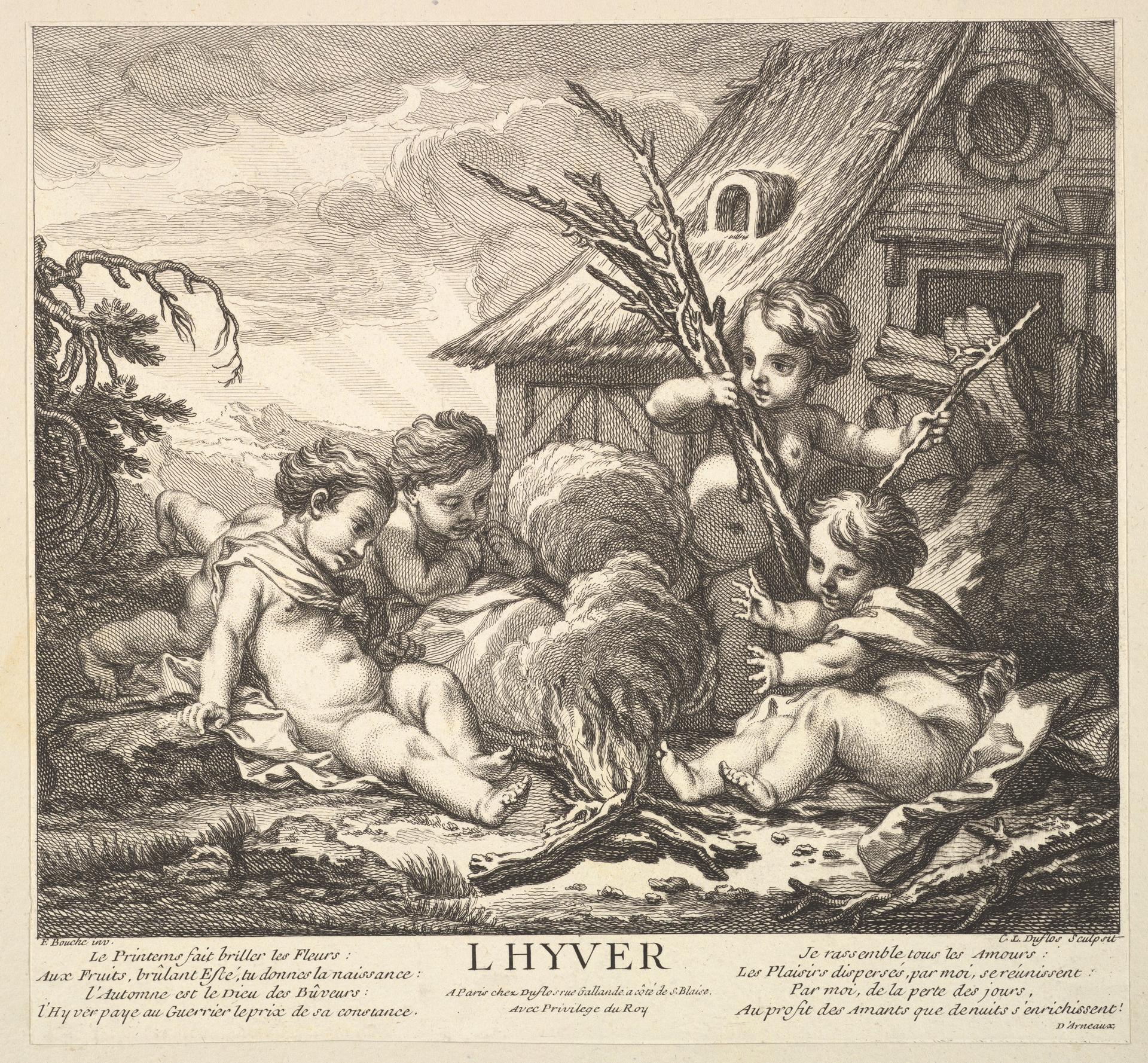
Claude Augustin Duflos le Jeune made Winter between 1735 and 1786 as an etching with engraving. Four putti gather in a snowy setting, rendered in greys, with a thatched farmhouse behind them.
Description
Four putti crouch on the ground, turning toward one another; two carry branches, and one holds a fur. Behind them stands a simple farmhouse with a straw roof. The layout feels balanced, the figures stay in the foreground, and the building recedes. Grey and white values dominate the palette and reinforce the wintry subject. The attention to detail suits eighteenth-century taste.
Context
Duflos le Jeune, an eighteenth-century French engraver, was known mainly for reproductive prints. His Winter dates from 1735 to 1786, a period when printmaking flourished in France. Putti of this kind were popular in the Rococo and often served as allegorical or decorative motifs.
Impact
The muted colouring and balanced arrangement give the sheet a calm, even effect. Graded shading creates a soft, almost lyrical tone that makes the winter mood palpable. The putti seem playful yet delicate—that is the charm of this view.
Technique
Etching and engraving work together here: the former brings softer transitions in the shadow areas, while the burin ensures precise linework and fine tonal gradations. The sheet was printed on paper and trimmed to 22.7 × 24.5 cm.
AI-generated description text
Source: Metropolitan Museum of Art · Public Domain (CC0 1.0)